Have you ever wondered whether to write cord vs chord when describing a string, an electrical wire, or a musical sound? These two words sound exactly alike, but their meanings and uses are quite different. Choosing the correct word can make your writing clearer and help you avoid common spelling mistakes.
The good news is that learning the difference between cord and chord is simple once you understand what each word means. Whether you are writing about electrical cords, musical instruments, geometry, or everyday objects, this guide will help you choose the right spelling with confidence.
Quick Answer: Cord vs Chord
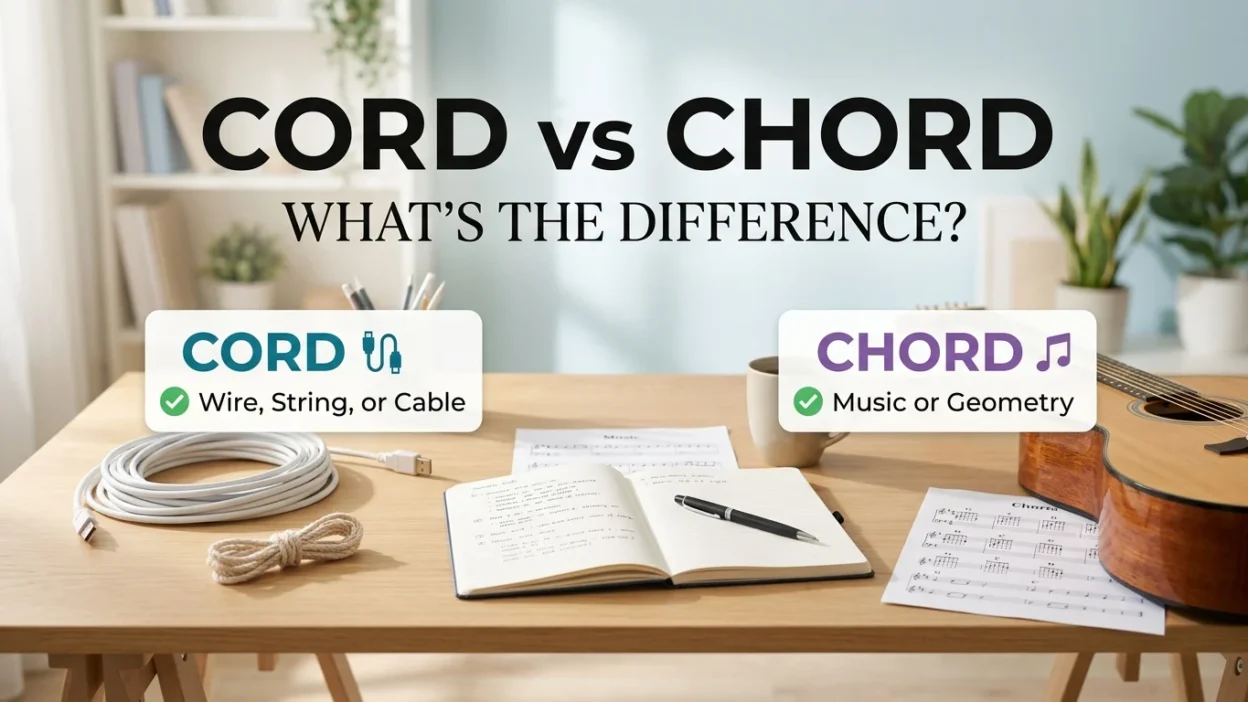
Cord usually refers to a thin rope, string, or flexible electrical wire. Chord refers to a combination of musical notes played together or a straight line connecting two points on a circle.
Although cord and chord are pronounced the same way, they are not interchangeable. The correct spelling depends on the meaning you want to express.
- Cord: A rope, string, or insulated electrical wire.
- Chord: A group of musical notes played together or a line segment joining two points on a circle.
Easy memory trick: Think of cord as a physical string or wire, and chord as something connected to music or geometry.
What Does Cord Mean?
The word cord is a noun that generally describes a thin, flexible rope, string, or cable made from twisted fibers or other materials. It can also refer to an insulated wire used to supply electricity to an appliance.
A cord may be made from cotton, nylon, plastic, or other materials, depending on its purpose. You can find cords in homes, offices, clothing, sports equipment, and electrical devices.
Common Meanings of Cord
1. A rope or string
A cord can be used to tie, secure, or hold something in place.
Examples:
- She used a strong cord to tie the package.
- The tent was secured with a thick nylon cord.
- He pulled the cord to open the blinds.
2. An electrical wire
An electrical cord carries power to an appliance or device.
Examples:
- Please unplug the electrical cord before cleaning the machine.
- The phone charger cord was tangled behind the desk.
- I replaced the damaged power cord on my computer.
3. A string used in clothing or accessories
Cords can also be found in drawstrings, jewelry, and other everyday items.
Examples:
- The hoodie has a cord around the waist.
- She wore a small pendant attached to a leather cord.
- Tighten the drawcord before going outside.
Common Phrases With Cord
Here are several expressions you may encounter in everyday English:
- Power cord: A cable that supplies electricity to a device.
- Extension cord: An electrical cable that extends the reach of a power outlet.
- Drawstring cord: A string used to tighten clothing or bags.
- Cordless: Operating without a connecting cord or cable.
- Cord of wood: A standard unit of measurement for stacked firewood, equal to 128 cubic feet.
Remember that cord is generally associated with a physical object, although its exact meaning depends on the context.
What Does Chord Mean?
The word chord is a noun most commonly used in music and mathematics. It has a different meaning from cord, even though the two words sound identical.
Common Meanings of Chord
1. A combination of musical notes
In music, a chord consists of two or more notes sounded together, typically three or more distinct notes in conventional tonal harmony.
For example, a C major chord contains the notes C, E, and G.
Examples:
- She learned a new chord on the guitar.
- The pianist played a beautiful chord at the end of the song.
- This song uses four basic chords.
- He practiced the G major chord until he could play it smoothly.
2. A line in geometry
In geometry, a chord is a straight line segment connecting two points on the circumference of a circle.
For example, a diameter is a special type of chord that passes through the center of a circle.
Examples:
- The teacher explained how to calculate the length of a chord.
- A diameter is the longest chord in a circle.
- The diagram shows a chord connecting two points on the circumference.
3. An emotional connection
The word also appears in the expression strike a chord, which means to cause someone to feel a strong emotional connection or recognition.
Examples:
- Her story struck a chord with the audience.
- The song struck a chord with people who had experienced similar hardships.
- His speech struck a personal chord with many listeners.
This expression is figurative. It does not refer to an actual musical chord being played.
Cord vs Chord: Key Differences
The easiest way to distinguish these words is to focus on their meanings and typical contexts.
| Feature | Cord | Chord |
| Part of speech | Usually a noun; also used in compounds | Usually a noun |
| Main meaning | Rope, string, or electrical cable | Musical notes or a geometric line segment |
| Common context | Household items, electronics, clothing | Music, geometry, emotional expressions |
| Example | The power cord is damaged. | The guitarist played a chord. |
| Memory clue | Think of cable or string | Think of music or circles |
Both words are homophones, meaning they have the same pronunciation but different spellings and meanings.
Cord vs Chord Examples in Everyday Sentences
Seeing both words in context can make the difference easier to remember.
Examples of Cord
- The electrician checked the power cord before turning on the machine.
- She tied the box with a piece of cord.
- My headphones have a long cord.
- The curtain cord became tangled.
- He bought a replacement cord for his lamp.
In each sentence, cord refers to a physical string, rope, or cable.
Examples of Chord
- The guitarist played a major chord.
- I need to learn the opening chords of this song.
- The students identified the chord in the geometry diagram.
- Her message struck a chord with readers.
- The musician changed the chord to create a different sound.
In these sentences, chord relates to music, geometry, or an emotional response.
Using Both Words in One Sentence
You can even use both words together:
- The guitar’s power cord was unplugged while the musician practiced a new chord.
- He moved the microphone cord aside before playing the final chord.
- The music teacher explained a chord while another student untangled the piano’s electrical cord.
These examples show why choosing the right spelling matters: the surrounding words often reveal the intended meaning.
Common Mistakes When Using Cord and Chord
Even experienced English speakers sometimes confuse homophones. Here are a few mistakes to watch for.
1. Writing “chord” for an electrical cable
Incorrect: The laptop’s power chord is missing.
Correct: The laptop’s power cord is missing.
Why? A power cord is a physical electrical cable, so cord is the correct spelling.
2. Writing “cord” for a musical combination
Incorrect: She played a beautiful cord on the piano.
Correct: She played a beautiful chord on the piano.
Why? A combination of musical notes is called a chord.
3. Confusing the phrase “strike a chord”
Incorrect: His words struck a cord with the audience.
Correct: His words struck a chord with the audience.
Why? The expression strike a chord describes an emotional connection. The established expression uses chord, not cord.
4. Assuming both spellings are interchangeable
Although the words sound the same, they have distinct meanings. Using the wrong spelling can confuse readers or make a sentence appear incorrect.
Helpful tip: Before choosing a spelling, ask yourself whether you are referring to a physical cable, a musical combination, a geometric line, or an emotional connection.
Are Cord and Chord Different in American and British English?
No significant spelling difference exists between American and British English for these words. Both varieties use cord for a string, rope, or electrical cable and chord for a musical combination or a geometric line segment.
For example:
- American English: The extension cord is behind the desk.
- British English: The extension cord is behind the desk.
- American English: He played a C major chord.
- British English: He played a C major chord.
The vocabulary used to describe electrical equipment may vary slightly by region, but the spelling distinction remains the same.
FAQs
1. Is it cord or chord for an electrical wire?
Use cord. An electrical cord carries power to a device or appliance. For example, “The power cord needs replacing.”
2. Is it cord or chord in music?
Use chord. A musical chord consists of notes played together. For example, “She played a D minor chord on the guitar.”
3. Are cord and chord pronounced the same?
Yes. Cord and chord are homophones in standard English. They share the same pronunciation but differ in spelling and meaning.
4. What does “strike a chord” mean?
“Strike a chord” means to create an emotional connection or a feeling of recognition. For example, “The film struck a chord with young viewers.”
5. Is a diameter a chord?
Yes. In geometry, a diameter is a special type of chord that passes through the center of a circle. It is also the longest possible chord in that circle.
6. What is the easiest way to remember cord vs chord?
Remember that a cord is usually a physical string or cable, while a chord belongs to music, geometry, or the expression “strike a chord.”
7. Is “power chord” correct?
No, when referring to an electrical cable, the correct phrase is power cord. However, “power chord” is also a legitimate musical term for a chord commonly built from a root note and its fifth, often used in rock music.
8. Can cord and chord be used interchangeably?
No. They have different meanings and cannot normally replace each other. Use cord for a string or cable and chord for music, geometry, or an emotional connection.
Summary: Cord vs Chord
The difference between cord vs chord becomes simple once you connect each spelling with its meaning. A cord is generally a physical string, rope, or electrical cable. A chord is a combination of musical notes, a line segment connecting two points on a circle, or part of the expression “strike a chord.” Although the words sound alike, their meanings determine which spelling belongs in your sentence.
The best way to avoid mistakes is to check the context before writing. If you are talking about a charger, rope, or extension cable, choose cord. If you are discussing a guitar, piano, circle, or emotional connection, choose chord. With a little practice, you can use both words correctly in everyday conversations, professional writing, and academic work.
Actionable takeaway: Remember this simple rule: cord = cable or string; chord = music, geometry, or emotion.