Learning emersion vs immersion becomes easy when you know their real meaning, helping you use both English words correctly every day.
Many people feel confused because emersion and immersion are similar, yet their meanings are different. This guide explains everything in simple terms to improve your understanding and help you understand the difference with confidence. From my experience in writing and editing, I have found that knowing this distinction helps improve daily communication, professional communication, and overall communication by reducing confusion and making sentences more accurate.
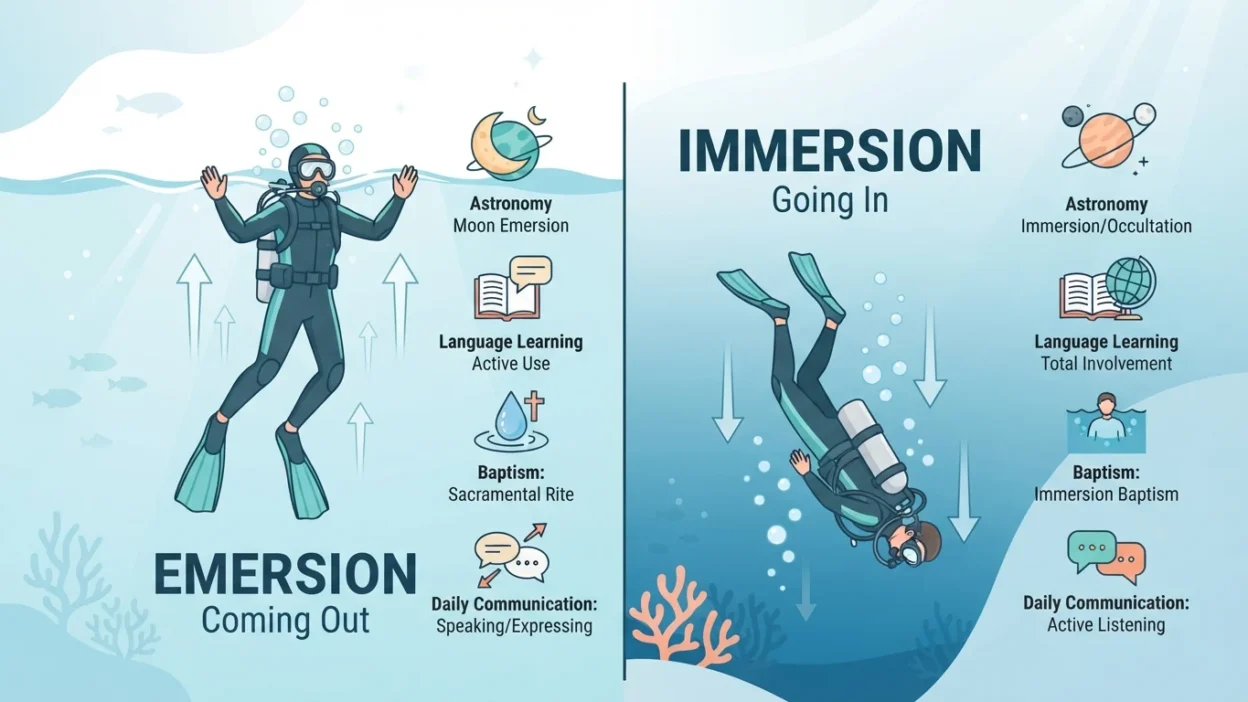
Emersion refers to coming or coming out of something, such as rising from water or overcoming difficulties. Immersion, however, means sinking or plunging into a liquid, an activity, or a situation. Both are valid English terms, and understanding when to use them avoids common mistakes in speaking and writing.
A practical way to learn is through examples from real life. In astronomy, emersion describes an object reappearing, while language learning encourages surrounding yourself with the language every day through immersion. During baptism, entering and leaving water make the contrast easier to remember. Keep these tips in mind, and you will use these words clearly and confidently in daily life.
Quick Answer
The difference between emersion and immersion is simple:
- Emersion means coming out of or rising from something, especially water.
- Immersion means going into, being surrounded by, or becoming deeply involved in something.
Think of it this way:
- Emersion = Exit
- Immersion = Enter
Although they look similar, they have nearly opposite meanings.
What Does Emersion Mean?
Emersion refers to the act of emerging, rising, or coming out of something. The word is commonly used in scientific, astronomical, biological, and medical contexts.
For example:
- The diver’s emersion from the water was smooth.
- The moon’s emersion from behind the planet was clearly visible.
- Plant emersion occurs when leaves rise above the water surface.
Common contexts
- Astronomy
- Biology
- Marine science
- Diving
- Medicine
Synonyms
- Emergence
- Rising
- Surfacing
- Appearance
- Coming out
What Does Immersion Mean?
Immersion means being completely surrounded by or deeply involved in something. It can refer to physical submersion in water or complete involvement in an activity, language, culture, or experience.
Examples include:
- Language immersion improves fluency.
- The child showed complete immersion in the story.
- Full-body immersion is part of some baptism ceremonies.
Common contexts
- Language learning
- Education
- Virtual reality
- Gaming
- Baptism
- Reading
- Cultural experiences
Synonyms
- Submersion
- Involvement
- Engagement
- Absorption
- Participation
Emersion vs Immersion: Side-by-Side Comparison
| Feature | Emersion | Immersion |
| Meaning | Coming out of something | Going into or being surrounded by something |
| Direction | Upward or outward | Downward or inward |
| Common Use | Science, astronomy, diving | Education, language learning, religion |
| Related Action | Rising | Sinking or entering |
| Easy Memory Tip | Exit | Enter |
Emersion vs Immersion in Simple Words
Imagine a swimmer.
When the swimmer dives underwater, that is immersion.
When the swimmer comes back to the surface, that is emersion.
The same idea works for many situations:
- Entering a new culture through study abroad is immersion.
- Coming out of the water after scuba diving is emersion.
Remember:
Immersion starts the experience. Emersion finishes it.
Real-Life Examples
Emersion Examples
- The whale’s emersion amazed everyone on the boat.
- Scientists observed the turtle’s emersion from the sea.
- The satellite’s emersion became visible after the eclipse.
- The diver completed a safe emersion.
- The lotus showed gradual emersion above the water.
Immersion Examples
- Language immersion helps students learn faster.
- She enjoyed complete immersion in the novel.
- The museum offers an immersive learning experience.
- Virtual reality creates total immersion.
- Cultural immersion helps travelers understand local traditions.
Common Mistakes People Make
Many writers accidentally replace one word with the other because they look similar.
Mistake 1
❌ The diver’s immersion from the water was quick.
✅ The diver’s emersion from the water was quick.
Mistake 2
❌ Language emersion improves speaking skills.
✅ Language immersion improves speaking skills.
Mistake 3
Using emersion when discussing learning, reading, or gaming.
Correct word:
✅ Immersion
Mistake 4
Using immersion to describe emerging from water.
Correct word:
✅ Emersion
Easy Memory Trick
A simple trick can help you remember forever.
Emersion
Think:
E = Exit
You are exiting the water.
Immersion
Think:
I = Into
You are going into the water or deeply into an activity.
This small memory trick works surprisingly well during exams, writing, and conversations.
When Should You Use Emersion?
Use emersion when talking about:
- Surfacing from water
- Emerging from a liquid
- Astronomical events
- Marine biology
- Scientific observations
Example:
The submarine’s emersion occurred at sunrise.
When Should You Use Immersion?
Use immersion when discussing:
- Language learning
- Reading
- Education
- Gaming
- Virtual reality
- Religion
- Cultural experiences
Example:
English immersion classes improve fluency.
Emersion vs Immersion in Different Fields
Astronomy
In astronomy, emersion describes a celestial object becoming visible again after being hidden behind another object.
Biology
Aquatic plants experience emersion when they grow above the water surface.
Language Learning
Immersion means learning by constantly hearing, reading, speaking, and living in the target language.
Baptism
Some Christian traditions practice full immersion baptism by completely submerging a person in water.
Diving
Divers experience immersion when entering the water and emersion when returning to the surface.
American vs British English
There is no significant difference between American English and British English regarding the meanings or spelling of emersion and immersion.
However:
- Immersion is commonly used in both varieties of English.
- Emersion is much less common and appears mainly in scientific, technical, biological, or astronomical writing.
So regardless of whether you’re writing in American or British English, the meanings remain exactly the same.
Why Are These Words So Confusing?
Several reasons cause confusion:
- They differ by only one letter.
- Both come from Latin roots.
- Both relate to water.
- Both are uncommon in everyday conversation.
- People hear immersion more often than emersion.
Learning their opposite directions makes them much easier to remember.
Tips to Remember the Difference
- Remember E = Exit.
- Remember I = Into.
- Think about a diver entering and leaving the water.
- Associate immersion with learning and engagement.
- Associate emersion with surfacing and appearing.
FAQs
1. What is the difference between emersion and immersion?
Emersion means coming out of something, while immersion means entering or being completely surrounded by something.
2. Is emersion a real English word?
Yes. Emersion is a valid English word, although it is less common than immersion and is mostly used in scientific fields.
3. Which word is used for language learning?
Immersion is the correct word because learners surround themselves with the language.
4. Is immersion the opposite of emersion?
Yes. In many situations, immersion and emersion describe opposite directions.
5. Can emersion be used outside science?
Yes, but it is relatively rare. Most everyday conversations use emerge instead of emersion.
6. Which word is more common?
Immersion is much more common in education, technology, travel, gaming, and daily English.
7. Does British English use emersion differently?
No. Both British and American English use the word with the same meaning.
8. How can I remember emersion vs immersion?
Think of E = Exit and I = Into. This simple trick helps most people remember the difference instantly.
Summary
Understanding emersion vs immersion is easier once you focus on direction. Emersion is about coming out, emerging, or rising, while immersion is about entering, surrounding, or becoming deeply involved. Although these words look alike, they are used in very different situations.
Whether you’re writing an academic paper, learning English, discussing astronomy, or talking about language immersion, choosing the correct word makes your communication clearer and more professional. With a few examples and the simple “Exit vs Into” memory trick, you’ll rarely confuse them again.
Actionable Takeaway
The next time you see these words, pause for a second and ask yourself one question: Is something coming out or going in? If it’s coming out, use emersion. If it’s going in or becoming deeply involved, use immersion. Practicing this simple habit will help you use both words naturally and accurately.