Have you ever wondered whether to write analog vs analogue when describing a traditional clock, an older audio system, or a signal that changes continuously? Both spellings are correct, but choosing the right one can be confusing, especially when you are writing for an American or British audience.
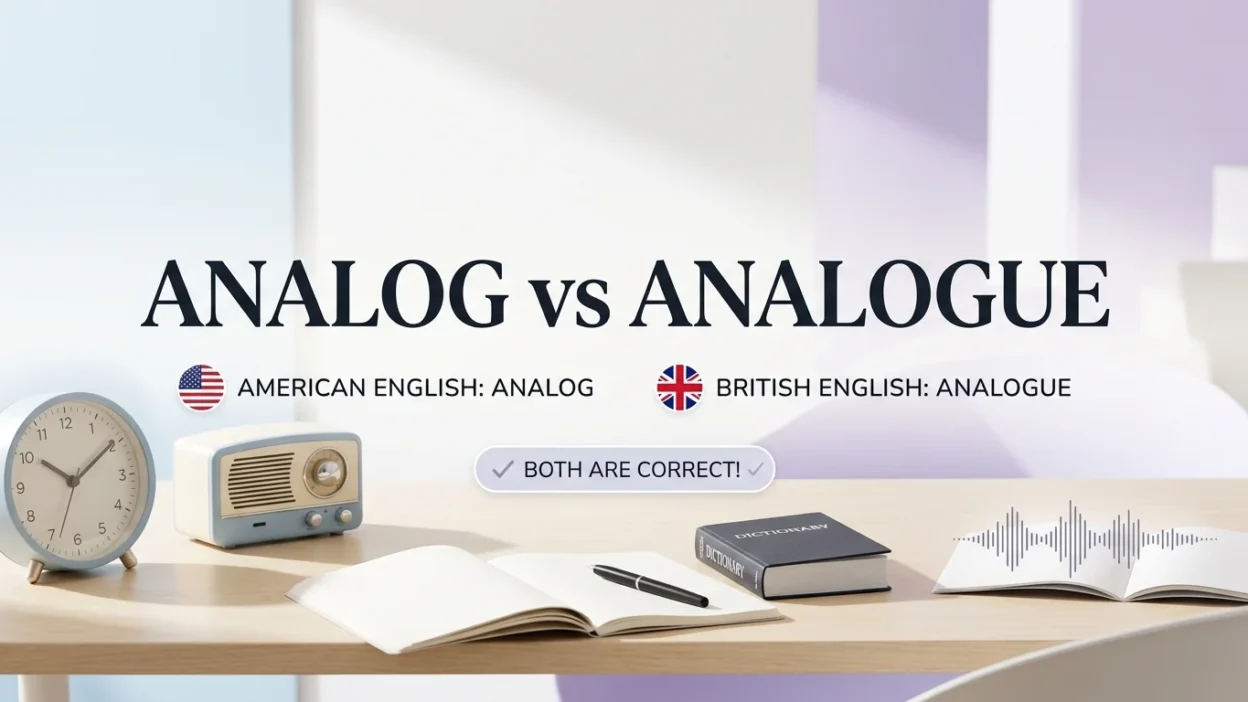
The good news is that analog and analogue generally have the same meaning. The main difference is regional spelling: analog is preferred in American English, while analogue is more common in British English. In this guide, you will learn when to use each spelling, explore practical examples, and discover how to avoid common mistakes in everyday and professional writing.
Quick Answer: Analog vs Analogue
Analog and analogue are two spellings of the same word. Both can describe something that represents information through continuously varying physical quantities, such as an analog clock or an analogue audio signal. They can also refer to something comparable to or functioning as a counterpart of another thing.
- Analog: The preferred spelling in American English.
- Analogue: The preferred spelling in British English and commonly used in other varieties of English influenced by British spelling.
Examples:
- American English: I prefer an analog watch.
- British English: I prefer an analogue watch.
Both sentences are correct. The best choice depends on your audience, publication style, and the variety of English you are using.
What Does Analog Mean?
Analog is an adjective and, in some contexts, a noun. It commonly describes a system or device that represents information through continuously varying signals rather than discrete digital values.
The word is frequently used in electronics, technology, audio equipment, watches, and scientific discussions.
1. Analog in Technology
An analog system uses a continuously varying physical quantity, such as voltage, to represent information. This contrasts with digital systems, which represent information using discrete values.
Examples:
- The engineer tested the analog signal before connecting the equipment.
- My grandfather still uses an analog telephone.
- The device converts an analog input into digital data.
- Analog technology remains useful in certain audio and measurement applications.
2. Analog in Everyday Life
The word can also describe traditional devices that do not display information digitally.
Examples:
- She wears an analog watch with moving hands.
- The classroom has an analog clock above the door.
- I prefer the look of an analog camera.
An analog clock displays time through moving hands rather than numerical digits on a digital screen.
3. Analog as a Noun
In technical contexts, analog can also be used as a noun, particularly in American English, to describe something comparable to or corresponding to another thing.
Example:
- The researcher found an analog of the original compound.
However, the noun analogue is also common, especially in British English.
What Does Analogue Mean?
Analogue has the same core meanings as analog. It is the preferred spelling in British English and is commonly found in British publications, technical writing, and scientific contexts.
Like analog, it can describe continuously varying signals or devices, as well as something that serves as a counterpart or equivalent of another thing.
1. Analogue in Technology
Examples:
- The engineer examined the analogue signal.
- This radio receives analogue broadcasts.
- The laboratory uses an analogue measuring instrument.
- The technician connected the analogue output to the recording equipment.
In these sentences, analogue refers to technology that represents or processes information using continuously varying quantities.
2. Analogue in Everyday Life
Examples:
- My father prefers an analogue watch.
- The museum displays an old analogue telephone.
- She bought an analogue camera for her photography project.
These examples are especially natural in British English, although readers in other English-speaking countries will generally understand them.
3. Analogue as a Noun
Analogue can also mean something that corresponds to, resembles, or serves a similar purpose to something else.
Examples:
- The scientist discovered an analogue of a naturally occurring substance.
- This ancient structure has no exact analogue in modern architecture.
- The new system is a digital analogue of the traditional process.
In these sentences, the word does not necessarily refer to electronic signals. It describes a comparable object, substance, or system.
Analog vs Analogue: Key Differences
The most important distinction is spelling preference, not meaning.
| Feature | Analog | Analogue |
| Preferred spelling | American English | British English |
| Part of speech | Adjective and noun | Adjective and noun |
| Technical meaning | Continuously varying signals or systems | Same meaning |
| Everyday example | Analog clock | Analogue clock |
| Scientific usage | An analog of a substance | An analogue of a substance |
| Correctness | Correct | Correct |
Neither spelling is universally better. The key is to use the form that matches your intended audience and remain consistent throughout your writing.
Analog vs Analogue in Different Contexts
Although both spellings share the same basic meaning, seeing them in context makes their use easier to understand.
Analog or Analogue Clock
An analog or analogue clock displays time with moving hands rather than a digital numerical display.
- American English: The analog clock stopped at noon.
- British English: The analogue clock stopped at noon.
Both are correct.
Analog or Analogue Signal
An analog or analogue signal represents information through a continuously varying quantity, such as voltage or current.
- American English: The microphone produces an analog signal.
- British English: The microphone produces an analogue signal.
The spelling changes, but the technical concept remains the same.
Analog or Analogue Photography
An analog or analogue camera uses a traditional photographic process, typically involving film, rather than relying entirely on digital image capture.
Examples:
- American English: Analog photography has become popular among hobbyists.
- British English: Analogue photography has become popular among hobbyists.
Analog or Analogue in Science
In scientific writing, either spelling may be used depending on the publication’s style guide.
Examples:
- The team developed an analog of the natural compound.
- The team developed an analogue of the natural compound.
Both sentences are correct. If you are writing for an American journal, analog may be preferred; a British journal may prefer analogue.
Common Mistakes When Using Analog and Analogue
Even though the difference is simple, writers sometimes make avoidable mistakes.
1. Thinking One Spelling Is Incorrect
Incorrect assumption: “Analogue is always wrong.”
Correct understanding: Both analog and analogue are standard English spellings.
Use analog for American audiences and analogue for British audiences unless a specific style guide instructs you otherwise.
2. Mixing Both Spellings in One Article
For example:
- The analog clock was beside an analogue radio.
- We studied analog signals and analogue devices.
These sentences are not necessarily grammatically wrong, but mixing regional spelling conventions without a reason can make an article look inconsistent.
Better approach: Choose one spelling convention for the whole document. Use analog consistently in American English content and analogue consistently in British English content.
3. Assuming Analog Always Means Old-Fashioned
Analog technology is often associated with traditional devices, but the word does not simply mean old or outdated.
An analog system describes how information is represented, not necessarily how old the technology is. Some modern devices still use analog circuits and signals.
Example: “The new audio equipment includes an analog input.”
The equipment may be modern even though the signal type is analog.
4. Confusing Analog With Digital
Analog and digital describe different ways of representing information.
- Analog: Uses continuously varying values.
- Digital: Uses discrete values to represent information.
For example, an analog clock uses moving hands, while a digital clock displays time numerically. However, not every difference between analog and digital devices is as simple as their appearance.
5. Using the Wrong Regional Spelling in Professional Writing
Using analogue in a British publication is natural, while analog is generally preferred in American publications.
Neither is incorrect in all contexts. The important thing is to understand your audience and follow the required editorial or academic style.
American English vs British English: Which Should You Use?
American and British English generally follow different spelling preferences for this word.
In American English: Use analog.
Examples:
- Analog watch
- Analog signal
- Analog electronics
- An analog of the original design
In British English: Use analogue.
Examples:
- Analogue watch
- Analogue signal
- Analogue electronics
- An analogue of the original design
British-influenced varieties of English may also favor analogue, although individual publications and technical communities can have their own preferences.
If you are writing for an international audience, either form will usually be understood. However, if you are creating an SEO article for a specific country, matching the local spelling convention can make your content feel more natural to readers.
FAQs
1. Is analog or analogue correct?
Both are correct. Analog is the preferred American English spelling, while analogue is more common in British English.
2. What is the difference between analog and analogue?
There is generally no difference in meaning. The distinction is mainly regional spelling, although specific technical or editorial contexts may follow established conventions.
3. Is analog American or British English?
Analog is the standard preferred spelling in American English. It is also understood internationally.
4. Is analogue British English?
Yes. Analogue is the preferred spelling in British English and is commonly used in other varieties influenced by British spelling.
5. Should I write analog clock or analogue clock?
Both are correct. Use analog clock for American English and analogue clock for British English.
6. Is analog technology better than digital technology?
Neither is automatically better. Analog and digital systems have different characteristics, advantages, and limitations. The right choice depends on the application, such as audio recording, measurement, communication, or timekeeping.
7. Can analogue be used as a noun?
Yes. Analogue can refer to something comparable to or corresponding to another thing, as in “an analogue of a natural compound.” American English often uses analog in the same context.
8. Do analog and analogue have the same pronunciation?
They are generally pronounced the same way, though pronunciation can vary slightly by accent. The difference is primarily in spelling rather than meaning or pronunciation.
Summary: Analog vs Analogue
The difference between analog vs analogue is straightforward: both spellings are correct and generally mean the same thing. They can describe continuously varying signals, traditional clocks, audio equipment, and things that serve as counterparts to other things. The main distinction is regional preference, with analog favored in American English and analogue preferred in British English.
When choosing between these spellings, consider your audience, publication requirements, and the type of English you are writing. Keep the spelling consistent throughout your article, essay, or professional document. Understanding this simple regional difference will help you write more confidently and avoid unnecessary spelling corrections.
Actionable takeaway: Remember analog = American English and analogue = British English. Both are correct, so choose the version that best suits your readers.