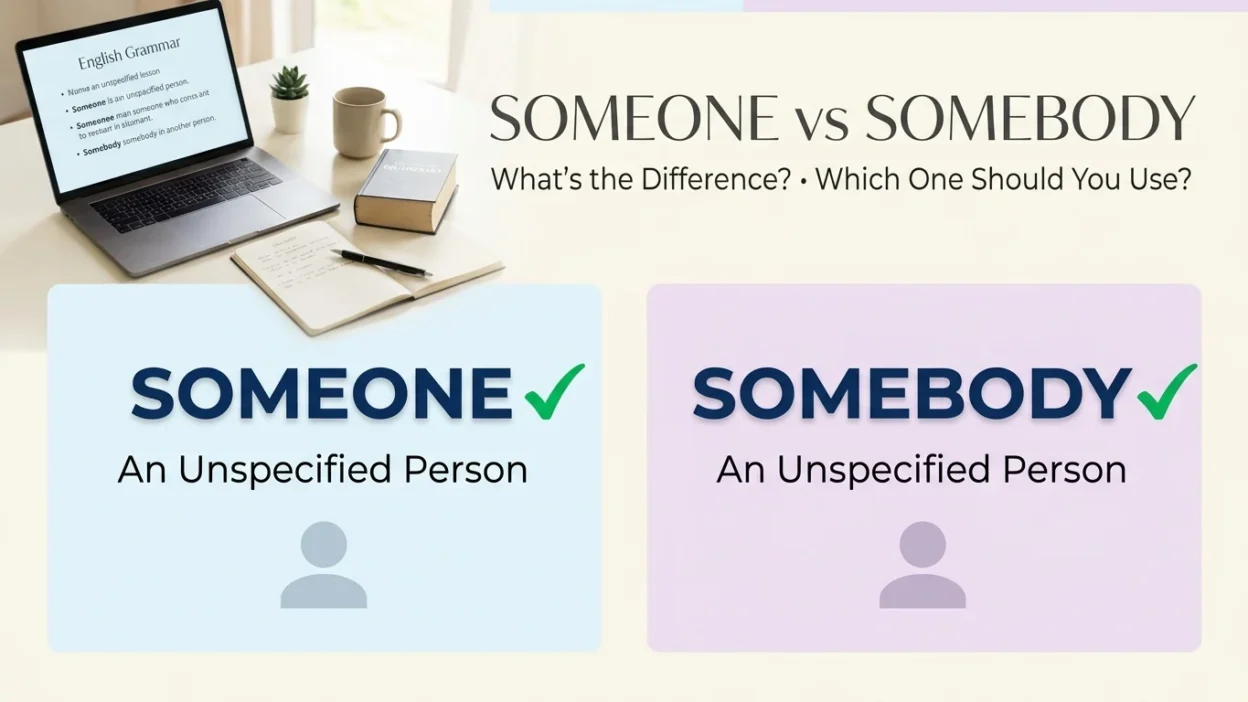
Have you ever wondered whether to use someone vs somebody in a sentence? If you have ever paused while writing an email, having a conversation, or completing an English assignment, you are not alone. These two words look different, but their meanings are almost identical, which can make choosing between them confusing.
The good news is that both someone and somebody are correct English words. They refer to an unspecified person, and in most everyday situations, you can use either one without changing the meaning of your sentence. However, small differences in tone, style, and context can help you decide which word sounds more natural.
Quick Answer: Someone vs Somebody
Someone and somebody mean the same thing: an unspecified or unknown person. Both are indefinite pronouns, and both are grammatically correct in everyday English.
- Someone: Often feels slightly more neutral or formal in some contexts.
- Somebody: Can sound slightly more conversational or informal in some contexts.
Examples:
- Someone left a bag near the door.
- Somebody left a bag near the door.
Both sentences are correct and communicate the same basic message.
Easy rule: Use someone or somebody when you mean an unspecified person. Choose the word that sounds most natural for your sentence and audience.
What Does Someone Mean?
Someone is an indefinite pronoun used to refer to a person whose identity is unknown, unspecified, or unimportant to the speaker.
You do not need to know the person’s name or identity to use this word. It is useful when talking about an unidentified person, describing an action, or making a general statement about an individual.
Examples of Someone in Sentences
- Someone is waiting for you outside.
- I need someone to help me with this project.
- Someone called while you were sleeping.
- Can someone explain this question to me?
- Someone has taken my notebook.
- I think someone is knocking at the door.
In each example, someone refers to a person without identifying exactly who that person is.
When Should You Use Someone?
You can use someone in many situations, including:
1. Professional communication
Someone often fits naturally in workplace emails, business messages, and formal writing.
Example: “Someone from the marketing team will contact you tomorrow.”
2. Everyday conversations
It is also completely natural in casual speech.
Example: “Someone told me about a great restaurant nearby.”
3. Requests and offers
Use someone when referring to an unspecified person who might perform an action.
Examples:
- Could someone help me carry these boxes?
- I need someone to check this document.
- Someone should remind him about the meeting.
Remember that someone is not limited to formal English. It is common in everyday conversations, too.
What Does Somebody Mean?
Somebody is also an indefinite pronoun that refers to an unspecified person. Its meaning is essentially the same as someone.
The word is common in conversations, informal writing, stories, and situations where the speaker wants to refer to a person without giving a name.
Examples of Somebody in Sentences
- Somebody left their phone on the table.
- I need somebody to talk to.
- Somebody is calling your name.
- Somebody has eaten the last slice of cake.
- Can somebody open the window?
- Somebody told me that you were moving.
Each sentence refers to an unidentified person, just as it would with someone.
When Should You Use Somebody?
1. Casual conversations
Somebody works naturally when talking to friends, family members, or colleagues.
Example: “Somebody told me you got a new job!”
2. Stories and personal experiences
It is useful when the identity of a person is unknown or does not matter.
Example: “Somebody knocked on the door, but nobody answered when I opened it.”
3. Requests for help
Somebody can make a request sound natural and conversational.
Examples:
- Can somebody give me a hand?
- Somebody needs to clean this room.
- I wish somebody would listen to me.
Although somebody can sound conversational, it is not incorrect or inappropriate in formal situations. Context and sentence structure matter more than the choice between these two words.
Someone vs Somebody: Key Differences
The main difference between someone and somebody is a slight difference in tone or style, not meaning.
| Feature | Someone | Somebody |
| Meaning | An unspecified person | An unspecified person |
| Part of speech | Indefinite pronoun | Indefinite pronoun |
| Tone | Often perceived as neutral | Sometimes perceived as more conversational |
| Formal writing | Common and appropriate | Also correct and appropriate |
| Everyday speech | Very common | Very common |
| Example | Someone is at the door. | Somebody is at the door. |
The distinction in tone is not a strict grammatical rule. Many speakers use the words interchangeably, and neither word is universally more formal than the other.
Can You Replace Someone With Somebody?
Yes. In most sentences, you can replace someone with somebody without changing the essential meaning.
For example:
- Someone wants to speak with you.
- Somebody wants to speak with you.
Both sentences are grammatically correct.
Similarly:
- I hope someone can help me.
- I hope somebody can help me.
Both express the same hope. The choice usually comes down to personal preference, rhythm, and the tone you want to create.
Someone vs Somebody vs Anyone vs Anybody
Understanding these related indefinite pronouns can help you choose the right word more confidently.
Someone and somebody generally refer to an unspecified person, often when the speaker thinks a person exists or when making a statement or request.
Anyone and anybody often appear in questions, negative statements, and situations involving any possible person.
Compare these examples:
- Someone called you. A person called you, but their identity is unknown.
- Did someone call me? You are asking whether a person called.
- Did anyone call me? You are asking whether any person called.
- I didn’t see anybody. You did not see any person.
- Anyone can learn this skill. The statement applies to any person.
These are tendencies rather than absolute rules. For example, someone can appear in questions, and anyone can appear in affirmative statements.
Common Mistakes When Using Someone and Somebody
Both words are easy to use, but learners sometimes make mistakes with agreement, word formation, or context.
1. Using the wrong verb form
Incorrect: Someone are waiting outside.
Correct: Someone is waiting outside.
Why? Someone and somebody are grammatically singular, so they generally take a singular verb.
Examples:
- Somebody wants to speak with you.
- Someone has taken my keys.
- Somebody was standing near the entrance.
2. Treating someone and somebody as plural
Incorrect: Somebody have left their bag here.
Correct: Somebody has left their bag here.
Why? These indefinite pronouns take singular verb forms in standard English.
However, singular they is commonly used to refer to an unspecified person’s gender.
Example: “Someone has forgotten their umbrella.”
Here, has agrees with someone, while their refers to the unspecified person’s belongings.
3. Writing “some one” or “some body” when you mean the pronoun
Incorrect: Some one is waiting outside.
Correct: Someone is waiting outside.
Incorrect: Some body called you.
Correct: Somebody called you.
When you mean an unspecified person, someone and somebody are normally written as single words.
The phrase some body can be correct in a different context when some modifies the noun body, but that is not the usual meaning discussed in this article.
4. Assuming somebody is always informal
Some learners believe somebody should never appear in professional writing. This is not true.
Both words are standard English. Someone may be preferred in a particular business document because it fits the writer’s style, but somebody is not inherently incorrect or unprofessional.
5. Using someone when you mean anyone
Incorrect for the intended meaning: Anyone can help me, but only one specific person is allowed.
Clearer: Someone can help me, but I need to identify the right person.
The words are related, but they do not always communicate the same idea. Use someone when referring to an unspecified person and anyone when emphasizing any person or an open possibility, depending on the sentence.
American English vs British English
There is no significant spelling or grammatical difference between American and British English when it comes to someone and somebody. Both forms are standard and widely understood in both varieties.
Examples in American English:
- Someone left a jacket in the classroom.
- Somebody is waiting for you.
Examples in British English:
- Someone has left a jacket in the classroom.
- Somebody is waiting for you.
Both varieties use these words in everyday speech and writing. Any preference for one over the other depends more on the individual, the sentence, and the writing style than on a firm regional rule.
FAQs
1. Is someone or somebody grammatically correct?
Both are grammatically correct. They are indefinite pronouns that refer to an unspecified person, and you can use either in most situations.
2. Is someone more formal than somebody?
Someone is sometimes perceived as slightly more neutral or formal, but this is only a general stylistic tendency. Somebody is also acceptable in professional and formal writing.
3. Do someone and somebody mean the same thing?
Yes. Both words refer to an unspecified or unidentified person. In most sentences, they can replace each other without changing the essential meaning.
4. Should I use someone or somebody in an email?
Either word is appropriate. Someone may fit naturally into a neutral professional email, but somebody is also correct. Choose the wording that best matches your intended tone.
5. Is somebody singular or plural?
Somebody is grammatically singular and generally takes a singular verb, such as is, has, or does. For example, “Somebody is calling.”
6. Can I use they with someone or somebody?
Yes. Singular they is widely accepted when the person’s gender is unknown, irrelevant, or unspecified.
Example: “Someone left their bag, and they may return to collect it.”
7. What is the difference between someone, anyone, and everyone?
Someone refers to an unspecified person, anyone often means any person, and everyone refers to all people in a particular group or context.
Examples:
- Someone is waiting outside.
- Anyone can join the class.
- Everyone enjoyed the event.
8. Is somebody one word or two words?
When referring to an unspecified person, somebody is written as one word. The same rule applies to someone.
Summary: Someone vs Somebody
The difference between someone and somebody is very small because both words mean an unspecified person. They are interchangeable in most everyday situations, professional messages, and general writing. Although someone can sound slightly more neutral and somebody can feel a little more conversational, these differences are flexible rather than strict rules.
To use these words correctly, focus on the meaning of your sentence and remember that both take singular verbs. You can write “Someone is calling” or “Somebody is calling” without changing the basic message. Instead of worrying about which word is universally better, choose the one that sounds natural for your audience and context.
Actionable takeaway: When you mean an unspecified person, use either someone or somebody. Both are correct—just make sure your sentence uses the appropriate singular verb.