Understanding what kind of vs what kinds of becomes simple when you learn the correct rules, making your English sound natural and accurate.
If you have ever paused mid-sentence, wondering which expression to choose, you are not alone. These phrases may look identical, but they have different purposes in English grammar. This guide provides a clear explanation to improve your understanding, help you understand the difference, and build confidence. From my experience as a writer, I have found that learning these simple rules makes speech and writing more natural and confident.
The basic rules are easy to remember. Use what kind of with a singular person, thing, or idea, and use what kinds of for plural ones. Every English learner, learner, or student benefits from practicing these forms in each sentence, using them correctly, and reviewing examples, especially real-life examples, to avoid common mistakes and everyday mistakes.
Keep these practical tips in mind whenever you use these expressions. They are friendly, clear, and easy to apply, helping you avoid confusion and never hesitate when choosing between what kind of vs what kinds of.
Quick Answer
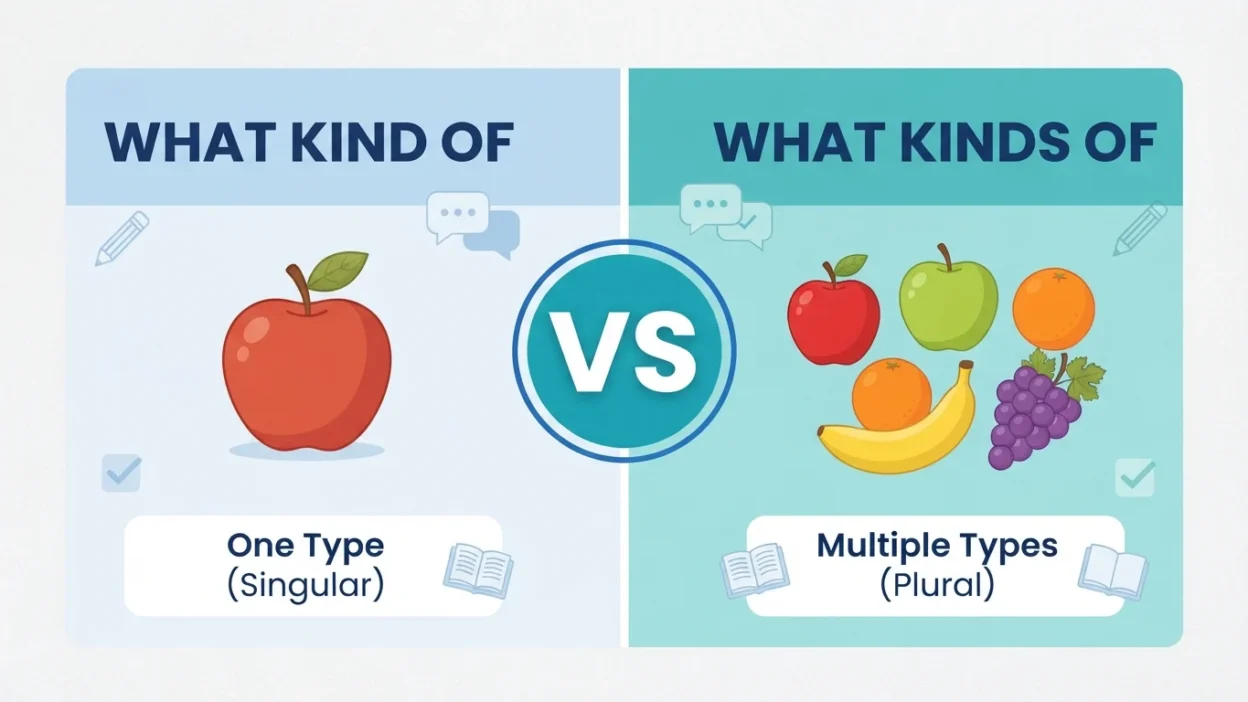
The difference between what kind of and what kinds of depends on number.
- What kind of is used when asking about one type or category (singular).
- What kinds of is used when asking about multiple types or categories (plural).
Examples:
- ✅ What kind of music do you like?
- ✅ What kinds of books do you enjoy?
Simply remember:
- Kind = One
- Kinds = More than One
What Does “What Kind of” Mean?
The phrase what kind of is used to ask about a single type, category, or class of something.
Even if the noun after it is uncountable or appears in a broader sense, you’re still asking for one category.
Examples
- What kind of car do you drive?
- What kind of coffee do you prefer?
- What kind of movie is this?
- What kind of music relaxes you?
- What kind of job are you looking for?
In each example, the speaker wants to know one specific type.
Common Situations
Use what kind of when asking about:
- A single object
- One category
- One preference
- One style
- One option
What Does “What Kinds of” Mean?
What kinds of asks about multiple categories, types, or varieties.
The speaker expects more than one answer.
Examples
- What kinds of books do you read?
- What kinds of sports do you enjoy?
- What kinds of animals live here?
- What kinds of questions were on the exam?
- What kinds of hobbies interest you?
Here, several answers are possible.
What Kind of vs What Kinds of: Main Difference
| Feature | What Kind of | What Kinds of |
| Number | Singular | Plural |
| Purpose | One category | Multiple categories |
| Expected Answer | One type | Several types |
| Best For | Specific choice | Variety of choices |
| Example | What kind of tea? | What kinds of tea? |
Simple Grammar Rule
The easiest way to choose between these phrases is to ask yourself one question:
Am I asking about one category or many?
If the answer is one, use:
What kind of
If the answer is many, use:
What kinds of
This simple rule works in almost every situation.
Easy Examples
What Kind of
- What kind of laptop should I buy?
- What kind of flower is this?
- What kind of language do they speak?
- What kind of phone do you use?
- What kind of weather do you enjoy?
What Kinds of
- What kinds of movies do you watch?
- What kinds of foods do children like?
- What kinds of computers are available?
- What kinds of jobs are hiring?
- What kinds of plants grow here?
Real-Life Conversation Examples
At a Restaurant
Customer:
What kind of soup do you have today?
At a Library
Librarian:
What kinds of books are you interested in?
While Shopping
What kind of shoes are you looking for?
Talking About Hobbies
What kinds of activities do you enjoy on weekends?
These conversations show how naturally both expressions fit into everyday English.
Common Mistakes
Many learners confuse these expressions because they focus only on the noun after them.
Mistake 1
❌ What kinds of music do you like?
✅ What kind of music do you like?
Why?
“Music” is treated as one category here.
Mistake 2
❌ What kind of books do you read?
✅ What kinds of books do you read?
Books belong to many categories.
Mistake 3
Using kind when asking for multiple options.
Correct:
✅ What kinds of restaurants are nearby?
Mistake 4
Using kinds when expecting one answer.
Correct:
✅ What kind of phone do you want?
Memory Trick
A simple trick can help you remember forever.
Kind = One
Think of one box.
One box contains one kind.
Kinds = Many
Imagine several boxes.
Each box contains a different kind.
So:
- Kind = One
- Kinds = Many
Everyday Examples
School
What kind of homework do we have?
What kinds of subjects do you enjoy?
Office
What kind of software does your company use?
What kinds of reports do you prepare?
Shopping
What kind of laptop should I buy?
What kinds of discounts are available?
Travel
What kind of hotel do you want?
What kinds of attractions can we visit?
Why Do People Get Confused?
Several reasons make these phrases confusing.
- They differ by only one letter.
- Both ask similar questions.
- The following noun sometimes looks plural.
- English has many exceptions.
- Learners often translate directly from another language.
Once you focus on whether you’re asking about one category or many categories, the confusion disappears.
Tips for Using Them Correctly
- Decide whether you expect one answer or several.
- Think about categories instead of nouns.
- Read your sentence aloud.
- Practice with everyday examples.
- Notice how native speakers use these expressions.
- Keep a list of common examples.
- Review grammar regularly.
American vs British English
There is no meaningful difference between American English and British English when using what kind of and what kinds of.
Both varieties follow the same grammar rules.
However, vocabulary may differ.
For example:
American English:
What kind of apartment do you want?
British English:
What kind of flat do you want?
The phrase stays the same. Only the vocabulary changes.
Related Grammar Topics
If you’re learning English grammar, you may also want to study:
- Singular vs plural nouns
- Countable and uncountable nouns
- Subject-verb agreement
- Question formation
- Determiners
- Quantifiers
- Articles
- Common English phrases
These topics make using what kind of and what kinds of even easier.
FAQs
1. What is the difference between what kind of and what kinds of?
What kind of asks about one type, while what kinds of asks about multiple types.
2. Can I use “what kind of” with plural nouns?
Usually, no. If you’re asking about several categories, what kinds of is the better choice.
3. Which phrase is more common?
Both are common. The correct choice depends on whether you’re asking about one category or many.
4. Is “what kinds of” grammatically correct?
Yes. It is the correct expression when referring to multiple categories or types.
5. Do American and British English use these phrases differently?
No. Both follow the same grammar rules.
6. How can I remember the difference?
Remember:
- Kind = One
- Kinds = Many
7. Can I use these expressions in formal writing?
Absolutely. Both expressions are appropriate in academic, professional, and everyday writing.
8. Why do English learners confuse these phrases?
Because they look very similar and both introduce questions about categories. Understanding singular and plural forms solves the problem.
Summary
The difference between what kind of vs what kinds of is based on whether you’re asking about one category or multiple categories. What kind of introduces questions about a single type, while what kinds of is used when several types are possible. Although the expressions are similar, using the correct one makes your English sound more natural and grammatically accurate.
With regular practice, this distinction becomes second nature. Try reading examples, listening to native speakers, and asking yourself whether you expect one answer or many before choosing the phrase. That simple habit will help you avoid mistakes in both writing and speaking.
Actionable Takeaway
The next time you’re about to ask a question, pause for a moment and think: Am I asking about one type or several? If it’s one, choose what kind of. If it’s many, choose what kinds of. Practicing this small rule every day will quickly build confidence and improve your English communication.