Learning messege vs message becomes easy when you know the correct spelling, helping your English communication stay clear and mistake-free every day.
In modern communication, message vs messege is a common topic because words have immense power. A single misspelling can alter meaning, create confusion, and affect clear communication. Many people encounter this common dilemma while using the English language. I once typed messege, wondered whether it was the correct spelling, and later discovered the truth through careful daily writing. This guide explains the difference, helping you clarify the correct form and avoid the incorrect one.
The main reason for this dilemma is pronunciation. We often pronounce word sounds in ways that make us swap vowels or forget the correct letter order. Because of this, many writers accidentally write messege instead of message, even though message is right. Looking at examples from real use makes the rule clearer, reduces mistakes, and helps you notice how proper spelling connects with accurate communication.
Over time, I have learned that repeating the correct form, repeat practice, and simple tricks make learning much easier. Focusing on the correct use in everyday situations helps you remember the spelling clearly, prevents every error, and keeps you from accidentally repeating the same mistake, even if you once felt alone or unsure.
Quick Answer
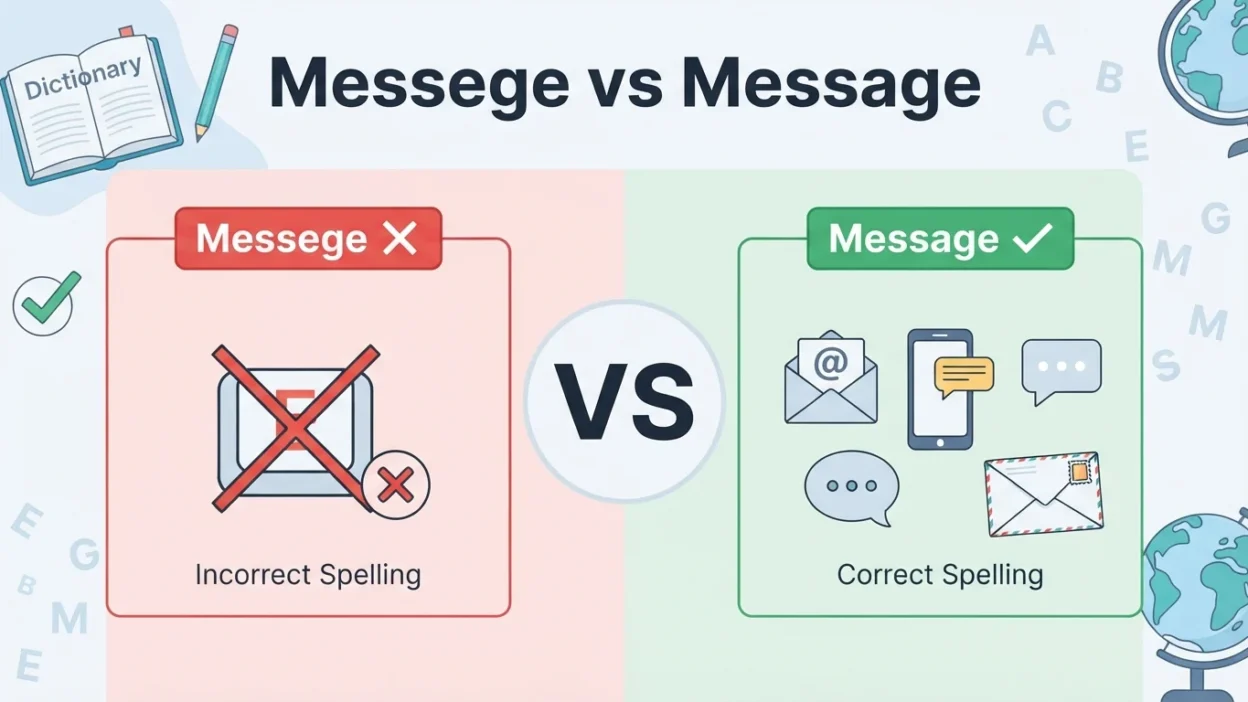
The correct spelling is message.
- ✅ Message = Correct English spelling
- ❌ Messege = Incorrect spelling
A message is a piece of written, spoken, or digital communication shared with another person. The spelling messege is simply a common typo or misspelling and is not recognized as a standard English word.
Is “Messege” a Real Word?
No. Messege is not a correct English word.
It usually appears because people write the word the way it sounds rather than the way it is spelled. English pronunciation doesn’t always match spelling, which is why this error happens so often.
Whether you’re writing an email, text message, business document, or school assignment, you should always use message.
What Does “Message” Mean?
A message is information that someone sends, speaks, writes, or shares with another person.
It can be:
- A text message
- An email
- A voice message
- A written note
- A social media message
- A business communication
- A meaningful statement or lesson
Examples
- I received your message this morning.
- Please send me a message after the meeting.
- The teacher left an important message for the class.
- Her speech carried a powerful message.
- I forgot to reply to your message yesterday.
Messege vs Message: What’s the Difference?
The difference is simple.
| Word | Correct? | Meaning |
| Message | ✅ Yes | A communication sent or received |
| Messege | ❌ No | Incorrect spelling of “message” |
Whenever you’re writing in English, choose message.
Why Do People Write “Messege”?
There are several reasons.
1. Pronunciation
The word sounds similar to how many people imagine it should be spelled.
2. Fast Typing
Typing quickly often leads to letter swaps.
3. Spelling Confusion
English contains many words where pronunciation and spelling don’t perfectly match.
4. Habit
If you’ve seen the incorrect spelling online, your brain may accidentally remember it.
Common Examples
Correct
- Send me a message.
- Your message was helpful.
- She received my message.
- Thank you for your message.
- I deleted the old message.
Incorrect
- ❌ Send me a messege.
- ❌ I read your messege.
- ❌ Please check your messege.
These examples show that messege should always be replaced with message.
Why Correct Spelling Matters
Correct spelling makes communication more professional and trustworthy.
Using the right spelling helps:
- Build credibility
- Improve readability
- Avoid misunderstandings
- Create a positive impression
- Strengthen professional writing
Whether you’re applying for a job or chatting with friends, accurate spelling reflects attention to detail.
Common Mistakes
Here are mistakes people frequently make.
Mistake 1
❌ I sent you a messege.
✅ I sent you a message.
Mistake 2
❌ Check your messege inbox.
✅ Check your message inbox.
Mistake 3
❌ Your messege made me smile.
✅ Your message made me smile.
Mistake 4
Believing that both spellings are acceptable.
Only message is correct.
Easy Memory Trick
Here’s a simple trick.
Look at the middle of the word.
Message
contains:
ss + a
Not:
ss + e
Remember this sentence:
A message always has the letter A after SS.
Another trick:
Think of the phrase:
Message arrives accurately.
Both message and accurately contain the letter A.
Real-Life Uses of “Message”
You will commonly see message in:
- Emails
- SMS texts
- WhatsApp chats
- Facebook Messenger
- Instagram DMs
- Business communication
- School assignments
- Customer support
- Marketing campaigns
In every one of these situations, message is the correct spelling.
Related Words
Understanding related vocabulary also helps improve your English.
Related words include:
- Messaging
- Messenger
- Text
- Communication
- Conversation
- Notification
- Letter
- Reply
- Inbox
Learning words in the same family makes spelling easier to remember.
American vs British English
There is no spelling difference between American English and British English.
Both use:
✅ Message
Neither variety accepts:
❌ Messege
The spelling remains exactly the same worldwide.
Tips to Remember the Correct Spelling
- Read more English books.
- Notice the spelling in text messages and emails.
- Practice writing the word daily.
- Use spell-check while learning.
- Read your writing before sending it.
- Learn words in families like message, messaging, and messenger.
- Remember that message contains the letter A after SS.
FAQs
1. Is messege a correct English word?
No. Messege is an incorrect spelling. The correct word is message.
2. Why do people spell message as messege?
Mostly because pronunciation can be misleading and typing quickly increases the chance of spelling mistakes.
3. Is message correct in American and British English?
Yes. Both American and British English use the spelling message.
4. How can I remember the correct spelling?
Remember that message has the letter A after SS.
5. Is messege accepted in dictionaries?
No. Standard English dictionaries recognize only message.
6. Can spell-check fix messege?
Most modern spell-check tools automatically suggest message.
7. Does using messege affect professional writing?
Yes. It can make your writing appear careless and reduce credibility.
8. What does message mean?
A message is information communicated from one person to another through speech, writing, or digital communication.
Summary
The confusion around messege vs message is understandable because English pronunciation doesn’t always match spelling. However, the rule is straightforward: message is the only correct spelling, while messege is simply a misspelling. Using the correct form improves your writing, builds credibility, and ensures your communication is clear.
Whether you’re sending a text, writing an email, posting on social media, or preparing a professional document, taking a moment to check your spelling can make a big difference. The more often you see and write message, the more natural the correct spelling becomes.
Actionable Takeaway
The next time you type this word, pause for a second and remember one simple rule: after “ss,” the correct word uses the letter “a”—message, not messege. Add it to your daily writing practice, and you’ll eliminate this spelling mistake for good.