If openned or opened ever makes you paused mid-sentence, this simple spelling guide will help you write with confidence every time.
Many writers are left wondering whether openned or opened is right, but you are not alone. In English, this common mistake appears when people expect a double consonant or a double n. From my editing experience, this word follows a simple spelling rule, so the error is usually just a typo, not a serious grammar issue. Learning the pattern makes everyday writing easier and more accurate.
The correct form is opened, while openned is incorrect. The verb open changes to the past tense and past participle by adding -ed, without adding a single n twice. Once you understand this rule, the confusion disappears, your usage improves in emails, school assignments, and professional documents, and you can avoid every misspelling with a quick check before you finish a sentence.
Quick Answer
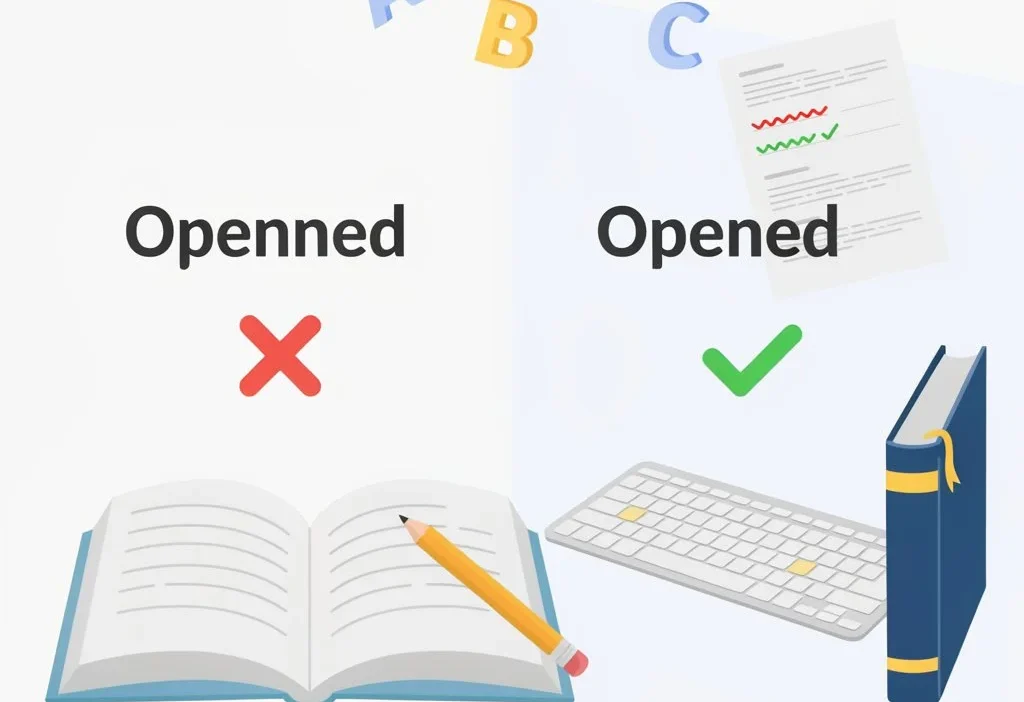
Opened is the correct spelling.
Openned is incorrect and is not recognized as a standard English word.
The verb open forms its past tense and past participle by simply adding -ed:
- ✅ Open → Opened
- ❌ Open → Openned
What Does “Opened” Mean?
Opened is the past tense and past participle of the verb open. It means that something was made accessible, unlocked, uncovered, or started.
Examples:
- She opened the window.
- The store opened at 9 a.m.
- He opened the email immediately.
- They opened a new restaurant last month.
Whether you’re talking about a door, a business, a conversation, or a computer file, opened is always the correct spelling.
Why Do People Write “Openned”?
Many English learners naturally assume that open should become openned because some verbs double their final consonant before adding -ed.
Examples include:
- Stop → Stopped
- Plan → Planned
- Drop → Dropped
However, open does not follow that spelling pattern.
The final syllable of open is not stressed, so the final n is not doubled.
Correct:
- Open → Opened
Incorrect:
- Open → Openned
Understanding this simple spelling rule eliminates the confusion.
Why “Opened” Is Correct
English spelling follows predictable patterns.
Most verbs ending in a consonant do not double the final letter unless they meet specific conditions:
- The word has one syllable or ends with a stressed syllable.
- It follows a consonant-vowel-consonant (CVC) pattern.
Examples:
| Verb | Correct Past Tense |
| Open | Opened |
| Visit | Visited |
| Offer | Offered |
| Enter | Entered |
Notice that none of these verbs double their final consonant.
Easy Rule to Remember
Remember this simple sentence:
Open keeps one “n,” so opened keeps one “n.”
If the base word has one n, adding -ed doesn’t change it.
Think:
- Open
- Opened
Never:
- Openned
Examples of “Opened” in Sentences
Here are everyday examples:
- I opened the package this morning.
- She opened the curtains.
- The teacher opened the discussion.
- We opened our books.
- They opened a savings account.
- He opened the document.
- Sarah opened the gift carefully.
- The museum opened last weekend.
Each sentence uses opened correctly.
Examples of Incorrect Usage
These examples are wrong:
❌ I openned the door.
✅ I opened the door.
❌ She openned her laptop.
✅ She opened her laptop.
❌ They openned a new office.
✅ They opened a new office.
Comparison Table: Openned vs Opened
| Feature | Openned | Opened |
| Correct spelling | ❌ No | ✅ Yes |
| Dictionary word | ❌ No | ✅ Yes |
| Past tense of open | ❌ No | ✅ Yes |
| Past participle | ❌ No | ✅ Yes |
| Used in formal writing | ❌ Never | ✅ Always |
| Accepted in exams | ❌ No | ✅ Yes |
Common Mistakes Writers Make
Many people confuse these spellings because they apply the wrong grammar rule.
Common mistakes include:
- Doubling the final n unnecessarily.
- Assuming every verb ending in n follows the same pattern.
- Relying on pronunciation instead of spelling.
- Typing quickly and missing the typo.
- Copying incorrect spellings from social media.
Always proofread your writing before publishing or submitting it.
How to Remember the Correct Spelling
Here are a few memory tricks:
- Think of open first.
- Simply add -ed.
- Never add another n.
- Read the sentence aloud.
- Use spell check when writing important documents.
The more often you write opened, the more natural it becomes.
Grammar Rule Behind “Opened”
The verb open is a regular verb.
Regular verbs form the past tense by adding -ed.
Examples:
- Open → Opened
- Clean → Cleaned
- Wash → Washed
- Jump → Jumped
- Cook → Cooked
Since open already ends correctly, no additional consonant is needed.
Similar Words That Cause Confusion
English contains many words that look similar or follow different spelling rules.
Examples include:
- Planned vs Planed
- Stopped vs Stoped
- Preferred vs Prefered
- Traveling vs Travelling
- Canceled vs Cancelled
- Focused vs Focussed
Learning spelling patterns instead of memorizing individual words makes writing much easier.
American vs British English
For opened, there is no spelling difference between American and British English.
Both varieties use:
- Opened ✅
Neither American nor British English accepts:
- Openned ❌
Although other words differ (such as traveled/travelled or canceled/cancelled), opened remains exactly the same in both versions of English.
Where You Will Use “Opened”
You’ll frequently use opened in:
- Emails
- School assignments
- Business communication
- Social media posts
- Stories
- Reports
- Blogs
- Academic writing
- Text messages
- Professional documents
Because it’s so common, mastering its spelling improves your overall writing accuracy.
Writing Tips
If you create online content, always use the correct spelling.
Using openned can:
- Reduce credibility.
- Hurt readability.
- Create a poor impression.
- Affect quality.
- Confuse readers.
Search engines value clear, accurate, and trustworthy content. Using proper spelling contributes to a better user experience.
FAQs
Is “openned” a real English word?
No. Openned is a misspelling. The correct word is opened.
Why isn’t the “n” doubled?
Because open does not meet the grammar rule that requires doubling the final consonant before adding -ed.
Is “opened” the past tense?
Yes. Opened is both the past tense and the past participle of open.
Do British and American English spell it differently?
No. Both use opened.
Can I use “openned” in informal writing?
No. It is always considered incorrect.
How can I remember the correct spelling?
Remember this phrase:
One n in open, one n in opened.
Does spell check catch “openned”?
Most modern spell checkers identify openned as a misspelling and suggest opened.
Summary
If you’ve been unsure about openned or opened, the correct choice is always opened. It is the standard past tense and past participle of open, accepted in dictionaries, schools, workplaces, and professional writing. The spelling openned is simply a common typo caused by misunderstanding English consonant-doubling rules.
The easiest way to remember the correct form is to start with the base verb open and add -ed—nothing more. With this simple rule, you’ll write with greater confidence, avoid common spelling mistakes, and produce clearer, more polished English in every situation.