Too vs to can seem confusing at first, but with regular practice and the right approach, anyone can learn the difference with confidence today.
Learning too vs to may feel challenging, especially during online English lessons or traditional English lessons. These two words are pronounced the same way, so in a conversation, the context usually helps people understand which one is used. However, in written English, the difference between to and too often causes mistakes. From my experience teaching grammar, it is one of the most common questions learners ask.
Luckily, you can learn the correct usage through practice. This article will show you how to recognize which one belongs in different situations, point out common mistakes to avoid, and help you know the right choice each time. Whether you study online or in a classroom, paying attention to the context makes every decision much easier.
Take time to read, keep using both words in everyday sentences, and learn more about their roles in English. The more examples you see, the more naturally you will understand the difference in all situations.
Quick Answer
The difference between too and to is simple:
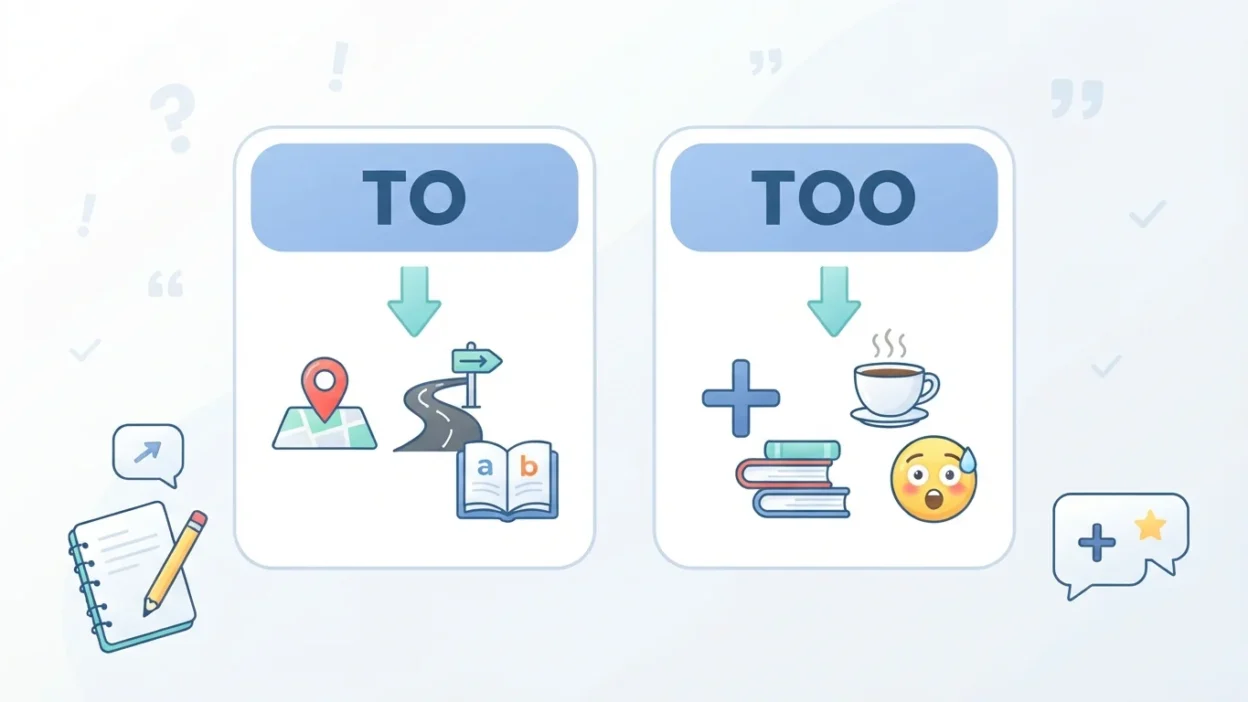
- To is mainly a preposition or part of an infinitive verb (e.g., go to school, to learn).
- Too means also or more than enough (e.g., I want to come too, The coffee is too hot).
Remember this easy trick:
- Too = also / excessively
- To = direction, purpose, or part of a verb
What Does “To” Mean?
The word to has several important jobs in English grammar.
1. To Shows Direction
It tells where someone or something is going.
Examples:
- I’m going to the office.
- She walked to the park.
- We drove to the airport.
2. To Is Part of an Infinitive Verb
An infinitive is the base form of a verb with to.
Examples:
- I want to learn English.
- She plans to travel next month.
- They hope to win.
3. To Shows Relationships
It can connect people, places, or things.
Examples:
- Give the book to Sarah.
- Send the email to your manager.
- This gift belongs to you.
What Does “Too” Mean?
The word too has two main meanings.
1. Too Means “Also”
Examples:
- I like pizza, too.
- She is coming too.
- We’d love to join too.
2. Too Means “More Than Needed”
Examples:
- The weather is too cold.
- This bag is too heavy.
- You’re speaking too quickly.
When too means “excessively,” it usually describes a problem or something beyond the desired amount.
Too vs To: Side-by-Side Comparison
| Feature | To | Too |
| Part of speech | Preposition, infinitive marker | Adverb |
| Main meaning | Direction, purpose, connection | Also, excessively |
| Example | Go to work | I’m coming too |
| Another example | Want to eat | It’s too expensive |
| Easy memory trick | One “o” points one way | Two “o”s = extra |
Simple Memory Tricks
If you often confuse these words, try these easy tricks.
Remember the Extra “O”
The word too has an extra o, just like it means something extra.
Examples:
- too much
- too many
- too expensive
- me too
Think of Direction
If you’re talking about going somewhere or doing something, you’ll probably need to.
Examples:
- Go to school.
- Want to sleep.
- Drive to work.
These small memory tricks can prevent many spelling mistakes.
Common Examples
Using “To”
- I need to finish my homework.
- We’re driving to the beach.
- She wants to become a doctor.
- Send the file to me.
Using “Too”
- I’d like some dessert too.
- It’s too noisy here.
- He’s too young to drive.
- Thank you too.
Common Mistakes to Avoid
Many English learners make these errors.
Incorrect:
I want too learn English.
Correct:
I want to learn English.
Incorrect:
I’m going too the office.
Correct:
I’m going to the office.
Incorrect:
She is to busy today.
Correct:
She is too busy today.
Incorrect:
Me to.
Correct:
Me too.
Reading your sentence aloud often helps you notice which word fits naturally.
Why Are “To” and “Too” Confusing?
The main reason is pronunciation.
Both words are pronounced the same way in standard English. Because they sound identical, writers sometimes choose the wrong spelling without realizing it.
Another reason is that to appears much more frequently than too, making people accidentally type it by habit.
The key is to think about the meaning, not the sound.
When Should You Use “To”?
Use to when talking about:
- Direction
- Destination
- Giving something
- Infinitive verbs
- Purpose
- Movement
Examples:
- Travel to London.
- Give it to John.
- Need to practice.
- Go to bed.
When Should You Use “Too”?
Use too when you mean:
- Also
- As well
- More than enough
- Excessively
Examples:
- I’d like coffee too.
- It’s too late.
- You’re working too hard.
- The music is too loud.
American vs British English
There is no grammatical difference between American English and British English when using to and too.
Both varieties:
- Spell the words the same way.
- Pronounce them similarly.
- Follow identical grammar rules.
- Use them in the same situations.
You may notice differences in accent or vocabulary, but the usage of to and too remains exactly the same.
Helpful Practice Sentences
Choose the correct word.
- I’m going ___ the store.
- I’d like to come ___.
- It’s ___ expensive.
- She hopes ___ see you soon.
- Please send it ___ me.
Answers:
- to
- too
- too
- to
- to
Practicing with short sentences helps you build confidence quickly.
Tips to Remember the Difference
Keep these tips in mind whenever you write.
- Too means “also” or “more than enough.”
- To usually shows direction or starts an infinitive.
- Look at the meaning of the sentence before choosing.
- Proofread emails and messages carefully.
- Practice with real examples every day.
Small habits make a big difference over time.
FAQs
Is “too” and “to” pronounced the same?
Yes. They are homophones, meaning they sound alike but have different meanings and spellings.
What is the easiest way to remember the difference?
Remember that too has an extra o, which represents something extra, such as “also” or “more than enough.”
Can “too” replace “to”?
No. They have different meanings and grammatical functions, so they cannot replace each other.
Is “me too” correct?
Yes. Me too is a common and correct way to agree with someone.
Why is “I want too learn” incorrect?
Because want must be followed by the infinitive marker to, not the adverb too.
Are “to” and “too” used differently in British English?
No. Both American and British English follow the same grammar rules for these words.
Is “too much” correct?
Yes. Too much means more than needed or more than is desirable.
Summary
Understanding too vs to is one of the simplest ways to improve your English writing. Although both words sound the same, they serve completely different purposes. To is used for direction, purpose, and infinitive verbs, while too means also or more than enough. Knowing this distinction will help you avoid common mistakes in emails, essays, messages, and everyday conversations.
The best way to master these words is through regular practice and careful proofreading. Every time you write, pause for a moment and ask yourself whether you’re talking about direction or purpose (to) or adding the meaning of “also” or “excessively” (too). With consistent practice, choosing the correct word will soon become automatic.