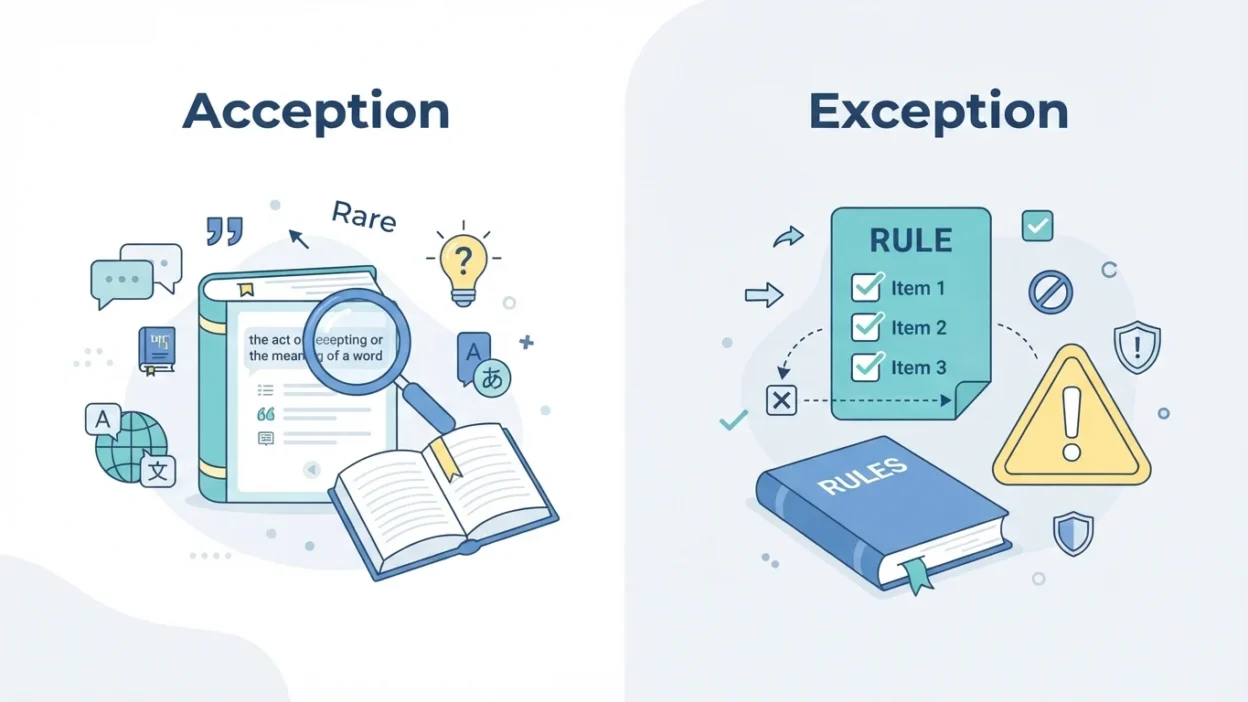
Acception vs Exception often confuses writers because the words look alike, sound related, yet have very different meanings in English usage.
Many writers feel confused when comparing acception vs exception because the words look similar, sound slightly related, and often trip up even experienced English learners. From my experience editing formal writing, emails, and exams, this is a common point of confusion. The truth is that one word is commonly used, while the other is rarely appropriate in everyday English.
If you have ever paused mid-sentence, wondering which word is correct, this guide will make the difference clear, explain it fast, break down the meanings, provide practical examples, and highlight common mistakes made while learning these terms.
You will also discover important usage differences so you never mix them up again. With a little practice, choosing the right word becomes easier, making your writing more natural and accurate.
Quick Answer
Exception is the correct word in almost every modern English situation. It means someone or something that does not follow a general rule.
Acception is a real but extremely rare English word. It refers to the acceptance or a particular meaning of a word, mainly in linguistics, philosophy, or historical texts. Most people never need to use it in everyday writing.
What Does “Exception” Mean?
An exception is a person, thing, or situation that does not follow a general rule or pattern.
It is one of the most common nouns in English and appears frequently in academic, professional, and casual writing.
Examples of “Exception”
- Everyone must wear a badge, with one exception.
- She never misses class, except during illness.
- This rule has no exceptions.
- He is the exception to the rule.
In each example, exception refers to something outside the normal rule.
What Does “Acception” Mean?
The word acception is much less common.
It means:
- The accepted meaning of a word.
- Acceptance of an idea in older or specialized writing.
Today, you’ll mostly encounter acception in:
- Linguistics
- Historical dictionaries
- Philosophy
- Academic language studies
Outside these fields, exception is almost always the word people intend.
Examples of “Acception”
- The dictionary lists an older acception of the term.
- Scholars debated the original acception of the word.
- The historical acception differs from today’s meaning.
Although these sentences are correct, most English speakers rarely use acception.
Acception vs Exception: Side-by-Side Comparison
| Feature | Acception | Exception |
| Meaning | Accepted meaning of a word; acceptance (rare) | Something excluded from a rule |
| Common today? | Very rare | Extremely common |
| Used in | Linguistics, philosophy, historical texts | Everyday English |
| Part of speech | Noun | Noun |
| Easy example | An older acception of the word | An exception to the rule |
Why Do People Confuse These Words?
The confusion happens because:
- Both words begin with “ac” or “ex” and end with “-ception.”
- They sound somewhat similar.
- Many people assume acception is simply another spelling of exception.
- Spell checkers may not always explain the difference clearly.
In reality, they have different meanings and should not be used interchangeably.
Common Mistakes to Avoid
Here are mistakes many writers make.
❌ There is one acception to the rule.
✅ There is one exception to the rule.
❌ She is the acception.
✅ She is the exception.
❌ This rule has no acceptions.
✅ This rule has no exceptions.
✅ Scholars discussed the historical acception of the word.
This is one of the few situations where acception is appropriate.
Easy Memory Trick
A simple trick can help you remember the difference.
Exception = Exit from the Rule
Think of exception as someone or something that exits the normal rule.
Exception → Exit → Outside the rule
Acception = Acceptance
Notice that acception begins with accept.
It relates to an accepted meaning or interpretation, not a rule.
When Should You Use “Exception”?
Use exception when talking about:
- Rules
- Laws
- Policies
- Grammar
- School
- Business
- Everyday conversations
- Contracts
- Procedures
Examples:
- Everyone attended except Tom.
- There are no exceptions.
- Safety rules apply without exception.
When Should You Use “Acception”?
Only use acception when discussing:
- Dictionary meanings
- Historical language
- Linguistics
- Word origins
- Semantic studies
- Academic writing
Examples:
- The medieval acception differs from today’s usage.
- Researchers examined every acception of the term.
If you’re writing an ordinary email, essay, or article, you almost certainly want exception.
Exception in Everyday Expressions
You’ll often hear expressions like:
- Exception to the rule
- Without exception
- Make an exception
- An important exception
- No exception
These phrases are standard English and appear in newspapers, books, classrooms, and workplaces.
American vs British English
There is no difference between American and British English regarding these words.
Both varieties:
- Spell exception the same way.
- Recognize acception as a rare, specialized word.
- Use exception in everyday communication.
- Follow identical grammar rules.
The difference lies in frequency, not nationality.
Related Words
Learning related vocabulary helps reinforce the meanings.
Related to Exception
- Except
- Exceptional
- Exceptionally
- Exclude
- Exclusion
- Rule
- Policy
- Exemption
Related to Acception
- Accept
- Acceptance
- Accepted meaning
- Interpretation
- Definition
- Sense
- Semantics
- Linguistics
These related terms make it easier to remember which word belongs in which context.
FAQs
Is “acception” a real word?
Yes. It is a legitimate English word, but it is rare and mainly used in linguistics, philosophy, and historical studies.
Is “exception” the correct word for everyday English?
Yes. In almost every normal conversation or piece of writing, exception is the correct choice.
Can “acception” replace “exception”?
No. They have different meanings and are not interchangeable.
Why have I never seen “acception” before?
Because modern English rarely uses it outside specialized academic fields.
Which word should I use in business writing?
Use exception unless you’re discussing the meaning of a word in a linguistic context.
Is “acception” an old-fashioned word?
It is considered archaic or highly specialized in most contexts today.
Are the pronunciations the same?
No. They are similar but pronounced slightly differently, although many learners still confuse them because of their spelling.
Summary
The debate over acception vs exception becomes simple once you understand their meanings. Exception is the everyday word that refers to something outside a rule, while acception is a rare noun meaning the accepted sense or interpretation of a word. Unless you’re writing about linguistics or historical language, exception is almost always the correct choice.
Whenever you’re unsure, ask yourself whether you’re talking about a rule or the meaning of a word. If it’s a rule, choose exception. If you’re discussing a historical or specialized meaning, acception may be appropriate. Knowing this difference will make your writing clearer, more accurate, and more professional.