Have you ever wondered whether you should write affirm or confirm? Although these two words are sometimes used in similar situations, they do not mean the same thing. Choosing the wrong one can make your message sound unnatural or even change its meaning, especially in professional, legal, or everyday communication.
If you’re comparing affirm vs confirm, you’re in the right place. This guide explains the meaning of each word, when to use them, common examples, key differences, grammar tips, and mistakes to avoid. By the end, you’ll know exactly which word fits your sentence with confidence.
Quick Answer
The main difference between affirm and confirm is their purpose.
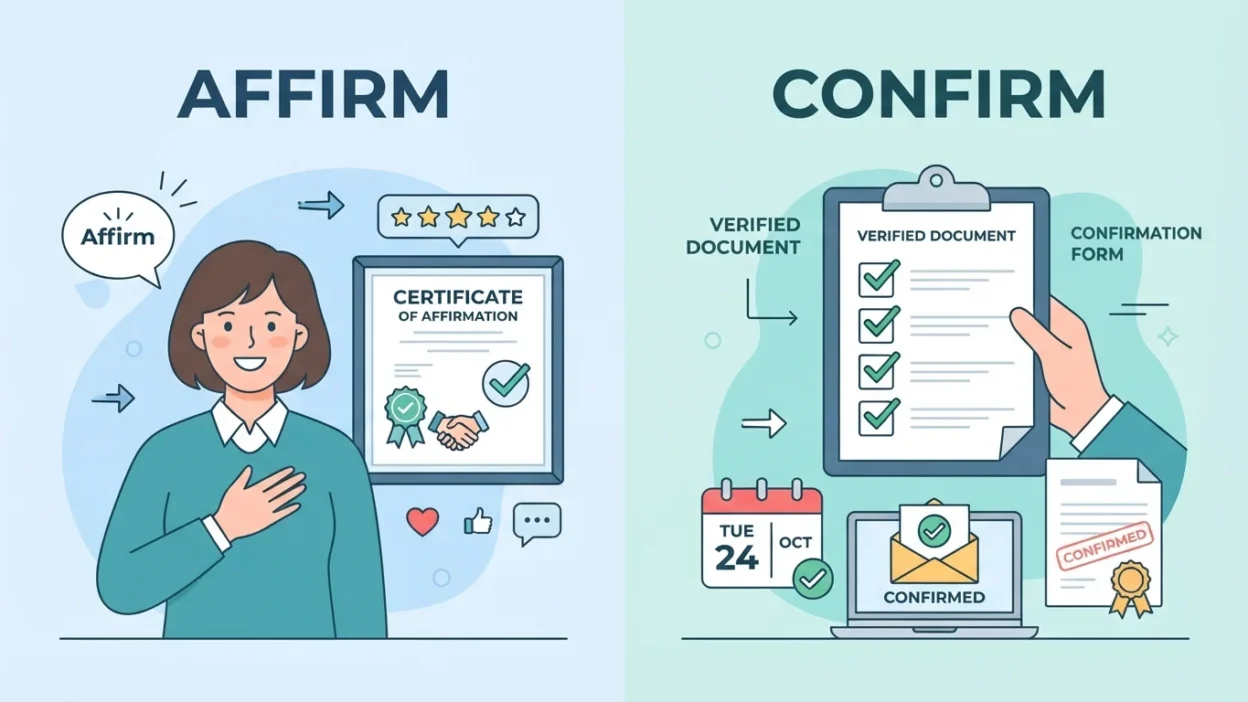
- Affirm means to state, declare, or support something as true, often with confidence or sincerity.
- Confirm means to verify, validate, or prove that something is true, correct, or certain.
In simple terms:
- Affirm = Declare or express confidence
- Confirm = Verify or check accuracy
What Does “Affirm” Mean?
The verb affirm means to state something positively, confidently, or officially. It often expresses belief, support, agreement, or commitment.
You may hear affirm in legal settings, formal speeches, personal development, or discussions where someone strongly declares that something is true.
Examples of “Affirm”
- I affirm that the statement is true.
- She affirmed her commitment to the project.
- The witness chose to affirm instead of taking an oath.
- They affirmed their support for the new policy.
In each example, affirm focuses on making a sincere or official declaration.
What Does “Confirm” Mean?
The verb confirm means to verify that something is correct or certain. It often involves checking facts, evidence, bookings, appointments, or information.
This word is extremely common in everyday English.
Examples of “Confirm”
- Please confirm your email address.
- Can you confirm the meeting time?
- The hotel confirmed my reservation.
- Police confirmed the report yesterday.
Here, confirm means to verify or establish that something is accurate.
Affirm vs Confirm: Comparison Table
| Feature | Affirm | Confirm |
| Meaning | Declare or state something confidently | Verify or prove something is true |
| Focus | Personal belief or official declaration | Evidence, facts, or accuracy |
| Common use | Legal, formal, motivational | Business, travel, emails, daily communication |
| Part of speech | Verb | Verb |
| Example | I affirm my commitment. | I confirm the appointment. |
The Main Difference Between Affirm and Confirm
Although both words relate to truth, they serve different purposes.
Use affirm when someone is expressing certainty, support, or belief.
Use confirm when checking facts or making something official through verification.
For example:
- I affirm my loyalty.
- I confirm my attendance.
One expresses commitment.
The other verifies information.
When Should You Use “Affirm”?
Choose affirm when you want to:
- Declare something formally.
- State your belief.
- Express support.
- Reinforce confidence.
- Make a legal statement.
- Give a positive declaration.
Examples:
- The president affirmed the country’s commitment.
- She affirmed her innocence.
- I affirm that this information is accurate.
- We affirm our shared values.
When Should You Use “Confirm”?
Use confirm when you need to:
- Verify facts.
- Check information.
- Approve reservations.
- Respond to invitations.
- Validate details.
- Make arrangements official.
Examples:
- Please confirm your attendance.
- The airline confirmed our tickets.
- Can you confirm your phone number?
- The doctor confirmed the diagnosis.
Common Situations
Business Emails
Correct:
- Please confirm receipt of this email.
- Kindly confirm your availability.
Less common:
- I affirm receipt of your email.
Although grammatically possible, it sounds overly formal and unnatural.
Legal Context
Common:
- The witness affirmed the statement.
- The court affirmed the lower court’s decision.
Less common:
- The witness confirmed the oath.
Legal English generally prefers affirm in these situations.
Personal Development
You’ll often hear:
- Affirm your strengths.
- Daily affirmations.
- Positive affirmations.
Here, confirm would sound incorrect because the focus is confidence, not verification.
Common Mistakes to Avoid
Many English learners confuse these words.
❌ Please affirm your booking.
✅ Please confirm your booking.
❌ I confirm my belief in honesty.
✅ I affirm my belief in honesty.
❌ The hotel affirmed my reservation.
✅ The hotel confirmed my reservation.
❌ She confirmed her values.
✅ She affirmed her values.
Understanding the context makes choosing the correct word much easier.
Memory Trick
Here’s an easy way to remember the difference.
Affirm = Assert
Both words begin with A.
Think:
Affirm → Assert → Declare
Confirm = Check
Imagine confirming a reservation or checking details.
Think:
Confirm → Check → Verify
This simple memory trick works well in everyday writing.
Related Words and Synonyms
Synonyms of Affirm
- Declare
- State
- Assert
- Proclaim
- Maintain
- Support
- Endorse
- Uphold
Synonyms of Confirm
- Verify
- Validate
- Approve
- Check
- Authenticate
- Certify
- Establish
- Corroborate
Knowing these related words helps you choose the most precise vocabulary.
American vs British English
There is no significant difference between American and British English when using affirm and confirm.
Both varieties:
- Use the same spellings.
- Follow the same grammar.
- Apply the same meanings.
- Prefer confirm in everyday communication.
- Use affirm more often in legal or formal contexts.
The difference is based on context, not geography.
Tips for Using the Right Word
Keep these simple tips in mind.
- Use affirm for beliefs, commitments, and declarations.
- Use confirm for facts, bookings, appointments, and information.
- Think about whether you’re expressing confidence or checking accuracy.
- Read your sentence aloud to ensure it sounds natural.
- If you’re writing a business email, confirm is usually the better choice.
FAQs
What is the difference between affirm and confirm?
Affirm means to declare or state something confidently, while confirm means to verify or prove that something is true.
Can affirm and confirm be used interchangeably?
Not usually. They have different meanings and are used in different contexts.
Which word is better in business emails?
Confirm is almost always the correct choice because business communication usually involves verifying information.
What does affirm mean in law?
In legal settings, affirm often means making a formal declaration or confirming a statement without taking a religious oath.
What are positive affirmations?
Positive affirmations are encouraging statements people repeat to build confidence or develop a positive mindset.
Is “confirm your attendance” correct?
Yes. It is one of the most common professional expressions.
Is “affirm your attendance” correct?
Generally, no. Confirm your attendance is the natural and widely accepted phrase.
Summary
When comparing affirm vs confirm, the key difference lies in intention. Affirm is used to declare, support, or express belief with confidence, while confirm is used to verify facts, check information, or make arrangements official. Although both relate to truth, they are not interchangeable in most situations.
The easiest way to remember the distinction is to think about the purpose of your sentence. If you’re expressing commitment, belief, or support, choose affirm. If you’re checking or verifying information, choose confirm. Using the correct word will make your communication more precise, professional, and natural.