If you’ve ever stopped while writing and wondered whether to use paid vs payed, you’re not alone. These two words look similar, but they are not interchangeable. In fact, one is correct in almost every everyday situation, while the other has a very specific nautical meaning.
Understanding the difference between paid and payed will help you avoid common grammar mistakes in emails, essays, business writing, and social media posts. This guide explains everything in simple English, complete with examples, comparisons, FAQs, and practical tips.
Quick Answer
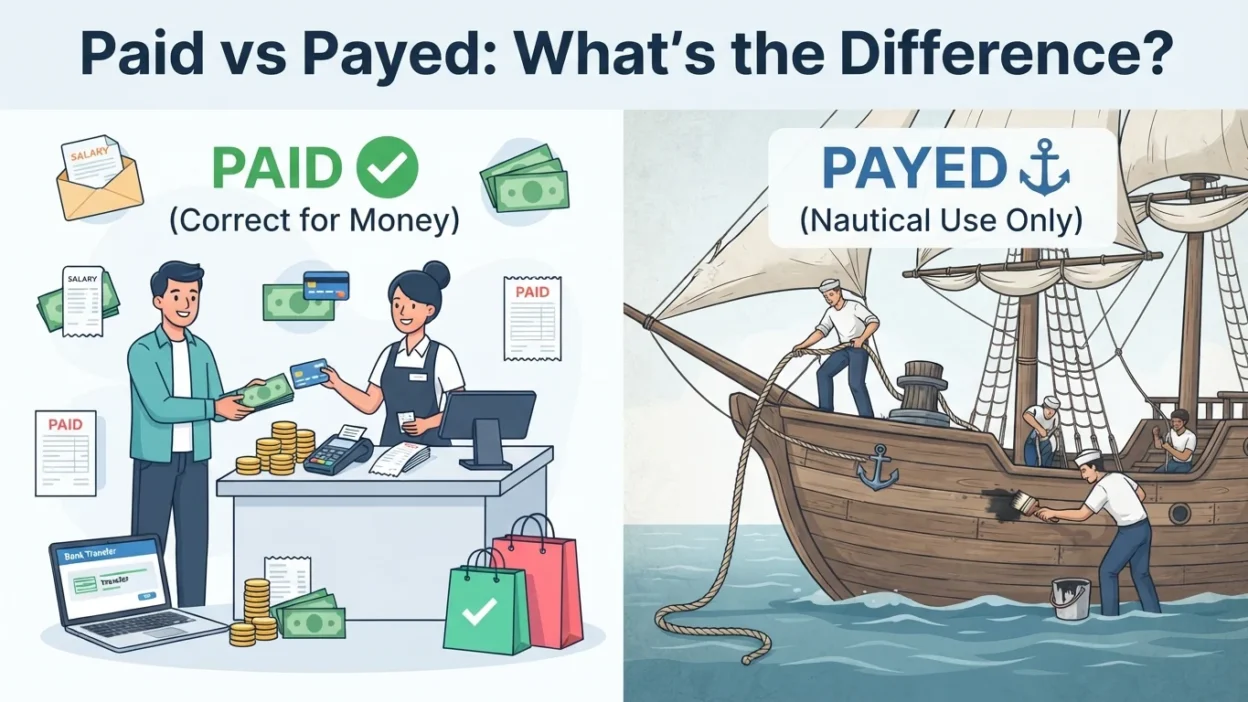
Paid is the correct past tense and past participle of pay when talking about money, bills, salaries, debts, or giving someone what is owed.
Payed is a rare word used only in nautical contexts, meaning to let out rope or to seal a wooden ship with tar.
Correct: I paid the rent yesterday. ✅
Incorrect: I payed the rent yesterday. ❌
Paid vs Payed: What’s the Difference?
Although both words exist in English dictionaries, they have completely different meanings.
- Paid is the standard past tense of pay.
- Payed is a specialized nautical term and is almost never used in everyday English.
Because paid is so common, most spell-checkers automatically flag payed as a mistake unless the context involves ships or sailing.
What Does “Paid” Mean?
The word paid refers to giving money or fulfilling a financial obligation. It is the correct form you’ll use in nearly every conversation involving payment.
Examples
- She paid the electricity bill on time.
- We paid for dinner together.
- He paid his employees every Friday.
- I already paid the membership fee.
- They paid attention during the lecture.
Notice that paid can also be used in expressions that don’t involve money.
Examples:
- She paid attention to every detail.
- His hard work paid off in the end.
- We paid respect to the veterans.
What Does “Payed” Mean?
The word payed is a legitimate English word, but it belongs almost exclusively to maritime language.
It has two traditional meanings:
- To let out a rope or cable gradually.
- To coat the seams of a wooden boat with tar or pitch to make it waterproof.
Examples
- The sailors payed out the anchor rope carefully.
- The crew payed the hull before beginning the voyage.
Unless you’re writing about sailing, ships, or maritime history, you almost certainly need paid, not payed.
Paid vs Payed Comparison Table
| Feature | Paid | Payed |
| Part of speech | Past tense of pay | Nautical verb |
| Everyday English | Yes | No |
| Refers to money | Yes | No |
| Used in business writing | Yes | No |
| Used in school assignments | Yes | No |
| Maritime meaning | No | Yes |
| Correct in most situations | ✅ Yes | ❌ No |
Why Do People Confuse Paid and Payed?
Many English verbs form their past tense by adding -ed.
Examples include:
- Walk → Walked
- Clean → Cleaned
- Jump → Jumped
Because of this pattern, many learners naturally assume:
Pay → Payed
However, pay is an irregular verb.
Its correct forms are:
- Pay
- Paid
- Paid
Just like:
- Say → Said
- Lay → Laid
This irregular spelling causes frequent confusion.
Examples of Paid in Everyday Sentences
Here are common examples you’ll actually use.
Money
- I paid the restaurant bill.
- She paid cash instead of using a card.
- We paid our taxes early.
Work
- The company paid everyone on Friday.
- He is a well-paid engineer.
- They paid overtime wages.
Idioms
- Your patience paid off.
- She paid attention in class.
- We paid tribute to the retiring teacher.
Examples of Payed in Nautical Writing
These examples show the rare situations where payed is correct.
- The crew payed out the rope slowly.
- Workers payed the seams with hot tar.
- The sailors payed additional cable during the storm.
Outside maritime contexts, these sentences are uncommon.
Common Mistakes to Avoid
Many writers accidentally use payed because it looks more regular.
Avoid these mistakes:
❌ I payed my credit card bill.
✅ I paid my credit card bill.
❌ She payed for the tickets.
✅ She paid for the tickets.
❌ We payed our employees yesterday.
✅ We paid our employees yesterday.
Remember:
If money is involved, use paid.
If ropes, ships, or tar are involved, payed may be correct.
Easy Trick to Remember the Difference
Here’s a simple memory tip.
Paid = Money
Think of the letter “i” in paid as standing for income.
Whenever you’re talking about:
- paying bills
- paying employees
- paying tuition
- paying for food
- paying taxes
always choose paid.
Only remember payed if you’re discussing ships or sailing.
Paid in Common Expressions
You’ll often see paid in popular phrases.
- Paid in full
- Paid vacation
- Paid leave
- Paid subscription
- Paid advertisement
- Paid partnership
- Paid employee
- Paid internship
- Paid service
- Paid account
These expressions always use paid, never payed.
American vs British English
Good news—there is no difference between American and British English for this word.
Both varieties use:
- Paid for financial meanings.
- Payed only in specialized nautical contexts.
Whether you’re writing in the United States, the United Kingdom, Canada, Australia, or other English-speaking countries, the rule stays the same.
Related Words
Understanding related vocabulary strengthens your grammar and helps search engines better understand the topic.
Relevant terms include:
- past tense of pay
- pay verb
- irregular verbs
- English grammar
- spelling difference
- commonly confused words
- grammar mistakes
- correct spelling
- paid meaning
- payed meaning
- writing tips
- proofreading
- business English
- academic writing
- English vocabulary
- word usage
- grammar guide
- paid off
- paid attention
- nautical terminology
When Spell Check Flags “Payed”
Most grammar tools and spell checkers automatically recommend paid.
That’s because payed appears so rarely that software assumes it’s a typo.
If you’re writing about finance, shopping, salaries, invoices, tuition, subscriptions, or everyday communication, accept the correction.
Only ignore it when writing about maritime operations.
FAQs
Is paid or payed correct?
Paid is correct in nearly every situation involving money or payment. Payed is reserved for nautical terminology.
Why isn’t payed the past tense of pay?
Because pay is an irregular verb. Its correct past tense is paid, not payed.
Is payed a real English word?
Yes. However, it is only used in maritime language to describe letting out rope or sealing a ship’s seams.
Which should I use in professional writing?
Always use paid unless you’re writing about ships or sailing.
Is “paid off” correct?
Yes. “Paid off” is a common English expression meaning something produced successful results.
Example:
My hard work paid off.
Does British English use payed?
Yes, but only in the same nautical contexts as American English.
Why does spell check change payed to paid?
Because paid is the correct word for almost every modern use, while payed is extremely rare.
How can I remember the difference?
Think of paid whenever money changes hands. Think of payed only when ropes or ships are involved.
Summary
The difference between paid vs payed is simple once you know the rule. Paid is the correct past tense and past participle of pay whenever you’re talking about money, bills, salaries, purchases, or common expressions like paid attention and paid off. It is the form used in everyday English, business communication, academic writing, and professional documents.
Although payed is a genuine English word, it belongs almost entirely to maritime vocabulary. Unless your writing involves ships, ropes, or traditional boat maintenance, you should choose paid. Remember this simple guideline, and you’ll avoid one of the most common English spelling mistakes with confidence.