If you are wondering about have fun or enjoy, this simple guide explains the exact difference in clear English so every sentence feels natural.
Many learners feel confused about whether to say have fun or enjoy, but you are not alone. These expressions look similar, yet people use them differently. Choosing the right phrase helps every sentence sound more natural, confident, and fluent in everyday conversation and writing.
Through my experience teaching and editing English, I have found that a simple guide with real examples makes it easier to learn the exact difference. When you understand how each expression works, you can use it correctly without overthinking, avoid common mistakes, and communicate with greater confidence.
The most helpful approach is to read and practice short examples, then say them aloud until they sound natural. This habit improves your confidence, helps you choose the right expression, and makes your English feel more fluent in both conversation and writing.
Quick Answer
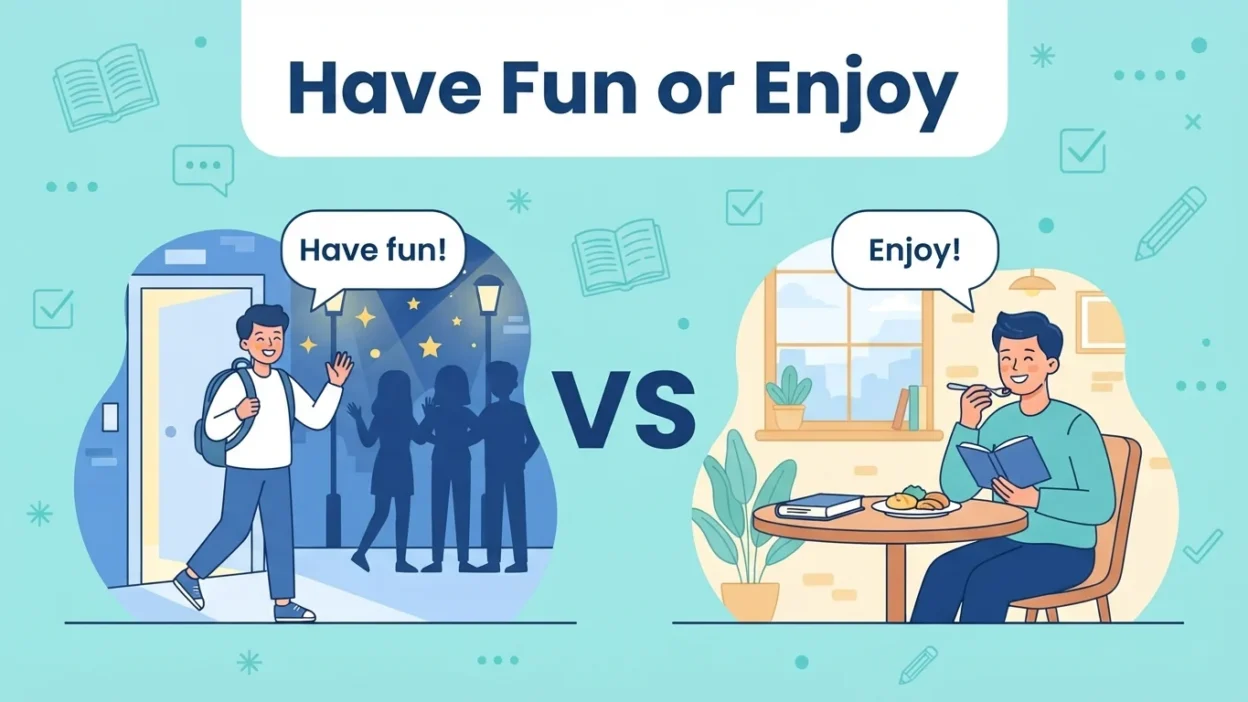
The difference between have fun and enjoy is simple:
- Have fun is usually a wish or encouragement. It means “I hope you have a good time.”
- Enjoy tells someone to take pleasure in something specific, such as a meal, trip, movie, or event.
Examples:
- ✅ Have fun at the party!
- ✅ Enjoy your meal.
- ✅ Have fun on your vacation.
- ✅ Enjoy the concert.
Although both express positive feelings, they are used in different ways depending on the situation.
What Does “Have Fun” Mean?
The phrase have fun means to experience enjoyment, amusement, or happiness while doing an activity. It is commonly used before someone starts an event or activity as a friendly wish.
People often say it before someone leaves for:
- A vacation
- A party
- A trip
- A game
- A concert
- School events
- Holidays
Examples
- Have fun at the beach.
- Have fun with your friends.
- Have fun during your vacation.
- Have fun playing soccer.
- I hope you have fun tonight.
In everyday English, this expression sounds warm, casual, and encouraging.
What Does “Enjoy” Mean?
The verb enjoy means to take pleasure in something. Unlike have fun, it usually needs an object.
You enjoy:
- food
- music
- books
- movies
- experiences
- hobbies
- travel
Examples
- Enjoy your lunch.
- Enjoy the movie.
- I really enjoy reading.
- She enjoys cooking.
- They enjoyed their holiday.
Notice that enjoy normally answers the question: Enjoy what?
Have Fun vs Enjoy: The Main Difference
Although both expressions involve happiness, they serve different purposes.
| Have Fun | Enjoy |
| Usually a wish | Usually describes pleasure |
| Often used before an activity | Refers to enjoying something specific |
| Informal and encouraging | Works in both formal and informal English |
| Doesn’t usually require an object | Usually requires an object |
| Focuses on having a good time | Focuses on appreciating or liking something |
When Should You Use “Have Fun”?
Use have fun when encouraging someone before they begin an activity.
Common situations include:
- Going on vacation
- Attending a party
- Visiting friends
- Playing sports
- Traveling
- Celebrating birthdays
- Going to an amusement park
Examples
- Have fun on your trip!
- Have fun at school.
- Have fun skiing.
- Have fun at the wedding.
- Have fun with your family.
Native speakers use this phrase naturally because it feels friendly and supportive.
When Should You Use “Enjoy”?
Use enjoy when talking about something someone can appreciate or experience.
Examples include:
- Enjoy your coffee.
- Enjoy the concert.
- Enjoy your weekend.
- Enjoy the sunshine.
- Enjoy your stay.
- Enjoy the view.
- Enjoy your flight.
You can also use enjoy to describe personal preferences.
Examples:
- I enjoy swimming.
- She enjoys painting.
- We enjoy learning English.
Can You Use Them Together?
Yes.
Sometimes both expressions work in the same conversation, but they express slightly different ideas.
Example:
Have fun at Disneyland, and enjoy every ride!
Here:
- Have fun wishes someone a good overall experience.
- Enjoy focuses on each attraction.
Common Mistakes to Avoid
Many English learners make small mistakes with these expressions.
1. Saying “Enjoy!” without context
While native speakers sometimes simply say Enjoy!, it usually works when the object is obvious.
Correct:
- Enjoy!
- Enjoy your meal.
- Enjoy your vacation.
2. Using “Have Fun” with objects incorrectly
Incorrect:
- Have fun your meal.
Correct:
- Enjoy your meal.
3. Using “Enjoy” Without an Object
Incorrect:
- I enjoy.
Correct:
- I enjoy hiking.
- I enjoy reading.
- I enjoy music.
4. Replacing Every “Enjoy” with “Have Fun”
Not everything is about having fun.
Correct:
- Enjoy your coffee.
- Enjoy the book.
Not:
- Have fun your coffee.
Everyday Examples
At Work
- Have fun at the team-building event.
- Enjoy your presentation.
At School
- Have fun during the school trip.
- Enjoy your new class.
Traveling
- Have fun in Paris.
- Enjoy your flight.
- Enjoy your hotel stay.
Dining
- Enjoy your dinner.
- Enjoy dessert.
Entertainment
- Have fun at the festival.
- Enjoy the movie.
Have Fun or Enjoy in Professional English
Both expressions appear in professional conversations.
Examples:
- Enjoy your conference.
- Enjoy the training session.
- Have fun at the company retreat.
- Enjoy your well-deserved vacation.
In emails, Enjoy your weekend is especially common.
American vs British English
There is very little difference between American and British English regarding have fun and enjoy.
Both varieties use them naturally.
Some slight tendencies include:
American English
- Have fun!
- Enjoy your vacation!
- Enjoy your meal!
British English
- Have fun!
- Enjoy your holiday!
- Enjoy your meal!
The main vocabulary difference is:
- American English: vacation
- British English: holiday
The expressions themselves remain the same.
Synonyms and Related Expressions
Depending on the context, you may also hear:
- Have a great time
- Have a wonderful time
- Enjoy yourself
- Take pleasure in
- Appreciate
- Delight in
- Make the most of
- Have an amazing day
- Have a good one
- Hope you enjoy it
These alternatives help make your English sound more natural.
Tips to Remember the Difference
A simple trick is:
Have Fun = Activity
Examples:
- Have fun skiing.
- Have fun camping.
- Have fun dancing.
Enjoy = Something Specific
Examples:
- Enjoy the music.
- Enjoy the food.
- Enjoy the weather.
- Enjoy your book.
Remembering this simple rule can help you choose the right phrase instantly.
Why English Learners Get Confused
The confusion happens because both expressions involve positive feelings.
Many languages use only one word for both ideas, so learners naturally translate directly into English.
Instead of translating, think about the situation:
- Are you wishing someone a good time? → Have fun
- Are you talking about taking pleasure in something? → Enjoy
This small habit quickly improves your fluency.
FAQs
Is it correct to say “Have fun”?
Yes. It is one of the most common and natural English expressions for wishing someone a good time.
Can I say “Enjoy” instead of “Have fun”?
Sometimes. If you’re referring to a specific thing, enjoy is usually the better choice.
Is “Enjoy your day” correct?
Yes. It is polite, natural, and commonly used in both spoken and written English.
Why does “Enjoy” usually need an object?
Because enjoy is a transitive verb that normally acts on something, such as a meal, book, trip, or activity.
Can I say “Enjoy yourself”?
Absolutely. It means nearly the same as have fun and is commonly used in formal and informal situations.
Which expression is more formal?
Enjoy is slightly more versatile and works well in professional settings, while have fun sounds more casual and conversational.
Do native English speakers use both expressions?
Yes. Both are extremely common and are used every day in conversations, emails, and messages.
Summary
Choosing between have fun or enjoy becomes easy once you understand their purpose. Have fun is mainly used to wish someone an enjoyable experience before an activity begins, while enjoy expresses taking pleasure in something specific. Although they share a positive meaning, each fits different situations and helps your English sound more natural.
The best way to master these expressions is through regular practice. Listen to native speakers, read authentic English content, and create your own example sentences. Over time, you’ll instinctively know whether have fun or enjoy is the better choice, making your spoken and written English more fluent and confident.
Actionable Takeaway
Before choosing between have fun and enjoy, ask yourself one simple question: Am I wishing someone a good time, or am I talking about enjoying something specific? If it’s a wish, use have fun. If it’s about taking pleasure in something, use enjoy. Practice this rule in your daily conversations, emails, and writing, and you’ll soon use both expressions naturally like a native speaker.