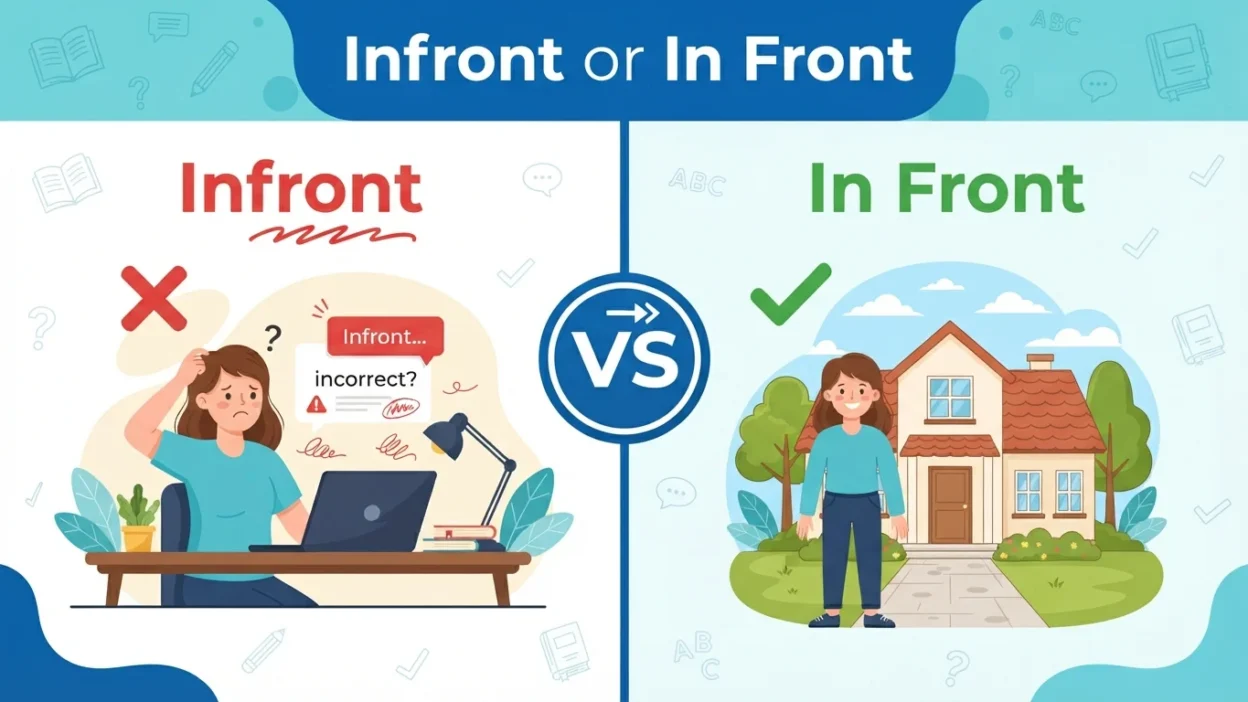
Choosing between infront or in front is easy once you learn the correct spelling rule and understand how native English uses the expression.
The phrase in front is the correct spelling form in the English language because it indicates a position or location relative to the front side of something. If you are deciding between infront or in front, remember that the two-word form follows standard usage.
On the other hand, infront is an incorrect spelling mistake that is frequently used in informal contexts, but it does not conform to British or American grammar rules. From my editing experience, this is one of the most common writing errors because people often type the words together without noticing.
To better understand the differences, it helps to explore why the incorrect version appears so often in everyday communication. Once you recognize the correct pattern, choosing in front instead of infront becomes much easier.
Quick Answer
The correct form is in front (two words).
- ✅ In front is the correct English phrase that refers to a position before or ahead of someone or something.
- ❌ Infront (one word) is a spelling mistake and is not accepted in standard English.
Examples:
- ✅ The car is parked in front of the house.
- ✅ She stood in front of the classroom.
- ❌ The car is parked infront of the house.
Whenever you describe location or position, always write in front as two separate words.
What Does “In Front” Mean?
In front is a prepositional phrase that describes the position of a person or object ahead of another person, place, or thing.
It answers questions like:
- Where is it?
- What is ahead?
- Who is standing before someone?
The phrase is commonly used in both spoken and written English.
Examples
- The bus stopped in front of the school.
- She stood in front of the mirror.
- Please wait in front of the building.
- A beautiful garden is in front of our house.
- The teacher is standing in front of the class.
The phrase always appears as two separate words.
Is “Infront” a Real Word?
No.
Infront is not recognized as a standard English word by major dictionaries or style guides.
It often appears because:
- people type quickly
- autocorrect sometimes misses it
- social media encourages informal spelling
- many learners assume it should be one word
Even though you may see infront online, it should be avoided in formal and professional writing.
Infront vs In Front Comparison
| Infront | In Front |
| Incorrect spelling | Correct spelling |
| Not accepted in standard English | Standard English phrase |
| Common typing mistake | Used in formal and informal writing |
| Not found in major dictionaries | Found in all English dictionaries |
| Should be avoided | Always recommended |
Why Do People Write “Infront”?
There are several reasons why this spelling mistake is so common.
1. Fast Typing
People often combine short words when typing quickly.
2. Similar Compound Words
English has many compound words, such as:
- inside
- outside
- into
- within
This makes writers believe infront should also be one word.
3. Social Media Habits
Informal writing on social media often ignores grammar and spacing rules.
4. Lack of Proofreading
Without reviewing your writing, small spacing mistakes can go unnoticed.
How to Remember the Correct Form
A simple trick is to think of in front of.
Examples:
- in front of the house
- in front of the door
- in front of me
- in front of everyone
Since front follows the preposition in, they remain separate words.
Whenever you’re unsure, remember:
In front = two words
Examples in Everyday English
At Home
- The bike is in front of the garage.
- The dog is sleeping in front of the fireplace.
At School
- She sits in front of me.
- The teacher stood in front of the whiteboard.
At Work
- Meet me in front of the office.
- Our company logo is displayed in front of the building.
Traveling
- The taxi stopped in front of the hotel.
- We took a photo in front of the museum.
Sports
- The goalkeeper stood in front of the goal.
- Fans gathered in front of the stadium.
Common Mistakes to Avoid
Many learners make the same mistakes.
Mistake 1: Writing “Infront”
❌ I stood infront of the door.
✅ I stood in front of the door.
Mistake 2: Confusing “In Front” with “Before”
Sometimes both expressions work, but not always.
Before often refers to time.
- I arrived before noon.
In front refers to location.
- I stood in front of the store.
Mistake 3: Omitting “Of”
Usually, in front is followed by of.
Correct:
- In front of the house.
Less common:
- Stand in front.
Both are correct depending on the sentence.
In Front vs Opposite
These expressions have different meanings.
In front of
The object is directly ahead.
Example:
- The tree is in front of the house.
Opposite
The object faces another object from across.
Example:
- The bank is opposite the hospital.
Understanding this difference improves accuracy.
American vs British English
Good news—there is no spelling difference.
Both American English and British English use:
- ✅ in front
Neither variety accepts:
- ❌ infront
Only vocabulary around the phrase may change.
For example:
American English
- Stand in front of the apartment.
British English
- Stand in front of the flat.
The phrase itself stays exactly the same.
Synonyms and Related Expressions
Depending on the sentence, you might also use:
- ahead of
- before
- facing
- at the front
- in the foreground
- directly ahead
- preceding
- before someone
- opposite (in different contexts)
Choosing the right expression depends on the meaning you want.
Tips for Better Writing
Professional editors often recommend these habits:
- Read your sentence aloud.
- Check spacing carefully.
- Use spell-check tools.
- Practice common English phrases.
- Read quality English books and articles.
- Remember that in front always has a space.
These simple habits prevent repeated spelling mistakes.
Why This Mistake Matters
Small grammar and spelling mistakes affect how readers see your writing.
Whether you’re writing:
- emails
- resumes
- reports
- essays
- blog posts
- business messages
using in front correctly shows attention to detail and professionalism.
FAQs
Is “infront” ever correct?
No. It is considered a spelling mistake in standard English.
Why is “in front” two words?
Because it is a prepositional phrase made up of the preposition in and the noun front.
Can I use “infront” in informal writing?
You may see it online, but it is still incorrect. It’s best to avoid it everywhere.
Is “in front of” grammatically correct?
Yes. It is the most common and correct form.
Do British and American English spell it differently?
No. Both use in front.
Is “front” a noun?
Yes. In the phrase in front, front functions as a noun referring to the forward part of something.
How can I remember the correct spelling?
Always think:
In front of
If you naturally say of, you’ll remember to keep in and front separate.
Summary
When deciding between infront or in front, the correct choice is always in front. Although infront appears frequently online and in casual messages, it is not accepted in standard English. Using the correct two-word phrase makes your writing clearer, more professional, and grammatically accurate.
The easiest way to avoid this mistake is to remember the complete expression in front of. Since the phrase naturally contains separate words, you’ll quickly build the habit of writing it correctly in emails, assignments, articles, and everyday conversations.
Actionable Takeaway
Whenever you’re unsure whether to write infront or in front, pause and ask yourself if you’re describing a location. If the answer is yes, write in front as two words. Save this rule, practice it with a few example sentences, and you’ll avoid this common spelling mistake for good.