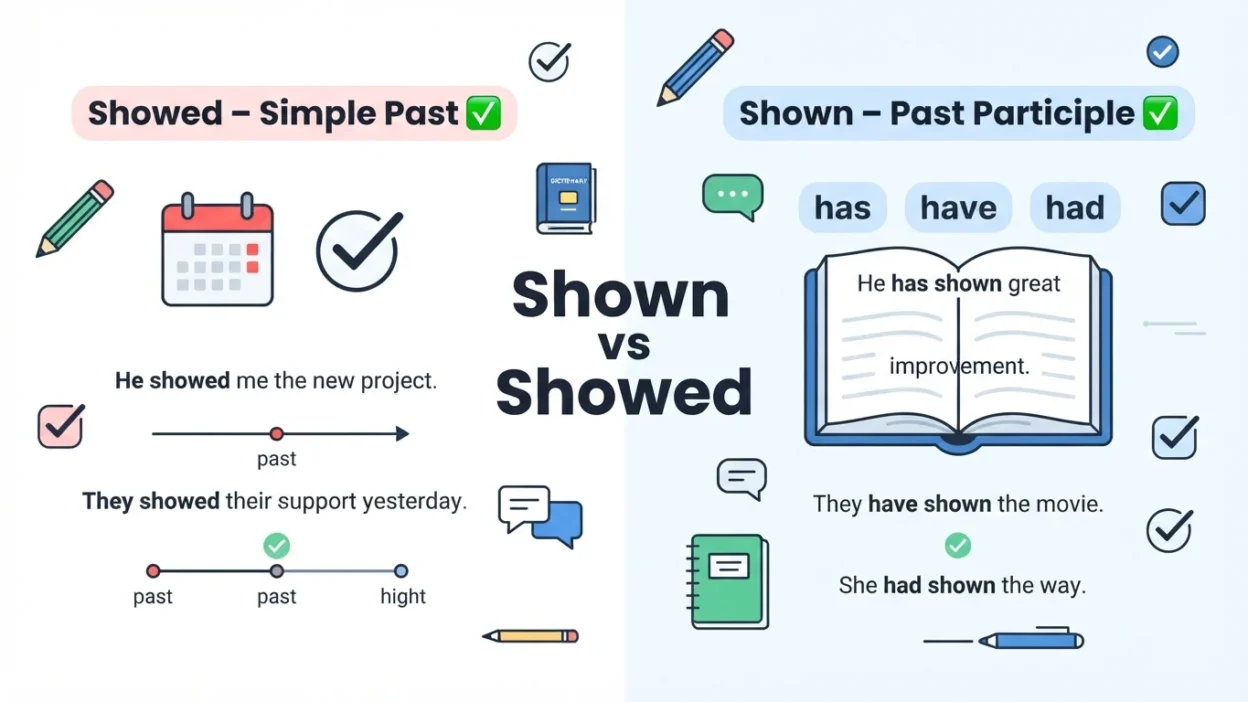
When learning Shown vs Showed, many people confuse these verb forms, but the difference is simple. The verb show changes to showed in the simple past or past form when talking about finished actions, a completed action, or any past time. The quick takeaway is that you use showed alone when no helping verbs, helper verbs, or helpers come before it. From my experience teaching English grammar, remembering this one rule makes everyday writing much easier.
The word shown is the past participle, so it always works with has, have, or had, which are auxiliary verbs. These words help build the correct tense, while showed stands by itself in the simple tense. If you have used both forms in your writing, checking whether a helper comes before the participle is an easy way to choose the correct word.
Both forms describe an action or actions, but they have different jobs in grammar. Understanding how shown and showed work helps you master English grammar and use these verb forms naturally in speaking and writing.
Quick Answer
The difference between shown vs showed is simple:
- Showed is the simple past tense of show.
- Shown is the past participle and must be used with a helping verb such as has, have, had, is, was, were, be, been, or being.
Correct examples:
- ✅ She showed me her new phone yesterday.
- ✅ She has shown me her new phone before.
- ❌ She shown me her new phone yesterday.
- ❌ She has showed me her new phone.
What Do “Showed” and “Shown” Mean?
Both showed and shown come from the verb show, which means:
- To present something
- To display something
- To let someone see something
- To demonstrate or explain
Although they share the same meaning, they belong to different verb forms.
Showed
Showed is the simple past tense.
Use it when talking about a completed action in the past.
Examples:
- He showed us his artwork.
- The teacher showed the answer yesterday.
- They showed great kindness.
Shown
Shown is the past participle.
It cannot stand alone as the main verb. It always follows a helping verb.
Examples:
- She has shown remarkable improvement.
- The results were shown on the screen.
- I had shown him the correct answer.
Understanding the Difference Between Shown vs Showed
Think of it this way:
- Showed tells what happened.
- Shown works with another verb to complete the sentence.
For example:
Simple Past
- I showed my passport.
Present Perfect
- I have shown my passport.
Past Perfect
- I had shown my passport.
The helping verb changes, but shown stays the same.
Comparison Table: Shown vs Showed
| Feature | Showed | Shown |
| Verb Form | Simple Past | Past Participle |
| Can Stand Alone? | Yes | No |
| Needs Helping Verb? | No | Yes |
| Used in Perfect Tenses | No | Yes |
| Example | She showed me. | She has shown me. |
When to Use “Showed”
Use showed when describing a completed action in the past.
Examples:
- Dad showed me how to ride a bicycle.
- My friend showed me the way home.
- The guide showed us the museum.
- She showed confidence during the interview.
- They showed excellent teamwork.
In every example, the action happened and finished in the past.
When to Use “Shown”
Use shown with helping verbs.
Common helping verbs include:
- Has
- Have
- Had
- Is
- Was
- Were
- Be
- Been
- Being
Examples:
- The movie has shown excellent reviews.
- I have shown you this document before.
- The pictures were shown during the meeting.
- He had shown interest earlier.
- The evidence was shown in court.
Notice that shown never appears by itself.
Why Do People Confuse These Words?
The confusion usually happens because English contains several irregular verbs.
For example:
- Write → Wrote → Written
- Break → Broke → Broken
- Speak → Spoke → Spoken
- Drive → Drove → Driven
- Show → Showed → Shown
Many learners accidentally replace the past participle with the simple past or vice versa.
Common Mistakes
Here are some mistakes you should avoid.
Incorrect
- ❌ She has showed me.
- ❌ He shown the report yesterday.
- ❌ They have showed us the photos.
- ❌ I shown my teacher the project.
Correct
- ✅ She has shown me.
- ✅ He showed the report yesterday.
- ✅ They have shown us the photos.
- ✅ I showed my teacher the project.
Easy Trick to Remember
Here’s a simple memory tip.
If your sentence contains:
- has
- have
- had
- is
- was
- were
you almost always need shown.
If there is no helping verb and you’re talking about something that already happened, use showed.
Examples:
- Yesterday I showed him the map.
- I have shown him the map many times.
This trick works in almost every situation.
Examples in Everyday English
At School
- The teacher showed us the experiment.
- The teacher has shown us many examples.
At Work
- My manager showed me the new software.
- The results have been shown to the client.
At Home
- Mom showed me the recipe.
- She has shown me how to bake many times.
While Traveling
- The guide showed us the historic building.
- The route had already been shown on the map.
Grammar Rule Behind Shown vs Showed
English verbs often have three main forms:
| Base Verb | Simple Past | Past Participle |
| Show | Showed | Shown |
| Write | Wrote | Written |
| Eat | Ate | Eaten |
| Break | Broke | Broken |
The past participle almost always needs an auxiliary or helping verb.
That is why:
- Showed = Simple Past
- Shown = Past Participle
American vs British English
There is no significant difference between American English and British English when it comes to shown vs showed.
Both varieties follow the same grammar rules:
- Showed is the simple past.
- Shown is the past participle.
Whether you’re writing for readers in the United States, the United Kingdom, Canada, Australia, or elsewhere, these forms remain the same.
Common Synonyms and Related Words
Understanding similar words helps strengthen your grammar.
Related words include:
- display
- present
- demonstrate
- reveal
- illustrate
- exhibit
- indicate
- explain
- prove
- teach
- point out
- uncover
Related grammar terms:
- verb forms
- simple past
- past participle
- helping verbs
- auxiliary verbs
- perfect tense
- English grammar
- irregular verbs
- grammar rules
- sentence structure
These LSI keywords also help clarify the topic and improve your understanding.
Tips to Always Choose the Right Word
Follow these simple tips:
- Identify the helping verb first.
- If there is has, have, or had, use shown.
- If the action simply happened in the past, use showed.
- Read your sentence aloud.
- Practice with common examples.
- Learn verb forms instead of memorizing isolated words.
Over time, choosing the correct form becomes natural.
FAQs
Is “shown” or “showed” correct?
Both are correct, but they are used differently. Showed is the simple past tense, while shown is the past participle.
Can I say “has showed”?
Standard English uses has shown, not has showed.
Why can’t “shown” stand alone?
Because shown is a past participle and requires a helping verb.
Is “showed” an irregular verb?
The verb show is partly irregular. Its simple past is showed, while its past participle is shown.
Is there a difference between American and British English?
No. Both use showed and shown in exactly the same way.
Which is more common: “shown” or “showed”?
Both are common because they serve different grammar functions. Showed appears in simple past sentences, while shown is frequent in perfect and passive constructions.
Can “shown” be used in passive voice?
Yes. For example:
- The results were shown on the screen.
How can I remember the difference?
Remember this simple rule:
No helper = showed.
Helper verb = shown.
Summary
Understanding shown vs showed becomes much easier when you remember their roles in English grammar. Showed is the simple past tense used for actions that happened and finished in the past, while shown is the past participle that must be paired with a helping verb. This distinction is consistent across both American and British English, making it a reliable rule for every English learner.
The next time you write, look for a helping verb before choosing between these two forms. If your sentence includes words like has, have, or had, use shown. If you’re simply describing a completed past action, use showed. Practicing with everyday examples will help you master this grammar point and write with greater confidence.
Actionable Takeaway: Before finalizing any sentence, check whether it contains a helping verb. This quick habit will help you choose shown or showed correctly every time and improve the accuracy of your English writing.