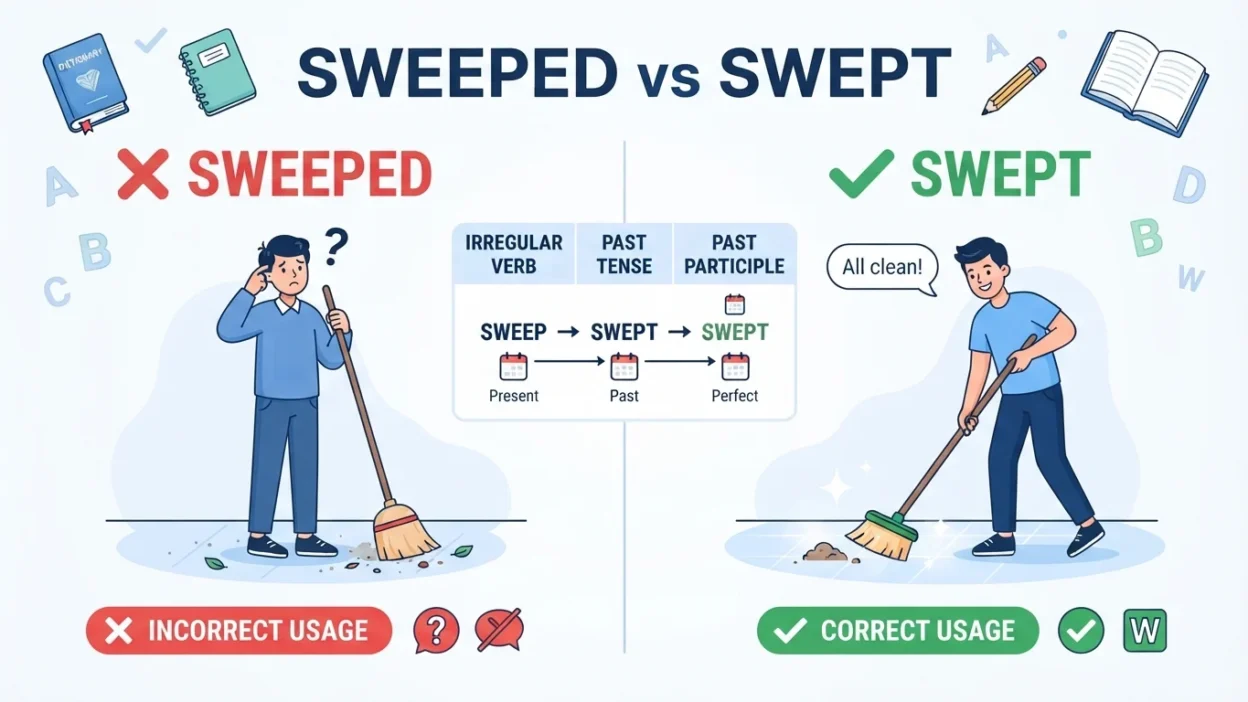
Learning sweeped vs swept becomes much easier when you understand one grammar rule, helping you avoid common mistakes in everyday English writing. Many learners, native speakers, and other people become confused because these two words sound alike. I once typed “sweeped the floor” in a quick message and already realized it felt wrong, so I took a pause because it sounded strange. This common doubt often happens, especially while studying English grammar.
Most verbs follow the usual rule of adding -ed, so walk becomes walked and clean becomes cleaned. However, sweep is an irregular verb, making swept the correct past tense and participle form, not sweeped. From my experience, understanding these verb forms improves your grammar, spelling, usage, and makes your writing much stronger.
Quick Answer
The correct past tense and past participle of sweep is swept.
- ✅ Swept = Correct
- ❌ Sweeped = Incorrect in standard English
Examples:
- ✅ She swept the kitchen yesterday.
- ✅ He has swept the floor already.
- ❌ She sweeped the kitchen yesterday.
- ❌ He has sweeped the floor.
What Does “Sweep” Mean?
The verb sweep means to clean a surface by removing dirt, dust, or debris using a broom, brush, or similar tool.
It can also have figurative meanings, such as:
- To move quickly across an area
- To win everything in a competition
- To spread across a place
Examples
- Please sweep the floor.
- The wind swept through the valley.
- Our team swept the championship series.
- She swept the leaves from the garden.
Is “Sweeped” a Real Word?
Many learners naturally assume the past tense of sweep should be sweeped, just as:
- Walk → Walked
- Clean → Cleaned
- Wash → Washed
However, English contains many irregular verbs that do not follow this pattern.
The correct forms are:
- Base Verb: Sweep
- Simple Past: Swept
- Past Participle: Swept
Because of this, sweeped is considered incorrect in standard English.
Why Is “Swept” Correct?
The verb sweep belongs to the group of irregular verbs.
Irregular verbs change their forms differently from regular verbs.
Examples include:
| Base Verb | Past Tense | Past Participle |
| Sweep | Swept | Swept |
| Keep | Kept | Kept |
| Sleep | Slept | Slept |
| Leave | Left | Left |
| Feel | Felt | Felt |
Notice how these verbs change their spelling instead of simply adding -ed.
Sweeped vs Swept: Side-by-Side Comparison
| Feature | Sweeped | Swept |
| Standard English | ❌ No | ✅ Yes |
| Past Tense | ❌ No | ✅ Yes |
| Past Participle | ❌ No | ✅ Yes |
| Used in Formal Writing | ❌ No | ✅ Yes |
| Dictionary Accepted | ❌ No | ✅ Yes |
The comparison clearly shows that swept is the only correct form in modern English.
When to Use “Swept”
Use swept whenever you’re referring to the past tense or past participle of sweep.
Past Tense Examples
- She swept the floor this morning.
- We swept the garage yesterday.
- They swept the sidewalk before sunrise.
- The janitor swept every classroom.
Past Participle Examples
- She has swept the kitchen already.
- They had swept the porch before guests arrived.
- The streets were swept after the parade.
- He has swept away all the leaves.
Common Mistakes
Many English learners make predictable errors.
Incorrect
- ❌ I sweeped my room.
- ❌ She has sweeped the floor.
- ❌ They sweeped the yard yesterday.
- ❌ We have sweeped the hallway.
Correct
- ✅ I swept my room.
- ✅ She has swept the floor.
- ✅ They swept the yard yesterday.
- ✅ We have swept the hallway.
Why Do People Say “Sweeped”?
The mistake happens because English learners often apply the regular verb rule.
Examples:
- Jump → Jumped
- Cook → Cooked
- Paint → Painted
Naturally, they assume:
- Sweep → Sweeped
Unfortunately, English irregular verbs don’t always follow predictable patterns.
That’s why memorizing irregular verbs is so helpful.
Easy Memory Trick
Here’s an easy way to remember it.
Think about these words:
- Keep → Kept
- Sleep → Slept
- Sweep → Swept
Notice the pattern?
The ending changes to -ept, not -eed.
This simple association makes the correct form much easier to remember.
Everyday Examples
At Home
- Dad swept the driveway.
- Mom has swept the kitchen.
At School
- The custodian swept the hallway.
- The classroom had been swept before students arrived.
At Work
- The cleaner swept the office.
- The warehouse was swept every evening.
Figurative Meaning
- The news swept across the country.
- The team swept the entire tournament.
In every example, swept is the correct choice.
Grammar Rule Behind Sweeped vs Swept
English verbs typically fall into two categories:
Regular Verbs
These simply add -ed.
Examples:
- Walk → Walked
- Wash → Washed
- Clean → Cleaned
Irregular Verbs
These change differently.
Examples:
- Sweep → Swept
- Sleep → Slept
- Keep → Kept
- Feel → Felt
Since sweep is irregular, it never becomes sweeped.
American vs British English
There is no difference between American English and British English regarding sweeped vs swept.
Both varieties use:
- ✅ Swept
Neither recognizes sweeped as the standard past tense or past participle.
Whether you’re writing for readers in the United States, the United Kingdom, Australia, Canada, or elsewhere, swept is always the correct choice.
Related Words
Here are related grammar terms and vocabulary that strengthen your understanding:
- irregular verbs
- past tense
- past participle
- verb forms
- English grammar
- grammar rules
- spelling mistakes
- confusing words
- English vocabulary
- sentence examples
- verb conjugation
- language learning
- proofreading
- grammar tips
- common English mistakes
- writing skills
- grammar checker
- correct usage
- clean
- broom
These LSI keywords help reinforce the topic while improving topical relevance.
Tips to Avoid This Mistake
Use these simple habits:
- Learn common irregular verbs.
- Practice writing sentences daily.
- Read English books regularly.
- Use grammar-checking tools.
- Remember keep → kept → sweep → swept.
- Proofread before sending important writing.
Soon you’ll naturally choose swept without thinking.
FAQs
Is “sweeped” ever correct?
No. Standard English uses swept as both the past tense and past participle of sweep.
Why isn’t “sweeped” correct?
Because sweep is an irregular verb and doesn’t follow the normal -ed rule.
What is the past tense of sweep?
The past tense is swept.
What is the past participle of sweep?
The past participle is also swept.
Is “swept” used in passive voice?
Yes.
Example:
- The floor was swept before dinner.
Is there any difference between American and British English?
No. Both use swept and reject sweeped.
How can I remember the correct form?
Think:
- Keep → Kept
- Sleep → Slept
- Sweep → Swept
The pattern makes it easy to remember.
Why do learners often write “sweeped”?
Because many regular verbs form the past tense by adding -ed, and learners mistakenly apply that rule to sweep.
Summary
Understanding sweeped vs swept is much easier once you know that sweep is an irregular verb. While many English verbs form the past tense by adding -ed, sweep changes to swept in both the simple past and past participle. The form sweeped is not accepted in standard English and should be avoided in both formal and informal writing.
Whenever you’re unsure, remember the pattern shared by keep → kept, sleep → slept, and sweep → swept. Recognizing this group of irregular verbs will make your writing more accurate and natural. With a little practice, you’ll automatically choose swept every time.
Actionable Takeaway
Before using the past tense of sweep, ask yourself whether it’s an irregular verb. If it is, choose swept, not sweeped. Practicing this simple habit will improve your grammar and help you avoid one of the most common verb mistakes.