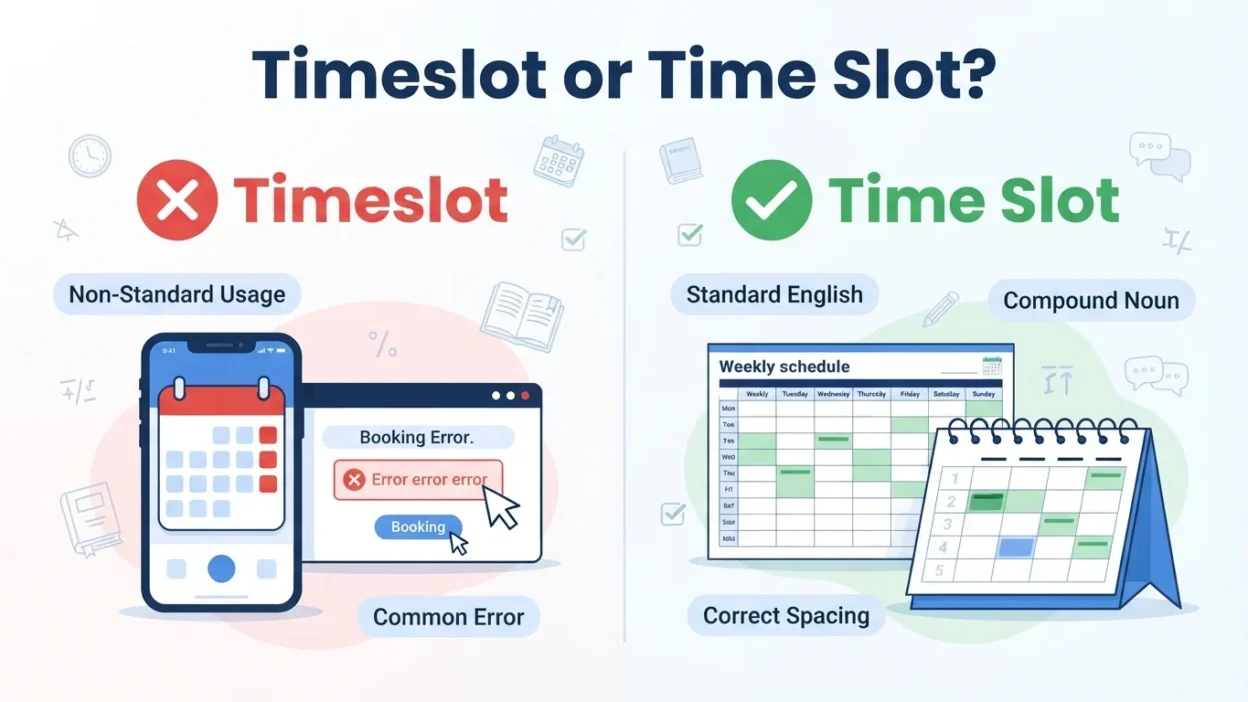
Understanding timeslot or time slot is easier than it seems once you know the standard grammar rule and apply it in everyday writing correctly. If you’ve ever paused while writing, you’re not alone. The choice between timeslot and time slot often creates a spacing issue and confusion. From my experience, this mistake appears in booking apps, emails, blogs, schedules, and professional documents, where both versions look reasonable, but only one follows standard English.
This guide explains the rule in simple language to help you learn the correct form with ease. In most cases, time slot is the preferred spelling, while timeslot keeps showing up even though it is usually wrong in formal writing. A hyphen only makes sense in certain compound modifiers, depending on the sentence.
Once you understand this small difference, you’ll write with greater confidence and clarity in every situation.
Quick Answer
The correct form in standard English is:
- ✅ Time slot (preferred)
- ❌ Timeslot (generally nonstandard or less widely accepted)
Examples:
- ✅ Please choose a time slot for your appointment.
- ✅ We have one available time slot left.
- ❌ Please choose a timeslot for your appointment. (Less preferred in standard English.)
Some companies and software platforms use timeslot as a branding or stylistic choice, but time slot remains the safer option for formal writing.
What Does “Time Slot” Mean?
A time slot is a specific period of time reserved for a particular activity, event, appointment, meeting, or broadcast.
It helps organize schedules by assigning activities to fixed periods.
Examples
- Book a time slot for your interview.
- The doctor has an available time slot at 3 p.m.
- Each speaker receives a 20-minute time slot.
- Choose your preferred time slot online.
- The television time slot changed this week.
Whether you’re scheduling meetings or booking services, time slot is the standard expression.
Why Is “Time Slot” Written as Two Words?
The phrase combines two separate nouns:
- Time
- Slot
Together, they create a compound noun.
Many English compound nouns begin as two words before some eventually become one word over time. However, time slot has remained the preferred open compound in most dictionaries and editorial style guides.
Is “Timeslot” Wrong?
Not always—but it isn’t generally the preferred spelling.
You’ll often see timeslot in:
- Booking software
- Mobile apps
- Online calendars
- Company websites
- Product interfaces
Many technology companies shorten compound words for branding or design consistency. However, for professional writing, academic work, business communication, and most published content, time slot is still the recommended choice.
Timeslot or Time Slot: Comparison Table
| Feature | Timeslot | Time Slot |
| Standard English | ❌ Less preferred | ✅ Preferred |
| Dictionary Acceptance | Limited | Widely accepted |
| Professional Writing | Rare | Recommended |
| Business Emails | Avoid | Preferred |
| Academic Writing | Avoid | Recommended |
| Common in Apps | Yes | Yes |
If you’re unsure which version to use, time slot is almost always the safest option.
When Should You Use “Time Slot”?
Use time slot whenever you’re referring to a scheduled period of time.
Examples
- Reserve your time slot online.
- Every patient receives a separate time slot.
- We selected the afternoon time slot.
- The conference has multiple time slots available.
- Please arrive before your assigned time slot.
This form works well in formal and informal writing.
Can “Timeslot” Ever Be Acceptable?
Yes, but mainly in informal or branded contexts.
Examples include:
- Software interfaces
- Booking systems
- Mobile applications
- Internal company terminology
- Product names
If a company consistently uses timeslot in its interface, it’s usually following its own style preference rather than standard grammar rules.
What About “Time-Slot”?
Sometimes you’ll see the hyphenated form:
- time-slot
This version usually appears when the phrase functions as a compound modifier before another noun.
Example:
- A time-slot booking system.
However, many modern style guides also accept:
- time slot booking system
When time slot stands alone as a noun, the open form is generally preferred.
Common Mistakes
Here are mistakes many writers make.
Incorrect
- ❌ Choose a timeslot for your meeting.
- ❌ I need another timeslot tomorrow.
- ❌ Every timeslot is full.
Better
- ✅ Choose a time slot for your meeting.
- ✅ I need another time slot tomorrow.
- ✅ Every time slot is full.
Easy Memory Trick
Here’s a simple way to remember it.
Think of similar compound nouns:
- parking lot
- dining room
- post office
- living room
Just as these remain separate words, time slot is usually written as two words.
Whenever you’re unsure, separate them.
Real-Life Examples
Booking App
- Please select your preferred time slot.
Hospital
- Your appointment time slot is 2:30 p.m.
School
- Students must choose a presentation time slot.
Television
- The show moved to a new time slot.
Business
- Every interview has a fixed time slot.
Why Do People Write “Timeslot”?
There are several reasons:
- Mobile apps save space.
- Software developers often combine compound words.
- Brand guidelines vary.
- Search habits influence spelling.
- Some websites ignore traditional style rules.
Although timeslot appears frequently online, frequency does not always equal correctness.
American vs British English
There is no major difference between American English and British English regarding time slot.
Both varieties generally prefer:
- ✅ Time slot
The closed form timeslot appears occasionally in both, especially in software, scheduling tools, and marketing materials, but it is not the standard choice in either variety.
Related Words
To strengthen your understanding, here are related words and phrases:
- appointment
- booking
- schedule
- scheduling
- calendar
- reservation
- availability
- meeting
- interview
- event planning
- timetable
- session
- slot
- broadcast schedule
- planning
- time management
- calendar event
- business communication
- compound nouns
- English grammar
- spacing
- word choice
- writing tips
- professional writing
These LSI keywords improve topical understanding and naturally support the main keyword.
Tips to Always Choose the Right Form
Use these practical tips:
- Remember that time slot is usually two words.
- Check your company’s style guide.
- Follow dictionary recommendations.
- Proofread before publishing.
- Keep compound nouns consistent.
- Use grammar-checking tools when necessary.
These habits will help you write with greater accuracy and professionalism.
FAQs
Which is correct: “timeslot” or “time slot”?
Time slot is the preferred spelling in standard English.
Is “timeslot” a real word?
It appears in some software, websites, and branding, but time slot is more widely accepted in formal writing.
Why do apps use “timeslot”?
Many apps combine compound words for design, branding, or interface consistency.
Should I write “for this timeslot”?
In formal English, it’s better to write:
for this time slot
Is “time-slot” correct?
Sometimes. It may be used as a compound modifier before another noun, although many style guides now prefer the open form.
Do American and British English spell it differently?
No. Both generally prefer time slot.
Is “time slot” one word?
No. In standard English, it is usually written as two separate words.
How can I remember the correct spelling?
Think of other compound nouns like parking lot or living room. If they stay separate, time slot usually does too.
Summary
Understanding timeslot or time slot is straightforward once you know the standard rule. While timeslot appears in apps, booking systems, and some company branding, time slot remains the preferred spelling in dictionaries, professional writing, academic work, and most editorial style guides. Using the open compound ensures your writing looks polished and follows standard English conventions.
Whenever you’re writing emails, creating website content, preparing business documents, or scheduling appointments, choosing time slot is the safest option. By paying attention to spacing and using consistent grammar, you’ll communicate more clearly and professionally.
Actionable Takeaway
The next time you write about scheduling, remember this simple rule: time slot is the standard form. Unless you’re following a company’s branding or interface style, keep the words separate for clear, accurate English.