Choosing between “by which” and “in which” can be confusing, especially because both expressions contain the relative pronoun “which.” The correct choice depends on the relationship you want to describe between the noun and the rest of the sentence. Understanding the preposition makes the difference much easier to remember.
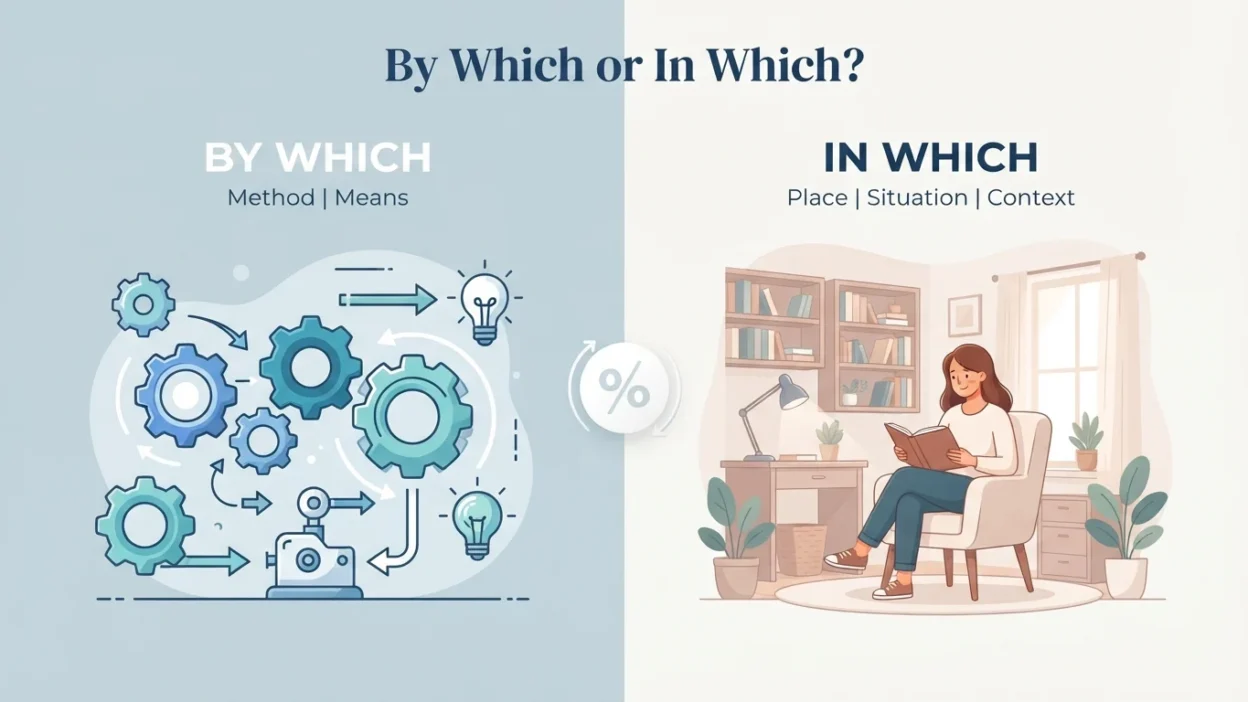
In simple terms, “by which” usually describes a method, means, process, or agent through which something happens. “In which” usually describes something that happens inside a place, situation, period, condition, or context. Once you understand this basic distinction, you can use both expressions naturally in everyday and formal English.
Quick Answer
“By which” is generally used when you mean “through which,” “by means of which,” or “using which.”
“In which” is generally used when you mean “inside which,” “during which,” or “within which.”
| Phrase | Main Meaning | Example |
| By which | By means of, through, using | “The method by which they solved the problem was effective.” |
| In which | Inside, during, within | “The room in which they met was large.” |
Easy rule
- By which = method, means, process, or agent
- In which = place, time, situation, or context
What Does “By Which” Mean?
The phrase “by which” combines the preposition by with the relative pronoun which.
It is commonly used when describing the method, means, process, or mechanism used to achieve something.
For example:
“This is the method by which the machine operates.”
Here, by which means “by means of which” or “through which.”
The sentence explains the method that allows the machine to operate.
Examples of “By Which”
- “They developed a system by which customers can track their orders.”
- “This is the process by which the data is collected.”
- “We need to understand the way by which the decision was made.”
- “The mechanism by which the device works is quite simple.”
- “That is the method by which the company measures success.”
- “She explained the procedure by which applications are reviewed.”
In each example, by which introduces a method, process, or mechanism.
What Does “In Which” Mean?
The phrase “in which” combines in with which. It is generally used to describe something that happens inside a place, during a period, or within a particular situation or condition.
For example:
“This is the room in which we had the meeting.”
Here, in which means “inside which.”
The room is the place where the meeting happened.
Examples of “In Which”
- “This is the house in which I grew up.”
- “She remembers the year in which they met.”
- “That was a situation in which nobody knew what to do.”
- “The company created an environment in which employees could succeed.”
- “We discussed the circumstances in which the accident occurred.”
- “This is the box in which I keep my old photographs.”
In these sentences, in which introduces a place, time, situation, or context.
By Which vs. In Which: The Main Difference
The most important difference is the relationship expressed by the preposition.
By commonly expresses means or method.
In commonly expresses location, time, situation, or circumstances.
Consider these two sentences:
“The process by which the product is made is complicated.”
This focuses on how the product is made.
Now compare:
“The factory in which the product is made is large.”
This focuses on where the product is made.
The noun before which helps you determine the correct preposition.
| Feature | By Which | In Which |
| Basic idea | By means of / through | Inside / during / within |
| Main question | How? By what method? | Where? When? In what situation? |
| Common nouns | method, process, means, mechanism, system | place, room, year, situation, environment |
| Example | “The method by which it works…” | “The room in which it works…” |
| Focus | Method or means | Location, time, or context |
When Should You Use “By Which”?
Use “by which” when the sentence explains how something is done, achieved, measured, created, or controlled.
A useful test is to replace “by which” with “by means of which.”
If the sentence still makes sense, by which is probably appropriate.
Example
“This is the method by which we solve the problem.”
You can expand it:
“This is the method by means of which we solve the problem.”
The meaning remains clear.
Another example:
“The system by which payments are processed has changed.”
The phrase explains the system used to process payments.
When Should You Use “In Which”?
Use “in which” when you are describing where something happens, when something happens, or the situation in which something occurs.
A useful test is to see whether you can replace it with “inside which,” “within which,” or “during which.”
Example: Place
“The building in which she works is old.”
This means:
“The building inside which she works is old.”
Example: Time
“The year in which they married was difficult.”
Here, in which means “during which.”
Example: Situation
“It was a situation in which everyone had to cooperate.”
Here, in which refers to the circumstances or situation.
Examples That Make the Difference Clear
Sometimes comparing two sentences is the easiest way to understand the distinction.
Example 1
“The method by which the problem was solved was effective.”
The sentence focuses on how the problem was solved.
“The environment in which the problem was solved was stressful.”
The sentence focuses on the circumstances or setting.
Example 2
“The system by which the company operates is efficient.”
This refers to the company’s method or system of operation.
“The building in which the company operates is modern.”
This refers to the place where the company operates.
Example 3
“The process by which the information is collected is automated.”
Focus: process or method.
“The database in which the information is stored is secure.”
Focus: place or system containing something.
“By Which” vs. “In Which” in Formal English
Both expressions are especially common in formal and academic English.
You may see them in:
- Academic papers
- Business reports
- Legal writing
- Technical documentation
- Research articles
- Professional communication
- Formal essays
For example:
“The study examines the process by which consumers make purchasing decisions.”
This sounds formal and precise.
Similarly:
“The social environment in which consumers make decisions can influence their behavior.”
These structures allow writers to connect ideas without using several short sentences.
Can You Replace Them With Simpler Words?
Yes. In everyday conversation, speakers often choose simpler alternatives.
Instead of:
“The method by which the machine operates…”
You might say:
“How the machine operates…”
Instead of:
“The house in which she lives…”
You might say:
“The house where she lives…”
This does not mean by which or in which are incorrect or unnecessarily formal. They are useful when you want a precise or more formal sentence structure.
Common Mistakes to Avoid
1. Using “In Which” for a Method
A common mistake is choosing in which when the sentence is actually describing a method.
Incorrect or awkward:
“The method in which the company operates…”
Better:
“The method by which the company operates…”
However, the exact noun and intended meaning matter, so always examine the sentence as a whole.
2. Using “By Which” for a Location
If you are describing a place where something happens, in which is usually the appropriate choice.
For example:
“The room in which the students studied was quiet.”
The room is the location, so in which fits naturally.
3. Confusing “By Which” With “Which”
Removing the preposition can change the meaning or make the sentence grammatically incomplete.
Compare:
“The method by which the machine works…”
with:
“The method which the machine works…”
The second sentence does not communicate the intended relationship correctly.
4. Using “In Which” Automatically After Every Noun
Not every noun requires in which.
For example:
“The process by which the product is created…”
Here, the process describes how, so by which is appropriate.
The best preposition depends on meaning, not simply on the noun.
American vs. British English
There is no major difference between American and British English regarding the basic meanings of “by which” and “in which.” Both varieties use these expressions in essentially the same way.
However, everyday speech in both varieties often prefers simpler alternatives such as:
- how
- where
- when
- that
Formal writing is more likely to retain structures such as by which and in which.
For example:
Formal:
“The process by which the results were obtained…”
More conversational:
“How the results were obtained…”
Similarly:
Formal:
“The period in which the research was conducted…”
More conversational:
“The period when the research was conducted…”
The choice often depends more on formality and sentence style than on American versus British English.
A Simple Trick to Remember
When deciding between by which and in which, ask yourself a question.
Ask “How?”
If the answer is about a method, process, means, or mechanism, use:
BY WHICH
“The process by which it works…”
Ask “Where, when, or in what situation?”
If the answer involves a place, time, environment, condition, or situation, use:
IN WHICH
“The environment in which it works…”
This simple test works in many common situations.
FAQs
What is the difference between “by which” and “in which”?
By which generally describes a method, means, process, or mechanism. In which generally describes a place, time, situation, environment, or context.
Is “by which” grammatically correct?
Yes. By which is a standard grammatical construction, particularly common in formal, academic, technical, and professional English.
Is “in which” grammatically correct?
Yes. In which is also completely grammatical and is commonly used to refer to locations, periods, situations, and circumstances.
Can “by which” mean “through which”?
Yes. In many contexts, by which can mean “through which” or “by means of which.”
For example:
“The method by which the results were obtained…”
can be understood as:
“The method through which the results were obtained…”
Can “in which” mean “where”?
Sometimes, yes. When in which refers to a physical or figurative place, where can often be used instead.
For example:
“The house in which I live…”
and:
“The house where I live…”
are both grammatical.
Is “by which” more formal than “how”?
Usually, by which sounds more formal and precise, while how is often more natural in everyday conversation.
Is “in which” more formal than “where”?
In many contexts, yes. In which is common in formal writing, while where is often more conversational and direct.
Which is correct: “the method by which” or “the method in which”?
“The method by which” is generally the correct choice when you mean the method or means used to do something.
Summary
The choice between “by which” and “in which” becomes much easier when you focus on the prepositions. By which usually describes the method, means, process, or mechanism through which something happens. In which usually describes the place, time, situation, environment, or circumstances where something happens. Both expressions are grammatically correct, but they serve different purposes.
When writing or speaking, remember the simple question test: How? → by which. Where, when, or in what situation? → in which. You can also think of by as showing the means used to achieve something and in as showing the setting or context in which something occurs.