Have you ever wondered whether to say “at the house or in the house” when talking about someone’s location? Both expressions are grammatically correct, but they do not always mean exactly the same thing. The difference mainly depends on whether you are talking about being at a particular home or physically inside it.
Understanding this small distinction can make your English sound more natural and precise. Whether you are writing a message, speaking with friends, or communicating professionally, knowing when to use at the house and in the house will help you choose the right expression with confidence.
Quick Answer
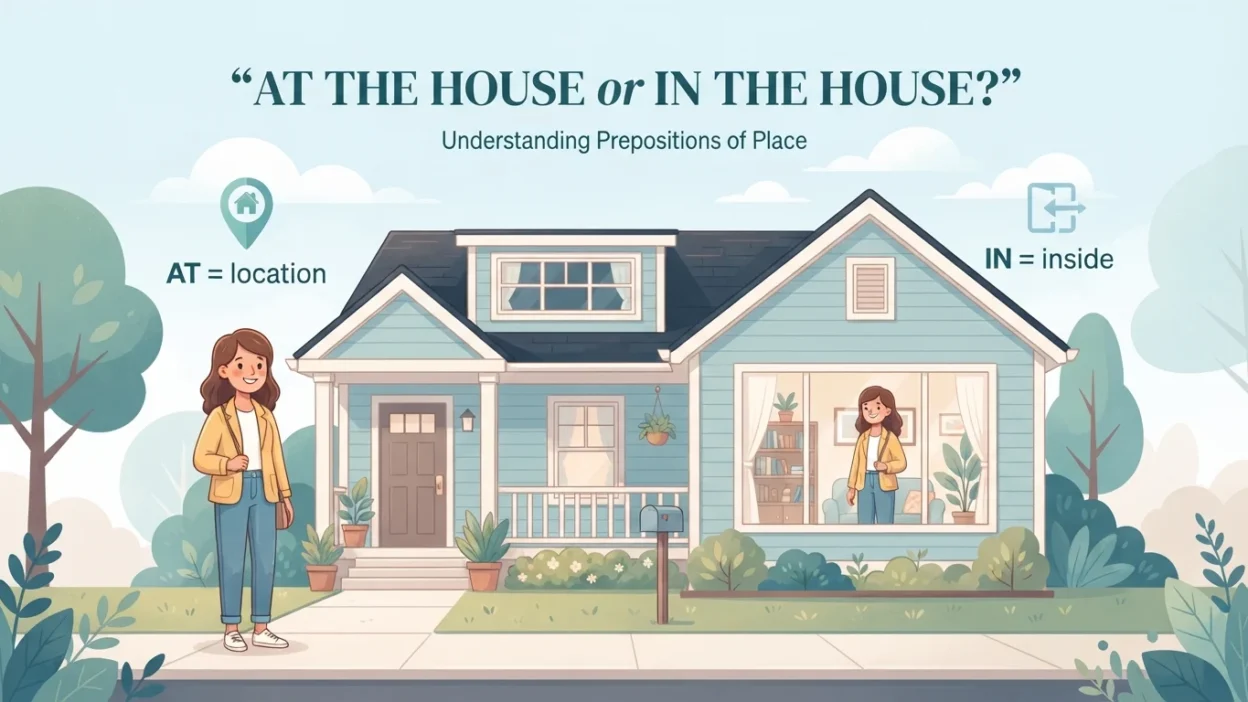
“At the house” usually refers to being at a particular house or property, without specifically saying that the person is inside.
“In the house” means being inside the house, within the building.
- At the house = at the location of the house
- In the house = physically inside the house
For example:
- “I’m at the house.” → I am at that house/property.
- “I’m in the house.” → I am inside the house.
Both are correct. The best choice depends on the meaning you want to communicate.
What Does “At the House” Mean?
The phrase “at the house” uses the preposition at to identify a general location or point. It tells the listener that someone is at a particular house, but it does not necessarily tell us whether that person is inside, outside, in the yard, on the porch, or somewhere else on the property.
For example:
“John is at the house.”
This could mean John is inside the house, standing outside it, working in the garden, or somewhere else around the property.
The important idea is the location, not the exact position inside the building.
Examples of “At the House”
- “I’ll meet you at the house at six.”
- “She is at the house with her family.”
- “Are you at the house right now?”
- “The workers are at the house repairing the roof.”
- “We left the documents at the house.”
- “My brother is staying at the house this weekend.”
In these sentences, at the house focuses on the house as a location or destination.
What Does “In the House” Mean?
The phrase “in the house” is more specific. The preposition in indicates that someone or something is inside an enclosed space.
Therefore, when you say:
“John is in the house.”
you are specifically saying that John is inside the building.
He is not merely somewhere on the property. He is physically within the house.
Examples of “In the House”
- “My children are in the house.”
- “There is someone in the house.”
- “I left my phone in the house.”
- “She is cooking in the house.”
- “It is warmer in the house.”
- “The dog is in the house.”
Here, in emphasizes the interior of the house.
At the House vs. In the House: Key Difference
The easiest way to remember the difference is to think about location versus interior.
| Expression | Basic Meaning | Main Focus | Example |
| At the house | At the house/property | General location | “I’m at the house.” |
| In the house | Inside the house | Interior location | “I’m in the house.” |
| At my house | At my home/property | Location | “Come over at my house.”* |
| In my house | Inside my home | Interior | “There is a cat in my house.” |
*In standard English, “at my house” is generally preferred over “at my house” when talking about being located at one’s home, while “come over to my house” is often the natural choice for an invitation.
When Should You Use “At the House”?
Use “at the house” when you want to talk about the house as a place or location rather than emphasize being physically inside it.
This is especially common when someone is arriving, leaving, waiting, working, or meeting at a house.
Example 1
I’ll be at the house all afternoon.”
This means the speaker will be at the property during the afternoon. They might be inside or outside.
Example 2
“The electrician is at the house.”
The electrician is at the property, but the sentence does not tell us exactly where he is.
Example 3
“Meet me at the house.”
The house is being used as the meeting location.
The person could wait at the front door, driveway, porch, or another nearby spot.
When Should You Use “In the House”?
Use “in the house” when the meaning specifically involves the inside of the building.
This is useful when contrasting inside and outside locations.
Example 1
“It’s raining, so let’s stay in the house.”
The speaker is emphasizing remaining indoors.
Example 2
“My keys are in the house.”
The keys are somewhere inside the building.
Example 3
“Is Sarah in the house?”
The speaker wants to know whether Sarah is physically inside.
This distinction becomes particularly important when the exact location matters.
“At the House” or “In the House” in Everyday Conversation
In everyday English, native speakers choose between these expressions naturally depending on context.
Imagine your friend asks:
“Where are you?”
You could answer:
“I’m at the house.”
This gives a general location.
But if your friend is looking for you outside and asks:
“Are you in the house?”
you might answer:
“Yes, I’m in the house.”
Here, the question specifically concerns whether you are indoors.
Another useful example is:
“I’ll wait for you at the house.”
This means the house is the meeting point.
However:
“I’ll wait for you in the house.”
means you will wait inside the house.
The difference is subtle but meaningful.
At the House vs. At Home
Another common question is whether “at the house” means the same thing as “at home.”
Not always.
At home usually refers to someone’s own home or their normal place of residence.
For example:
- “I’m at home.”
- “She stayed at home today.”
At the house usually identifies a particular house as a location.
For example:
- “I’m at the house.”
- “The contractor is at the house.”
You might say “I’m at the house” when talking about a specific property, such as a family member’s house, a house being renovated, or a house you are visiting.
At the House vs. In the House in American and British English
Both “at the house” and “in the house” are used in both American and British English. The basic distinction between general location and being inside remains the same.
However, there can be differences in preferred expressions depending on context.
American English commonly uses:
- “I’m at the house.”
- “I’m at home.”
- “I’m in the house.”
British English also uses these expressions, although speakers may sometimes choose “at home” or another location phrase depending on the situation.
There is no major American-versus-British grammar rule that makes one of these phrases universally correct and the other incorrect.
The key is still meaning and context.
Common Mistakes to Avoid
1. Assuming “at” Always Means Inside
At does not necessarily mean inside.
Incorrect assumption:
“I’m at the house, so I must be inside.”
Not necessarily. You could be in the driveway or garden.
2. Using “in” for a General Location
If you simply want to identify the house as a meeting point, at is often more appropriate.
For example:
- “Meet me at the house.” ✓
- “Meet me in the house.” ✓ but specifically means inside.
3. Confusing “At Home” and “At the House”
At home and at the house can overlap in meaning, but they are not interchangeable in every situation.
“I am at home” usually identifies your residence.
“I am at the house” identifies a particular house as your location.
4. Thinking One Phrase Is Grammatically Correct and the Other Is Wrong
Both expressions are grammatically correct.
The issue is not usually grammar versus incorrect grammar. It is about choosing the expression that accurately communicates your intended location.
Easy Memory Trick
Here’s a simple way to remember the difference:
AT = location
IN = inside
Think of at as pointing to a place on a map.
Think of in as putting someone or something inside a box.
So:
“I’m at the house.”
→ Think: 📍 house location.
“I’m in the house.”
→ Think: 🏠 person inside.
This simple trick can help you make the right choice quickly.
FAQs
Is “at the house” grammatically correct?
Yes. “At the house” is grammatically correct and commonly used when referring to someone’s location at a particular house or property.
Is “in the house” grammatically correct?
Yes. “In the house” is correct when you mean that someone or something is physically inside the house.
What is the difference between “at the house” and “in the house”?
“At the house” refers to the general location of the house or property, while “in the house” specifically means inside the building.
Should I say “I’m at the house” or “I’m in the house”?
It depends on what you mean. Say “I’m at the house” when you are referring generally to the property. Say “I’m in the house” when you want to emphasize that you are inside.
Does “at the house” mean “at home”?
Not necessarily. “At home” generally refers to your own residence, while “at the house” can refer to any specific house being discussed.
Is “at the house” more common in American English?
It is used in American English, but it is not exclusively American. British English speakers also use “at the house.” The choice depends mainly on context.
Can “at the house” mean outside?
Yes. Someone saying “I’m at the house” could be inside, outside, in the yard, on the porch, or somewhere else on the property.
Which is better: “Meet me at the house” or “Meet me in the house”?
Both can be correct, but they communicate slightly different ideas. “Meet me at the house” identifies the house as the meeting location. “Meet me in the house” specifically tells someone to meet you inside.
Summary
The difference between “at the house or in the house” is mainly about how specific you want to be about someone’s location. At the house refers to being at a particular house or property without necessarily specifying whether you are inside. In the house is more specific and means that someone or something is physically inside the building.
Both phrases are correct in standard English, and neither should automatically be considered a mistake. When you are talking about a general location, at is usually the better choice. When you want to emphasize the interior of the building, choose in. Remembering “at = location” and “in = inside” will make this distinction much easier.
Actionable Takeaway
When you’re unsure which phrase to use, ask yourself one simple question:
Am I talking about the house as a location, or am I talking about being physically inside it?
- General location → at the house
- Inside the building → in the house
- Your own residence → often at home
- Specific interior location → in the house
Once you focus on the intended meaning rather than simply memorizing a grammar rule, choosing between at the house and in the house becomes straightforward.