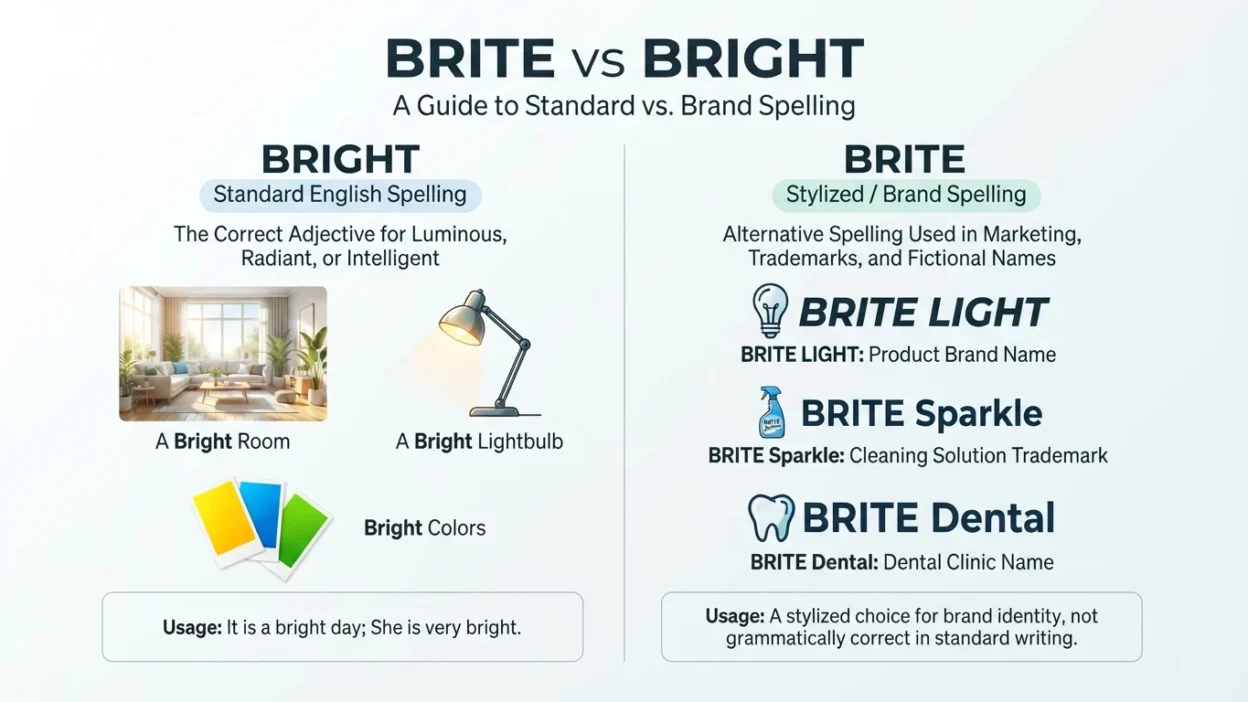
When choosing brite vs bright, remember that bright is the standard spelling in normal English, while brite is often stylized or branded for names, products, or creative purposes. In everyday writing and regular prose, bright is the natural choice. For example, “The bright room looks cheerful” uses the correct spelling for a normal English sentence.
The main difference is usually a change in spelling convention, not a change in meaning or speech. In practical English editing, I would use bright when describing something in ordinary English and reserve brite for a brand, product, or name. A phrase such as Brite Light may therefore be a product name rather than a normal English phrase, with its unusual spelling chosen for style or effect.
When deciding which form to use, consider your purpose and what the word describes. If it appears in ordinary writing, bright is the correct and standard form; if it appears as part of a particular brand or is intentionally selected for naming, brite may be appropriate. This distinction helps explain why brite can be intentional even though bright remains the usual spelling.
Quick Answer: Brite vs Bright
Bright is the standard spelling used in normal English. It can describe something that gives off a lot of light, has a strong or vivid color, is intelligent, or looks cheerful.
Brite is usually a nonstandard or stylized spelling. It is commonly found in brand names, product names, business names, advertising, and creative writing. It may be chosen to make a name look distinctive or memorable.
Examples:
- The room is bright and comfortable.
- She wore a bright yellow dress.
- He is a bright student.
- The product is called Brite Light.
- “Brite” may be part of a company or product name.
So, if you are writing an ordinary English sentence, bright is usually the word you need.
What Does “Bright” Mean?
Bright is a common English adjective with several meanings. Its most familiar meaning relates to light.
For example:
The sun is very bright today.
Here, bright means producing or reflecting a lot of light.
The word can also describe colors that are strong, vivid, or easy to notice:
- She bought a bright red jacket.
- The walls are painted bright blue.
- The flowers have bright colors.
Another common meaning relates to intelligence. If someone is described as bright, it can mean that the person is intelligent or quick to understand things.
For example:
Emma is a bright student who learns quickly.
Bright can also describe a cheerful or hopeful mood:
He gave me a bright smile.
Because of these different meanings, bright is a well-established word in standard English and appears frequently in everyday speech and writing.
What Does “Brite” Mean?
Brite does not normally function as the standard spelling of the adjective bright. Instead, it is often used as a stylized spelling.
Companies and advertisers sometimes change the spelling of familiar words to create a distinctive brand name. The spelling brite can therefore appear in product names, business names, trademarks, advertisements, and other forms of branding.
For example:
- Brite Light could be the name of a lighting product.
- A company might use Brite as part of its business name.
- A product might use Brite to create a modern or memorable identity.
This does not mean that brite has replaced bright in standard English. In most cases, the unusual spelling serves a particular naming or branding purpose.
Brite vs Bright: Comparison Table
| Feature | Bright | Brite |
| Standard English spelling | Yes | No |
| Common in everyday writing | Yes | No |
| Used as an adjective | Yes | Usually not |
| Used for light | Yes | Usually only in names |
| Used for vivid colors | Yes | Usually not |
| Used to describe intelligence | Yes | No |
| Common in brand names | Sometimes | Yes |
| Common in product names | Sometimes | Yes |
| Stylized spelling | No | Yes |
| Appropriate for normal sentences | Yes | Usually no |
The easiest rule is simple: use bright in standard English and use brite when it is intentionally part of a name or brand.
Brite vs Bright Examples
Understanding the difference becomes easier when you see the words in context.
Examples With “Bright”
Here are some natural examples of bright in standard English:
- The bright light hurt my eyes.
- She has a bright smile.
- We painted the kitchen a bright color.
- The children wore bright clothes.
- He is a bright young man.
- The future looks bright for the company.
- The stars were bright in the clear sky.
In each sentence, bright is being used as a normal English word.
Examples With “Brite”
Brite is more likely to appear in a name or branding context:
- Brite Light is the name of a fictional lighting product.
- The company chose Brite as its brand name.
- I saw a Brite product at the store.
- The advertisement used the word Brite as part of its product branding.
Notice that Brite is not being used simply because the writer forgot how to spell bright. It may have been deliberately chosen as a brand or creative spelling.
Common Mistakes With Brite and Bright
One of the most common mistakes is using brite in ordinary sentences because it looks like a shorter version of bright.
For example:
❌ The room is brite.
✅ The room is bright.
Another mistake is assuming that because brite appears in a company or product name, it must be an alternative standard spelling. It is better to check the exact name before changing it.
For example, if a company officially calls its product Brite Light, you should preserve the spelling when referring to that specific product.
Mistake 1: Using “Brite” in Normal Writing
If you are writing an essay, email, article, school assignment, or professional document, bright is normally the correct choice.
Mistake 2: Correcting a Brand Name
If Brite is intentionally used in a business or product name, changing it to Bright could make the name inaccurate.
Mistake 3: Assuming the Words Are Pronounced Differently
In most contexts, brite and bright are intended to represent the same pronunciation. The major difference is spelling and usage rather than pronunciation.
Is “Brite” a Correct Spelling?
The answer depends on what you mean by “correct.”
If you are asking about standard English spelling, bright is correct.
If Brite is part of an official name, trademark, product name, or brand, then that spelling can be correct for that particular name.
For example:
The room is bright.
Here, bright is standard English.
But:
I bought a product called Brite Light.
Here, Brite may be correct because it is part of the product’s name.
This distinction between standard spelling and brand spelling is useful when proofreading. A spelling that looks unusual is not necessarily an error if it belongs to a proper name.
American vs British English: Brite vs Bright
There is no major American English versus British English difference between brite and bright.
Both American and British English use bright as the standard spelling.
For example:
- American English: The room is bright.
- British English: The room is bright.
The spelling brite is generally associated with branding, creative naming, or other nonstandard uses rather than being a standard British or American variant.
This is important because some English spellings really do change between American and British English, such as color/colour and center/centre. Brite vs bright is different. You do not normally switch from bright to brite simply because you are writing for a British audience.
How to Remember Brite vs Bright
A simple memory trick can make this distinction easy.
Think:
Bright = standard English
Brite = brand or style
If you are describing a light, color, person, smile, or hopeful situation, choose bright.
If you see Brite attached to a specific product, company, or creative name, keep the spelling if it is intentional.
When proofreading, ask yourself:
“Am I describing something, or am I naming something?”
If you are describing, bright is usually correct.
If you are naming, brite may be intentional.
FAQs
Is “brite” a real word?
Brite can appear as a stylized spelling, especially in brand names, product names, and creative contexts. However, bright is the standard spelling in ordinary English.
Which is correct, brite or bright?
Bright is correct for standard English writing. Brite may be correct when it is intentionally used as part of a brand, product, business, or other proper name.
Is “brite” an alternative spelling of “bright”?
Not in standard modern English. Although brite may look like an alternative spelling, it is generally used as a stylized or branded form rather than as the normal spelling of bright.
Can I use “brite” in an English sentence?
You generally should use bright in an ordinary English sentence. Use brite when the spelling is part of a specific name or intentionally stylized expression.
Is Brite Light spelled correctly?
If Brite Light is the official name of a particular product or brand, then Brite Light should retain that spelling. As a general phrase describing a light, however, standard English would normally use bright light.
Do Americans spell bright as brite?
No. American English uses bright as the standard spelling. Brite is generally associated with branding, product names, or stylized writing.
Do British people spell bright as brite?
No. British English also uses bright as the standard spelling. Brite is not a standard British spelling of bright.
Does brite sound different from bright?
Usually, no. When brite is used as a stylized spelling of bright, it is generally intended to have the same pronunciation. The important difference is its spelling and context.
Summary
The difference between brite vs bright is mainly about standard spelling and purpose. Bright is the normal English spelling and should be used when you are describing light, colors, intelligence, smiles, moods, or other qualities. It works naturally in everyday conversations, schoolwork, professional writing, websites, and formal documents.
Brite, on the other hand, is usually a stylized spelling used for branding, products, business names, or creative effect. It should not normally replace bright in standard English. When you are unsure, remember the simplest rule: bright for ordinary English, brite when the spelling is intentionally part of a name or brand.
Actionable Takeaway
Before using either spelling, ask yourself: “Am I describing something or naming something?” For normal English, choose bright. For an established brand or product name, preserve brite if that is the official spelling.