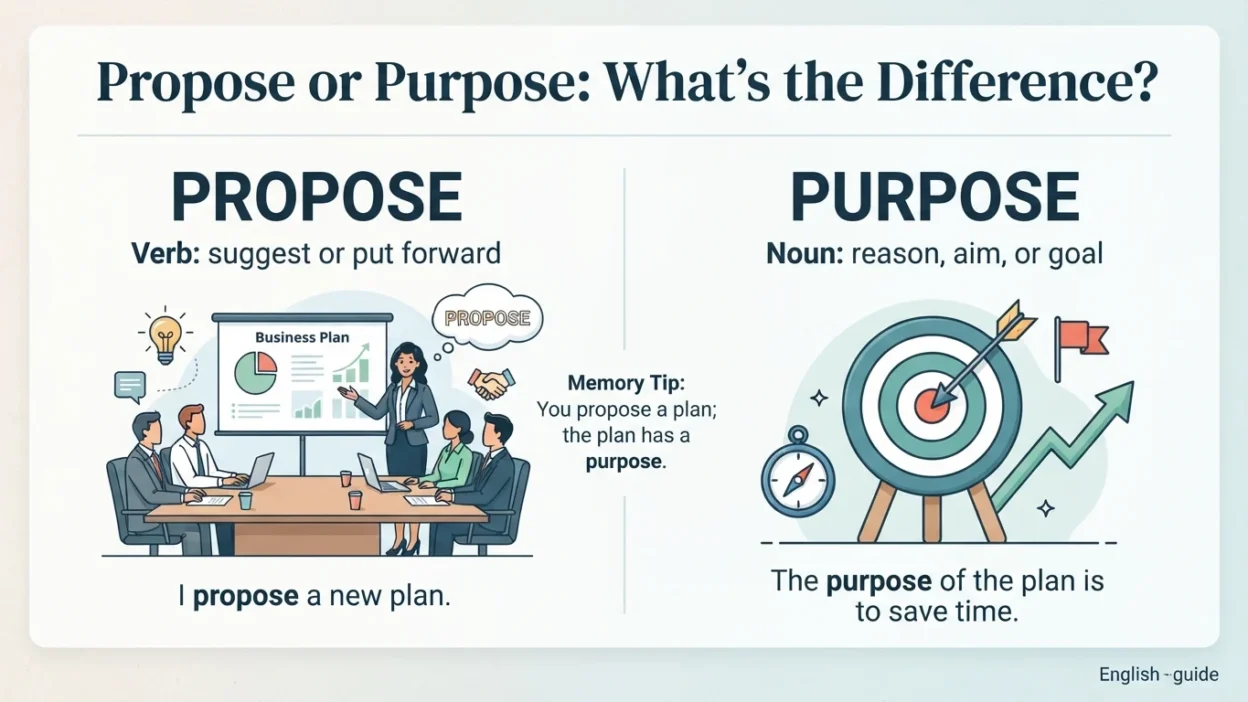
Propose or purpose can be confusing because these two words look and sound somewhat similar, but they have completely different meanings and grammatical roles. One is mainly a verb connected with suggesting an idea or making a formal plan, while the other is usually a noun that refers to a reason, intention, or goal.
If you have ever stopped while writing an email, assignment, business document, or formal message and wondered whether you should use propose or purpose, you are not alone. A simple understanding of their meanings, pronunciation, and common sentence patterns can help you choose the right word every time.
Quick Answer: Propose or Purpose?
Propose is a verb meaning to suggest an idea, plan, or action for consideration. It can also mean to formally ask someone to marry you.
Purpose is mainly a noun meaning the reason why something exists or why someone does something. It can also refer to an intended goal or objective.
Easy rule
- Propose = suggest, recommend, put forward, or ask for marriage.
- Purpose = reason, intention, aim, goal, or objective.
Examples:
I propose a new solution to the problem.
The purpose of this meeting is to discuss the project.
The words are related to ideas and intentions, but they cannot normally be substituted for each other.
What Does “Propose” Mean?
Propose is a verb. Its most common meaning is to suggest or put forward an idea, plan, method, or action for other people to consider.
For example:
She proposed a new marketing strategy.
Here, she suggested the strategy for consideration.
The word is especially common in professional, academic, business, and formal contexts.
Examples of “Propose”
- The manager proposed a new schedule.
- I would like to propose a different approach.
- The committee proposed several changes.
- They proposed building a new community center.
- The scientist proposed a possible explanation.
- We propose that the meeting be moved to Friday.
In each example, propose describes an action: someone is putting forward an idea or suggestion.
Propose Can Also Mean “Ask to Marry”
Propose has another very common meaning. Someone can propose to another person when asking them to marry.
For example:
He proposed to his girlfriend during their vacation.
Here, proposed does not mean “suggested an idea.” It means he asked her to marry him.
The related noun is proposal:
She accepted his marriage proposal.
So, the context determines which meaning of propose is intended.
What Does “Purpose” Mean?
Purpose is primarily a noun. It refers to the reason, aim, intention, or goal behind an action, object, activity, or situation.
For example:
The purpose of this meeting is to review our progress.
The sentence explains the reason for the meeting.
You can use purpose when explaining why something exists or why someone does something.
Examples of “Purpose”
- What is the purpose of this machine?
- The purpose of the meeting is to make a decision.
- She joined the organization with a clear purpose.
- The main purpose of the project is to help students.
- He believes everyone needs a sense of purpose.
- The exercise serves a useful purpose.
Common synonyms for purpose include:
- reason
- aim
- goal
- objective
- intention
- function
- role
The best synonym depends on the context.
Propose vs Purpose: Comparison Table
| Feature | Propose | Purpose |
| Main grammatical role | Verb | Noun |
| Basic meaning | Suggest or put forward | Reason, aim, or goal |
| Related word | Proposal | Purposeful |
| Common context | Plans and suggestions | Reasons and objectives |
| Marriage meaning | Yes: ask someone to marry | No |
| Example | I propose a new plan. | The purpose is clear. |
| Synonyms | suggest, recommend, offer | reason, aim, goal |
A useful way to remember the difference is to focus on the action.
If someone suggests something, they propose it.
If you explain why something exists or happens, you are describing its purpose.
Propose vs Purpose in Sentences
Putting the two words side by side makes the distinction clearer.
Propose
I propose that we start the project next month.
The speaker is making a suggestion.
Purpose
The purpose of the project is to improve customer service.
The sentence explains the project’s goal.
Both in One Sentence
It is even possible to use both words in the same sentence:
We propose a new project whose purpose is to improve employee training.
Here, propose describes the act of suggesting the project, while purpose describes the project’s goal.
This is a helpful way to remember the difference: you propose an idea, but an idea has a purpose.
Common Mistakes With Propose and Purpose
Mistake 1: Using “Purpose” as a Verb
❌ I purpose a new solution to the problem.
For most standard English contexts, this is not the word you want.
✅ I propose a new solution to the problem.
Propose is the natural verb when you mean “suggest.”
Mistake 2: Using “Propose” When You Mean “Reason”
❌ The propose of the meeting is to discuss the budget.
✅ The purpose of the meeting is to discuss the budget.
The word purpose means the reason or objective.
Mistake 3: Confusing “Proposal” and “Purpose”
A proposal is an idea, plan, or suggestion that someone puts forward.
A purpose is the reason or goal behind something.
For example:
Her proposal was approved.
The purpose of her proposal was to reduce costs.
Mistake 4: Confusing Their Pronunciation
The words can sound similar to learners, especially when spoken quickly. However, their vowel sounds are different in standard pronunciation.
Propose is generally pronounced approximately like pruh-POHZ.
Purpose is generally pronounced approximately like PUR-puhs.
Listening carefully to the stressed syllable can help you distinguish them.
Propose or Purpose in Formal Writing
Both words are common in formal English, but they perform different jobs.
Propose is useful when presenting an idea or recommendation:
We propose implementing a new training program.
Purpose is useful when explaining an objective:
The purpose of the training program is to improve employee performance.
You will often see propose in:
- Business reports
- Research papers
- Project plans
- Meetings
- Policy documents
- Academic writing
You will often see purpose in:
- Mission statements
- Research descriptions
- Business plans
- Instructions
- Academic papers
- Explanations of goals
Using the correct word makes professional writing clearer and more precise.
American vs British English
There is no major spelling difference between American and British English for propose and purpose. Both varieties use the same words with the same basic meanings.
For example:
American English:
We propose a new approach.
British English:
We propose a new approach.
Likewise:
The purpose of the study is to examine the results.
This sentence works naturally in both varieties.
The pronunciation can vary slightly between individual speakers and regional accents, but the distinction between the words remains the same.
Therefore, you do not need to choose propose or purpose based on whether your audience uses American or British English. Choose according to the meaning you want to express.
How to Remember the Difference
Try this simple memory trick:
Propose = put forward an idea.
Purpose = the reason behind an idea.
Imagine a meeting. You might say:
I propose a new plan.
Then someone might ask:
What is the purpose of the plan?
This creates a natural connection between the two words.
Another useful pattern is:
propose something
She proposed a solution.
purpose of something
The purpose of the solution is to save time.
Learning these common sentence patterns is often more effective than memorizing dictionary definitions alone.
FAQs
What is the difference between propose and purpose?
Propose is mainly a verb meaning to suggest or put forward an idea. Purpose is mainly a noun meaning the reason, aim, or goal behind something.
Is “purpose” a verb?
Purpose is primarily used as a noun in everyday modern English. If you mean “suggest,” propose is the natural verb to use.
Q H Is “propose” a noun?
Propose is a verb. Its related noun is proposal.
For example:
They proposed a new plan.
Their proposal was accepted.
Can propose mean “ask someone to marry”?
Yes. Propose can mean to formally ask someone to marry you.
He proposed to her last summer.
What is another word for purpose?
Depending on the sentence, alternatives include reason, aim, goal, objective, intention, and function.
What is another word for propose?
Common alternatives include suggest, recommend, put forward, offer, and present.
Which is correct: “the propose of” or “the purpose of”?
The correct phrase is “the purpose of.”
The purpose of this meeting is to discuss the project.
Are propose and purpose pronounced the same?
No. Although they may sound similar to some learners, their standard pronunciations are different. Propose has the main stress toward the end, while purpose is stressed at the beginning.
Summary
The difference between propose or purpose becomes easy when you focus on their grammatical roles. Propose is a verb used when someone suggests, recommends, or puts forward an idea, plan, or action. It can also describe asking someone to marry. Purpose, on the other hand, is mainly a noun that describes the reason, aim, intention, or goal behind something.
These words are common in everyday and professional English, so learning their sentence patterns can prevent frequent spelling and word-choice mistakes. Remember that you propose something, while something has a purpose. Both American and British English use these words in essentially the same way, so the key issue is meaning rather than regional spelling.
Actionable Takeaway
When you mean “suggest”, use propose:
I propose a new solution.
When you mean “reason” or “goal,” use purpose:
The purpose of the solution is to save time.
A quick memory rule is: You propose a plan; the plan has a purpose.