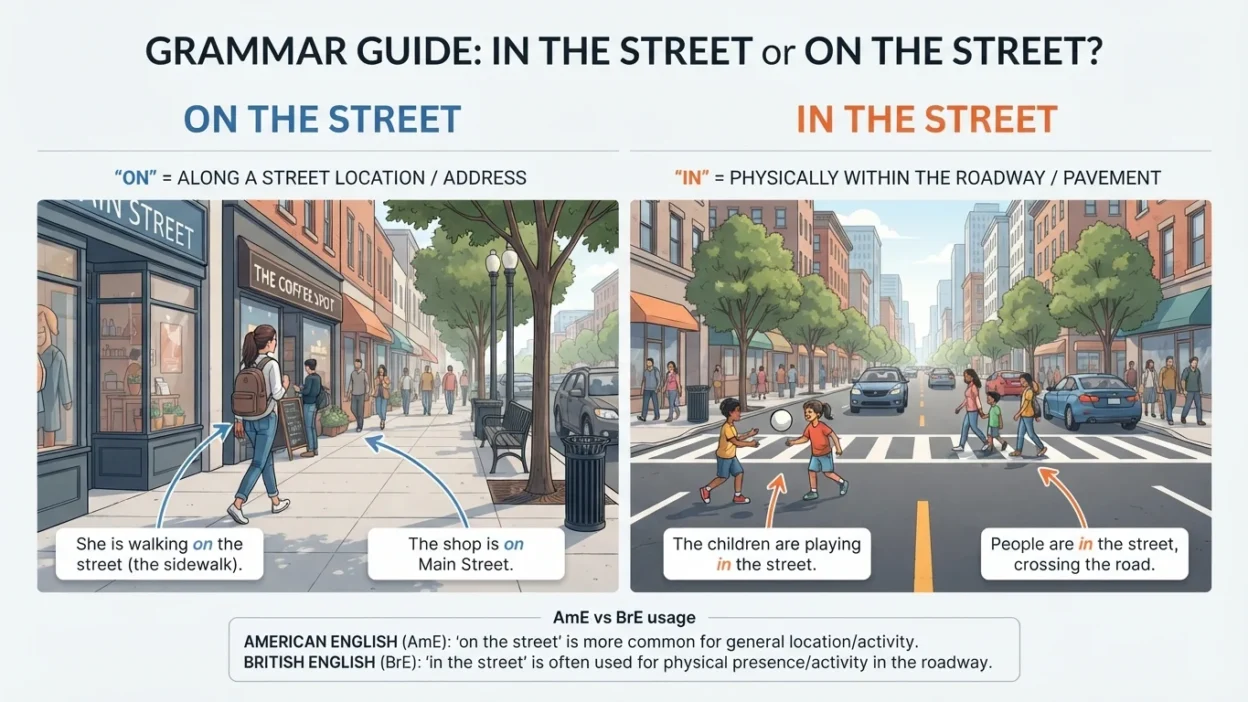
If you are wondering whether to say “in the street” or “on the street,” you are not alone. Both expressions are grammatically correct, but they are not always used in exactly the same way. The right choice depends on what you want to describe and, in some cases, whether you are following American or British English.
In everyday English, “on the street” is generally the more common expression, especially in American English. However, “in the street” is also natural and correct when you are talking about being physically within the roadway or when British English usage is intended. Understanding this small difference can make your English sound more natural and precise.
Quick Answer: In the Street or On the Street?
Both “in the street” and “on the street” are correct.
- On the street usually means being somewhere along or beside a street, or being at a particular street location.
- In the street usually emphasizes being physically in the roadway or middle area of the street.
- On the street is especially common in American English.
- In the street is more common in some contexts in British English, particularly when referring to someone physically standing or playing in the roadway.
Simple examples:
- I saw Sarah on the street.
→ Sarah was somewhere along the street. - The children were playing in the street.
→ The children were physically in the roadway.
The difference is sometimes subtle, and native speakers may use either expression depending on context.
What Does “On the Street” Mean?
“On the street” is a common prepositional phrase used to describe someone’s location, a place, or something happening along a street.
It can mean that someone is walking, standing, living, working, or located somewhere along a particular street.
For example:
- I met an old friend on the street.
- There is a new restaurant on the street.
- She lives on Main Street.
- I saw a man selling flowers on the street.
- We were walking on the street when it started raining.
In American English, “on the street” is especially natural when giving information about location.
For example:
The bank is on Oak Street.
You can also use “on the street” in a broader sense. For example, someone who has no permanent home may be described as living on the street.
What Does “In the Street” Mean?
“In the street” usually focuses more strongly on physical position. It often means that a person, animal, vehicle, or object is actually within the roadway.
For example:
- The children are playing in the street.
- A car stopped in the street.
- There is a large box in the street.
- The dog was running in the street.
- Someone left a bicycle in the street.
The phrase can create a stronger image of something being in the road rather than simply being somewhere along the street.
For instance, compare these two sentences:
- I saw John on the street.
- I saw John in the street.
The first sentence simply tells us that you saw John somewhere along the street. The second suggests that John was physically in the roadway.
In the Street vs. On the Street: Key Difference
The easiest way to remember the difference is to think about location and physical position.
| Expression | Common meaning | Example |
| On the street | Somewhere along or beside a street | I saw her on the street. |
| In the street | Physically within the roadway | The children were playing in the street. |
| On Main Street | Located along a named street | The store is on Main Street. |
| In the middle of the street | Directly within the roadway | The car stopped in the middle of the street. |
| On the street corner | At or near a street intersection | We met on the street corner. |
This distinction is useful, but it is not an absolute rule. Context and regional usage can influence which preposition sounds most natural.
When Should You Use “On the Street”?
Use “on the street” when you are talking about a location along a street or describing something situated there.
1. Talking about a location
- The pharmacy is on the street.
- There is a coffee shop on the street.
- I saw your brother on the street.
2. Giving an address or street name
When a specific street name is mentioned, “on” is generally used.
- She lives on Park Avenue.
- Our office is on King Street.
- There is a hotel on Baker Street.
This is particularly common in American English.
3. Describing something happening along a street
- There were musicians performing on the street.
- We found a small market on the street.
- People were dancing on the street.
Here, “on the street” can describe activities taking place in a street environment without necessarily emphasizing the roadway itself.
When Should You Use “In the Street”?
Use “in the street” when you want to emphasize that someone or something is physically inside the roadway.
1. Someone is physically in the road
- The child ran in the street.
- A man was standing in the street.
- The dog was sleeping in the street.
2. Something is blocking the road
- There is a fallen tree in the street.
- A truck is parked in the street.
- There is a chair in the street.
3. Describing activities taking place in the roadway
- The children were playing in the street.
- People gathered in the street after the parade.
- The neighbors were celebrating in the street.
In these examples, “in” creates a stronger sense that people or objects occupy the actual street area.
American English vs. British English
There can be a noticeable difference between American and British English when using these expressions.
In American English, “on the street” is extremely common when talking about a location.
For example:
- I live on Fifth Avenue.
- The restaurant is on the street.
- I saw him on the street.
However, Americans also naturally say “in the street” when someone or something is physically in the roadway.
In British English, “in the street” can be more common when describing people or activities physically taking place in the street.
For example:
- The children are playing in the street.
- There were people dancing in the street.
British speakers also use “on the street”, so this is not a strict American-versus-British grammar rule. The difference is mainly about usage, context, and natural preference.
Common Mistakes to Avoid
Because both expressions are correct, learners sometimes assume that they can always be used interchangeably. That is not necessarily true.
Mistake 1: Using “in” for a street address
❌ I live in Main Street.
✅ I live on Main Street.
When referring to a specific street as an address or location, “on” is generally the natural choice.
Mistake 2: Thinking “in the street” is always wrong
❌ The children are playing in the street.
This sentence is actually correct.
If the children are physically playing in the roadway, “in the street” is perfectly natural.
Mistake 3: Thinking “on the street” always means literally standing on the road
Not necessarily.
“On the street” can simply mean somewhere along a street or in the surrounding street environment.
For example:
I met her on the street.
This does not necessarily mean she was standing directly in the traffic lane.
Mistake 4: Confusing “on the street” with “in the street” in location descriptions
Consider:
The bookstore is on the street.
This means the bookstore is located along that street.
But:
The box is in the street.
This suggests the box is physically in the roadway.
“On the Street” or “In the Street” Examples
Here are some practical examples to make the difference easier to remember:
- I saw a police officer on the street.
- The children were playing in the street.
- There is a supermarket on this street.
- A car is blocking traffic in the street.
- We met on the street yesterday.
- Someone left a table in the street.
- She lives on Green Street.
- People were dancing in the street during the festival.
- There are several restaurants on this street.
- A large hole has appeared in the street.
Notice how on often identifies a general street location, while in often highlights physical presence within the roadway.
Is “On the Street” More Common Than “In the Street”?
In many everyday situations, especially in American English, “on the street” is the more common choice.
However, frequency does not mean that “in the street” is incorrect. The two phrases communicate slightly different ideas.
If you are talking about a person’s general location, “on the street” will often sound natural:
I ran into my teacher on the street.
If you are emphasizing that someone is physically occupying the roadway, “in the street” is often better:
The children were playing in the street.
The context determines the best choice.
A Simple Trick to Remember the Difference
Think of “on” as pointing to a location along a street and “in” as emphasizing something inside the street area.
ON = location along the street
The shop is on Main Street.
IN = physically within the roadway
The ball is in the street.
This is not a perfect rule for every sentence, but it is an excellent starting point for English learners.
FAQs
Is “in the street” grammatically correct?
Yes. “In the street” is grammatically correct and commonly used when someone or something is physically within the roadway.
Is “on the street” grammatically correct?
Yes. “On the street” is also correct and very common. It often describes someone’s location along a street or a place situated there.
Should I say “I live in Main Street” or “I live on Main Street”?
The natural expression is “I live on Main Street.” When referring to a particular street as an address, “on” is generally used.
Do Americans say “on the street” more often?
Yes, “on the street” is particularly common in American English for describing location. However, Americans also use “in the street” when emphasizing physical position in the roadway.
Do British people say “in the street”?
Yes. “In the street” is common in British English, especially when describing people or activities physically taking place in the roadway. British speakers also use “on the street.”
Can “in the street” and “on the street” mean the same thing?
Sometimes they can refer to the same general situation, but they may create different impressions. “In the street” usually emphasizes physical position, while “on the street” often gives a broader location.
Which is more natural: “children playing in the street” or “children playing on the street”?
Both can be heard, but “children playing in the street” is especially natural when the children are actually playing in the roadway. “Playing on the street” can also be used, particularly when referring more generally to street play.
Which phrase should English learners use?
Use “on the street” for a general street location or a named street, and use “in the street” when you want to emphasize that someone or something is physically in the roadway.
Summary
Both “in the street” and “on the street” are correct English expressions. The main difference is the meaning you want to emphasize. “On the street” generally refers to a location along a street and is especially common in American English. It is also the normal choice when referring to a named street, such as “on Main Street” or “on King Road.”
“In the street” usually emphasizes physical position within the roadway. For example, “The children are playing in the street” suggests that they are actually in the road. British English may favor “in the street” more frequently in some situations, but both expressions are used in both varieties of English.
Actionable Takeaway
Remember this simple rule:
Use “on the street” for a general location or street address. Use “in the street” when you mean physically inside the roadway.
If you are still unsure, ask yourself: Am I describing where something is located along a street, or am I emphasizing that it is physically in the road? That small distinction will usually help you choose the right preposition.