Imitated vs intimated is a common English word confusion because these two words look and sound somewhat similar, but their meanings are completely different. One is related to copying or mimicking something, while the other is a formal word connected to communicating or indicating information.
Understanding the difference between imitated and intimated is important because using one in place of the other can completely change the meaning of a sentence. Whether you are writing an email, academic paper, professional report, or everyday message, knowing which word fits the context will help you communicate clearly and accurately.
Quick Answer: Imitated vs Intimated
Imitated and intimated are both correct words, but they have different meanings.
- Imitated means copied, mimicked, or reproduced the behavior, appearance, voice, or actions of someone or something.
- Intimated means suggested, hinted at, or communicated something indirectly.
- Imitated comes from the verb imitate.
- Intimated comes from the verb intimate, meaning to communicate or suggest something indirectly.
Simple examples:
The child imitated his father’s voice.
This means the child copied his father’s voice.
She intimated that she might leave the company.
This means she hinted or suggested that she might leave.
A simple way to remember the difference is:
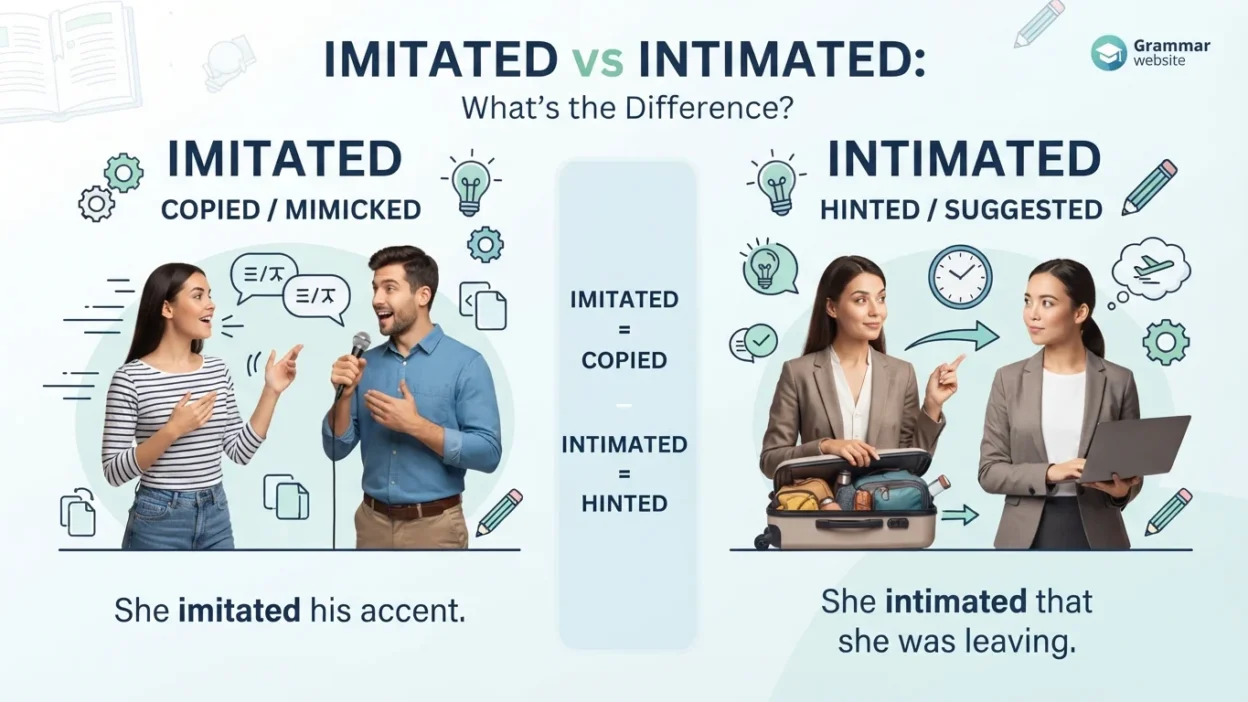
Imitated = copied
Intimated = hinted or suggested
What Does “Imitated” Mean?
Imitated is the past tense and past participle of the verb imitate.
To imitate means to copy the behavior, appearance, speech, actions, style, or characteristics of another person or thing.
The word is commonly used when someone reproduces something that already exists.
For example:
- The comedian imitated the actor’s voice.
- The young boy imitated his mother’s gestures.
- The artist imitated the style of a famous painter.
- The students imitated the teacher’s pronunciation.
- The design was imitated by several competitors.
In each example, something is being copied or mimicked.
Synonyms for “imitated”
Depending on the context, synonyms include:
- copied
- mimicked
- reproduced
- replicated
- emulated
- echoed
- followed
- modeled after
However, these words are not always perfect replacements. Emulated, for example, can suggest copying someone because you admire or want to achieve similar success, while imitated simply means copying.
What Does “Intimated” Mean?
Intimated is the past tense and past participle of intimate when it is used as a verb.
As a verb, to intimate means to suggest, hint at, or communicate something indirectly.
It is a relatively formal word and is more common in professional, academic, legal, and literary writing than in casual conversation.
For example:
- He intimated that he was unhappy with the decision.
- The manager intimated that changes were coming.
- She intimated that she might resign.
- The report intimated that the company had financial difficulties.
- His comments intimated that he knew more than he was saying.
In these sentences, the person does not necessarily state something directly. Instead, they hint at it or suggest it.
Synonyms for “intimated”
Common alternatives include:
- suggested
- hinted
- implied
- indicated
- signaled
- conveyed
- implied indirectly
- gave the impression
For everyday English, suggested or hinted is often clearer than intimated.
Imitated vs Intimated: Key Difference
The most important difference is the action each word describes.
| Word | Meaning | Root verb | Simple synonym | Example |
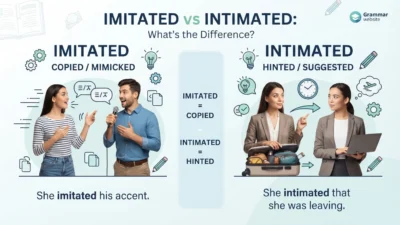
| Imitated | Copied or mimicked | Imitate | Copied | She imitated his accent. |
| Intimated | Suggested or hinted | Intimate | Suggested | She intimated that she was leaving. |
The two words should not normally be substituted for each other.
If you say:
He imitated that he was unhappy.
The sentence is incorrect because imitate does not mean “suggest.”
The correct sentence would be:
He intimated that he was unhappy.
Likewise:
The child intimated her mother’s voice.
This is incorrect if you mean that the child copied her mother’s voice.
The correct version is:
The child imitated her mother’s voice.
Examples of “Imitated”
Here are some practical examples to help you understand imitated:
Copying someone’s behavior
The toddler imitated his older brother.
The toddler copied his brother’s actions or behavior.
Copying someone’s voice
The comedian imitated the politician’s voice.
The comedian copied the politician’s manner of speaking.
Copying an artistic style
The student imitated the painter’s technique.
The student copied or reproduced the painter’s artistic approach.
Copying an animal
The children imitated the sound of a dog barking.
They copied the sound.
Reproducing a successful design
Several companies imitated the product’s original design.
The companies copied aspects of the original design.
Examples of “Intimated”
Now consider examples using intimated.
Hinting at a decision
The director intimated that the project might be canceled.
The director suggested this without directly saying, “The project will be canceled.”
Suggesting dissatisfaction
She intimated that she was unhappy with the service.
She indirectly communicated her dissatisfaction.
Hinting at future plans
He intimated that he would move abroad.
He suggested or hinted that moving abroad was a possibility.
Indicating hidden information
The witness intimated that there was more to the story.
The witness suggested that additional information existed.
Suggesting a problem
The report intimated that the company was facing financial difficulties.
The report indicated or suggested the problem without necessarily stating it directly.
Why Are “Imitated” and “Intimated” Confused?
These words are easy to confuse because they share several letters and have similar pronunciations.
Imitated comes from imitate, while intimated comes from intimate.
Their spelling differs by only a few letters:
- imitated
- intimated
Their meanings, however, are completely different.
This is an example of a vocabulary mix-up caused by similar-looking words, sometimes called commonly confused words or lexical confusions.
The best way to avoid the mistake is to connect each word with its basic meaning:
Imitate → imitate a person → copy them
Intimate → intimate something → hint or suggest it
Common Mistakes to Avoid
Mistake 1: Using “imitated” when you mean “suggested”
❌ The manager imitated that the company would expand.
✅ The manager intimated that the company would expand.
If the manager only hinted at the possibility, intimated is the correct word.
Mistake 2: Using “intimated” for copying
❌ The actor intimated the singer’s accent.
✅ The actor imitated the singer’s accent.
The actor copied the accent, so imitated is correct.
Mistake 3: Assuming “intimated” means “intimate” in the modern everyday sense
The word intimate can be an adjective meaning close or personal, as in:
They are intimate friends.
But intimate also exists as a verb meaning to suggest or communicate indirectly.
Therefore:
She intimated that she knew the answer.
has nothing to do with romantic or personal intimacy.
Mistake 4: Using “intimated” when “hinted” would be clearer
Although intimated is correct, it can sound formal.
For example:
He hinted that he wanted to leave.
is more conversational than:
He intimated that he wanted to leave.
Both are grammatically correct.
Imitated vs Intimated in American and British English
There is no major American-versus-British spelling difference between imitated and intimated. Both words are standard in American English and British English.
The difference is mainly related to style and context, rather than regional grammar.
Imitated is common in both varieties of English whenever someone or something is copied.
Intimated is also used in both varieties, but it is relatively formal. You are more likely to encounter it in:
- formal writing
- journalism
- academic writing
- legal language
- business communication
- literature
In casual American or British conversation, speakers may prefer hinted, suggested, or implied.
How to Remember the Difference
Use this simple memory trick:
IMITATED = IMITATE = COPY
Think:
Imitated = I copied it.
For example:
She imitated her teacher.
She copied her teacher’s behavior, speech, or mannerisms.
INTIMATED = HINTED
Think of intimated as a formal alternative to hinted or suggested.
For example:
He intimated that he was leaving.
He hinted or suggested that he was leaving.
This simple association can help you choose the correct word quickly.
Imitated vs Intimated: Quick Comparison
- Imitated describes copying.
- Intimated describes hinting or suggesting.
- Imitated comes from imitate.
- Intimated comes from the verb intimate.
- Imitated can describe voices, actions, behavior, styles, designs, and sounds.
- Intimated usually introduces an idea, feeling, possibility, or message that is communicated indirectly.
- Both words are standard in American and British English.
- Intimated is more formal and less common in everyday conversation.
Frequently Asked Questions
Is “imitated” the same as “intimated”?
No. Imitated means copied or mimicked, while intimated means suggested or hinted at. They have different meanings and should not normally be used interchangeably.
What is the difference between imitated and intimated?
Imitated means reproducing or copying something. Intimated means communicating or suggesting something indirectly.
For example, “She imitated his accent” means she copied his accent, while “She intimated that she was upset” means she hinted that she was upset.
Is “intimated” a formal word?
Yes. Intimated is generally considered a formal or somewhat literary word when used as a verb. In casual English, hinted, suggested, or implied may sound more natural.
What is an easy synonym for imitated?
The simplest synonym for imitated is copied. Depending on the context, mimicked, reproduced, or replicated may also work.
What is an easy synonym for intimated?
The easiest synonyms for intimated are hinted, suggested, and implied. The best choice depends on the sentence and the exact meaning.
Can “intimate” be a verb?
Yes. As a verb, intimate means to suggest or communicate something indirectly.
For example:
The lawyer intimated that further action might be necessary.
Are “imitated” and “intimated” pronounced differently?
Yes. Although they look similar in writing, their pronunciation differs. Imitated follows the pronunciation of imitate, while intimated follows the verb intimate. Listening to both words can help reinforce the distinction.
Which word should I use in formal writing?
Use imitated when you mean copied and intimated when you mean suggested or hinted. If you want maximum clarity, especially for a broad audience, simpler words such as copied or suggested may be preferable.
Summary
The difference between imitated vs intimated becomes simple once you focus on their meanings. Imitated means copied, mimicked, or reproduced. You can imitate someone’s voice, behavior, appearance, actions, writing style, or technique. It comes from the verb imitate and is common in both everyday and formal English.
Intimated, on the other hand, means hinted, suggested, or communicated indirectly. It comes from the verb intimate and tends to appear more often in formal, professional, academic, journalistic, and literary contexts. Both words are correct in American and British English, but they cannot normally be substituted for one another.
Actionable Takeaway
Remember just two words: imitated = copied and intimated = hinted. If someone reproduces another person’s voice or behavior, use imitated. If someone indirectly suggests an idea, feeling, decision, or possibility, use intimated.
When proofreading your writing, replace imitated with copied and intimated with hinted in your mind. If the sentence still makes sense, you have probably chosen the correct word. This quick test can prevent one of the most common vocabulary mistakes between these similar-looking words.