If you are wondering whether the correct word is “emasculate” or “demasculate,” you are not alone. The two words look as though they should be opposites or grammatical alternatives, but standard English strongly favors emasculate. It can mean to make someone feel less masculine or powerful, and it can also mean to weaken the effectiveness of something. In specialized biological contexts, it can refer to removing male reproductive parts or stamens from a plant.
Demasculate does appear occasionally in English, usually with the intended meaning “to remove masculinity,” but it is much less established and is not the normal choice in formal standard English. If you are writing an article, academic paper, professional document, or general-audience content, emasculate is the safer and more widely recognized word.
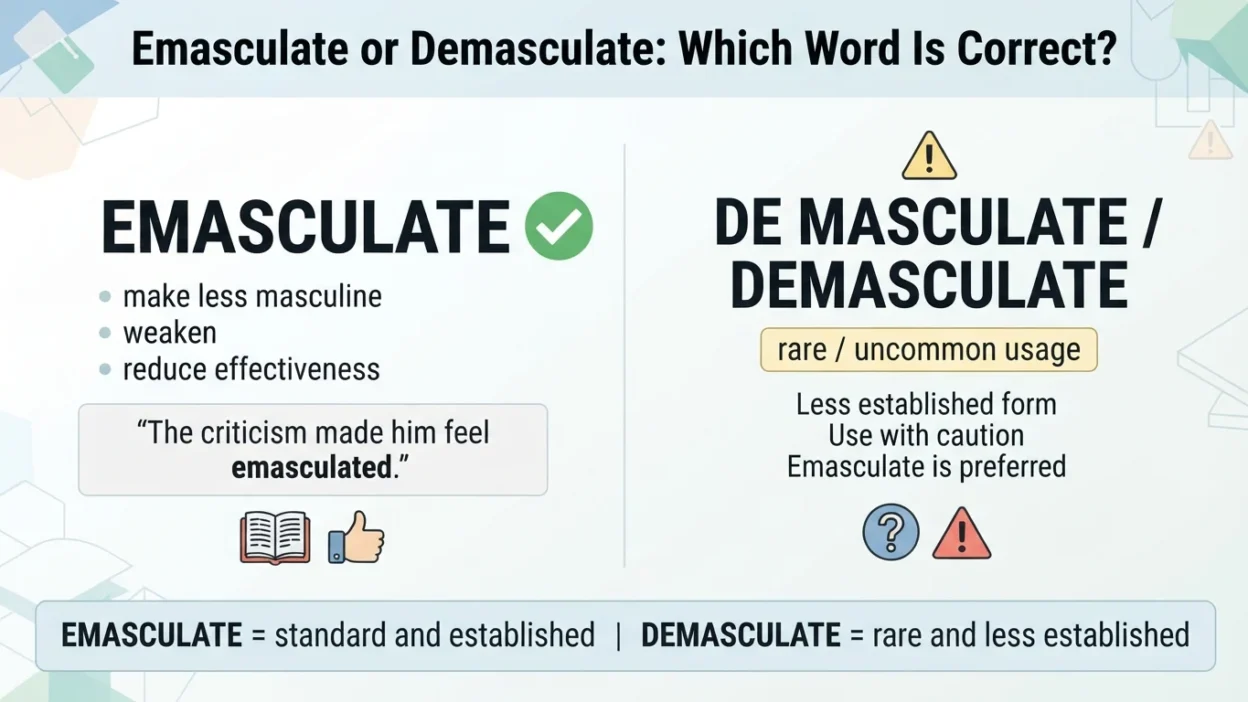
Quick Answer: Emasculate or Demasculate?
Emasculate is the established and standard word. Demasculate is a rare or nonstandard alternative that occasionally appears with a similar meaning.
- Emasculate = to make someone feel less masculine or powerful.
- Emasculate = to weaken or make something less effective.
- Emasculate can also have a literal biological meaning related to castration or removal of male reproductive parts.
- Demasculate = a rare term used to mean removing masculinity, but it is not the usual choice in standard formal English.
- For most writing, choose emasculate.
Simple example
The criticism made him feel emasculated.
This means the criticism made him feel less masculine, confident, or powerful.
If you wrote:
The criticism made him feel demasculated.
Readers may understand what you mean, but emasculated is the established and more conventional form.
What Does “Emasculate” Mean?
Emasculate is a formal verb with several related meanings.
Its most common figurative meanings are:
- To make a man feel less masculine, powerful, or confident.
- To weaken something and make it less effective or forceful.
It also has specialized biological meanings involving the removal of male reproductive parts or, in botany, the removal of stamens from a flower to prevent self-pollination.
Emasculate meaning: less masculine
For example:
He felt emasculated after being publicly criticized by his colleagues.
The sentence means that the experience made him feel that his confidence, authority, or sense of masculinity had been diminished.
Another example:
Losing his position made him feel emasculated.
Here, the word focuses on a perceived loss of power, status, confidence, or traditionally masculine identity.
It is important to remember that this is a figurative and contextual meaning. Not every man who experiences criticism or loss of authority will feel emasculated.
What Does “Emasculate” Mean When It Refers to Weakening Something?
Emasculate can also describe an idea, law, organization, report, policy, or system that has been made weaker or less effective.
For example:
The amendments emasculated the proposed law.
This means the amendments weakened the law so that it was less powerful or effective.
Another example:
The changes emasculated the report’s recommendations.
The recommendations were weakened or stripped of some of their effectiveness. Cambridge specifically gives this sense as “to reduce the effectiveness of something.”
This meaning is especially useful in political, legal, academic, journalistic, and professional writing.
Synonyms for this meaning
Depending on the context, you could use:
- weaken
- undermine
- diminish
- reduce
- impair
- dilute
- undermine the force of
- make less effective
For general readers, weaken is often clearer than emasculate.
What Does “Demasculate” Mean?
Demasculate is occasionally used to mean “to remove masculinity from someone” or “to make someone less masculine.” It is formed in a way that may seem logical to English speakers because de- often suggests removal or reversal.
However, its use is far less established than emasculate. Wiktionary currently records demasculate as an English verb meaning “to remove the masculinity from” someone, while major established dictionaries such as Cambridge and Oxford prominently define emasculate for these meanings.
That distinction matters if your goal is standard, polished English.
For example:
He felt emasculated by the situation.
is the conventional choice.
He felt demasculated by the situation.
may be understandable, but it is much less standard and can sound unusual to many readers.
Emasculate vs Demasculate: Key Difference
| Word | Meaning | Standard usage | Example |
| Emasculate | Make someone feel less masculine or powerful | Standard, established | He felt emasculated by the criticism. |
| Emasculate | Weaken something or reduce its effectiveness | Standard, established | The changes emasculated the law. |
| Demasculate | Remove masculinity or make someone less masculine | Rare/nonstandard in formal usage | The term is occasionally used online. |
The important point is that emasculate is the established word you should normally choose.
Why Do People Say “Demasculate”?
The confusion is understandable.
English contains many words beginning with de- that suggest removal, reversal, or reduction:
- deactivate
- deconstruct
- defrost
- dehydrate
- demoralize
- decentralize
Because masculine means relating to masculinity, someone may naturally reason that:
de + masculine → demasculate
It seems logical from a modern word-building perspective.
However, English vocabulary does not always follow perfectly predictable patterns. Emasculate developed historically from Latin emasculare, related to masculus, meaning “male.” Oxford traces the word to the early 17th century and gives its figurative meanings as making someone or something less powerful or making a man feel that he has lost his male role or qualities.
So, although demasculate may seem like the more logically constructed word, emasculate is the established choice.
Common Mistakes to Avoid
Mistake 1: Assuming “demasculate” is the standard opposite of “masculate”
It may look logical, but English does not require every word to be formed using the most obvious modern prefix.
If you mean “make someone feel less masculine,” use:
emasculate
rather than relying on demasculate in formal writing.
Mistake 2: Thinking “emasculate” only means castrate
Historically and literally, emasculate can refer to castration or removal of male reproductive parts. But modern English also uses it figuratively to mean
weaken or make someone feel less masculine or powerful.
For example:
The new restrictions emasculated the organization.
No physical meaning is intended. The organization has simply been weakened.
Mistake 3: Using “emasculate” without considering tone
Emasculate can be a strong and emotionally loaded word when describing a person’s sense of masculinity.
For example:
The experience emasculated him.
This may suggest that the experience damaged his sense of masculinity or male identity.
If that is not what you mean, alternatives such as undermined his confidence, made him feel powerless, or weakened his authority may be clearer and more precise.
Mistake 4: Using “demasculate” in formal writing
Even if readers can understand demasculate, it may look unusual or nonstandard.
For formal articles, academic writing, professional communication, and edited content, emasculate is generally the better choice.
Examples of “Emasculate”
Here are some natural examples:
Making someone feel less masculine
The public criticism made him feel emasculated.
Reducing someone’s sense of power
Being excluded from the decision left him feeling emasculated.
Weakening an organization
The budget cuts emasculated the department.
Weakening a law
The amendments emasculated the legislation.
Weakening an argument
Removing the strongest evidence emasculated the argument.
Biological use
Researchers emasculated the flowers before pollination.
In botanical research, emasculation can refer to removing the stamens from flowers to prevent self-pollination.
Emasculate vs Demasculate in American and British English
There is no major American-versus-British spelling difference between the two forms.
Emasculate is established in both American and British English. Both varieties use the word in figurative, general, and specialized contexts.
For example:
The policy was emasculated by several amendments.
This sentence works in both varieties of English.
The important difference is not regional. It is standardness and frequency. Emasculate is the established dictionary word, while demasculate is much less common and less suitable for formal writing. Cambridge and Oxford both provide established entries for emasculate.
Better Alternatives to “Emasculate”
Sometimes emasculate may be unnecessarily strong or formal. Choosing a simpler synonym can make your writing clearer.
If you mean “make someone feel less powerful”
Use:
- undermine
- disempower
- weaken
- diminish
- make someone feel powerless
- damage someone’s confidence
Example:
The criticism undermined his confidence.
This may be more precise than:
The criticism emasculated him.
If you mean “make something less effective”
Use:
- weaken
- dilute
- undermine
- reduce
- impair
- limit
Example:
The changes weakened the policy.
This is often clearer than:
The changes emasculated the policy.
Emasculate or Demasculate: Which One Should You Use?
If you are deciding between these two words, choose “emasculate” in standard English.
Use emasculate when you mean:
- make a man feel less masculine
- diminish someone’s sense of masculine identity or power
- weaken someone’s authority or effectiveness
- weaken a law, policy, argument, organization, or system
- use the specialized biological meaning
Use demasculate only when you have a specific reason to reproduce a rare usage or are discussing the word itself.
For normal writing, emasculate is clearer, more established, and more widely recognized.
FAQs
Is “demasculate” a correct English word?
Demasculate does appear as an English verb in some sources and is used with the meaning “to remove masculinity,” but it is uncommon. For standard formal English, emasculate is the safer and more established choice.
Is “emasculate” the correct word?
Yes. Emasculate is the established standard word. It can mean making someone feel less masculine or powerful, weakening something, or, in specialized contexts, removing male reproductive parts or stamens.
Does emasculate mean “make less masculine”?
Yes. In its figurative sense, emasculate can mean to make a man feel less masculine by diminishing his power, confidence, or sense of a traditionally masculine role.
Does emasculate mean weaken?
Yes. Emasculate can also mean to reduce the effectiveness or strength of something. For example, a law can be emasculated if changes make it substantially less effective.
Is “demasculated” better than “emasculated”?
No, not for standard formal English. Emasculated is the conventional form. Demasculated may be understood, but it is much less established.
What is the opposite of emasculate?
There is no single universal opposite that works in every context. Depending on the intended meaning, possible alternatives include empower, strengthen, or reinforce. The best opposite depends on whether you are talking about a person’s confidence or the effectiveness of something.
Is emasculate offensive?
It can be sensitive because it refers to masculinity and can suggest that a man has lost power, status, or traditionally masculine qualities. In professional writing, use it when that specific meaning is important; otherwise, a more precise phrase such as undermine his confidence may be preferable.
Is there a British English version of emasculate?
No separate British form is required. Emasculate is standard in both British and American English. The meaning is essentially the same in both varieties.
Summary
When choosing between emasculate or demasculate, the best standard-English choice is emasculate. It is an established verb meaning to make someone feel less masculine or powerful, to weaken the effectiveness of something, and, in specialized biological contexts, to remove male reproductive parts or stamens.
Demasculate is occasionally used with the intended meaning of removing masculinity, but it is far less established and can sound unusual in formal writing. If you want your writing to be clear, natural, and widely accepted, choose emasculate. Both American and British English use emasculate, so this is not primarily a regional spelling issue.
Actionable Takeaway
Remember one simple rule: use “emasculate” when you mean “make less masculine,” “make less powerful,” or “weaken.” If you are tempted to write demasculate, especially in formal or professional content, replace it with emasculate unless you are specifically discussing the rare word itself.
For even clearer writing, consider the context before choosing the word. If you mean emotional or personal impact, “make someone feel less masculine” or “undermine someone’s confidence” may be more direct. If you mean reducing effectiveness, “weaken” or “undermine” may communicate your meaning more plainly.