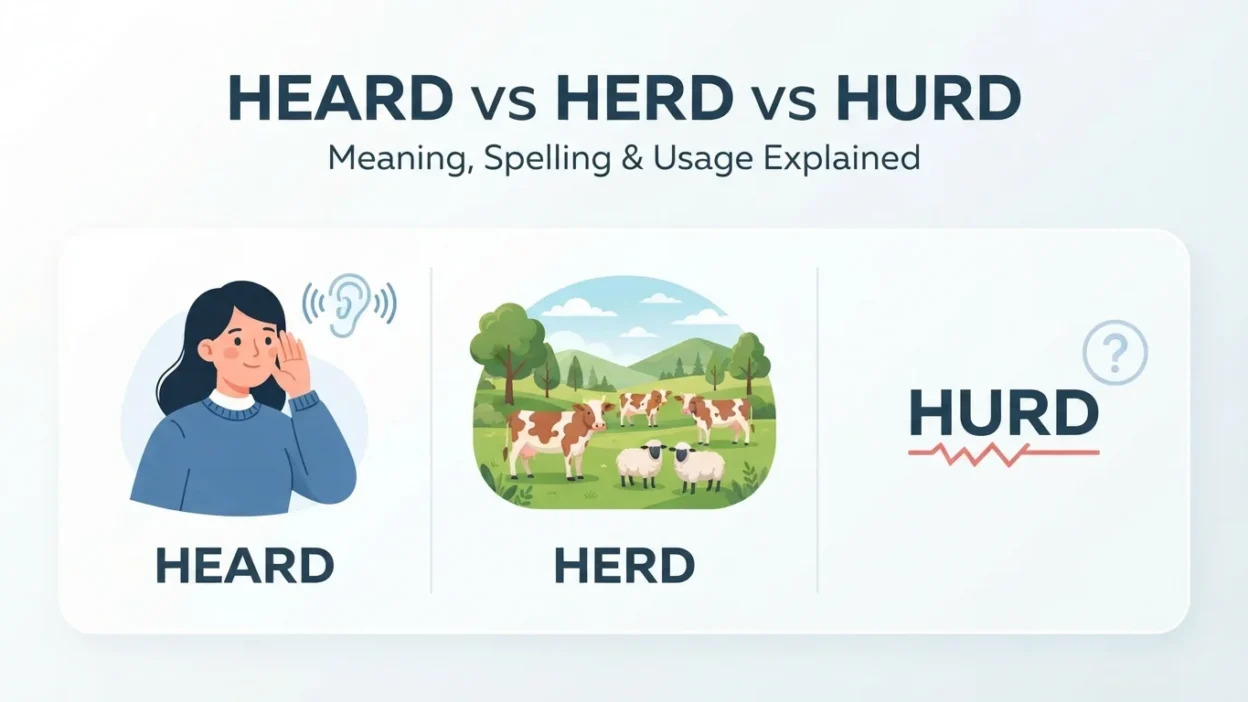
Heard vs herd vs hurd can be confusing because these words can sound the same while having completely different meanings and uses. If you are unsure whether to write heard or herd, you are not alone—these are classic English homophones that often cause spelling mistakes.
The good news is that the difference becomes simple once you connect each spelling with its meaning. Heard relates to hearing or receiving information, while herd usually refers to a group of animals and can also function as a verb. Hurd is not normally used as a standard English word for either meaning, although it can appear as a surname, in specialized terminology, or in historical/dialectal English.
Quick Answer: Heard vs Herd vs Hurd
- Heard = the past tense and past participle of hear.
Example: I heard a strange noise. - Herd = a group of animals, or a verb meaning to gather, guide, or move animals or people together.
Example: A herd of elephants crossed the river. - Hurd = generally not the standard spelling when you mean heard or herd. It can, however, occur legitimately in specialized contexts, such as hemp hurd, or as a surname.
The easiest memory trick is:
Heard → ears → sound
Herd → animals → group
Hurd → usually avoid it unless you have a specific name or technical meaning
Both heard and herd are pronounced the same in standard varieties of English, which is why context and spelling are so important.
Heard: Meaning and Definition
Heard is the past tense and past participle of the verb hear. The verb hear means to perceive a sound with your ears, listen to something, or receive information.
For example:
- I heard a loud bang outside.
- She heard someone calling her name.
- We heard the news yesterday.
- Have you heard this song before?
- I heard that they moved to London.
The word heard can describe both physical sounds and information. You can hear music, voices, noises, announcements, opinions, rumors, or news.
The basic verb forms are:
hear → heard → heard
So, if you are talking about something you listened to or received through hearing, heard is the correct spelling.
Examples of Heard in Sentences
Here are some common examples:
- I heard a dog barking outside.
- She heard the teacher explain the instructions.
- We heard an interesting story about the trip.
- Have you heard from your brother?
- I heard that the meeting was canceled.
- He heard music coming from the next room.
Notice that every example is connected to hearing, listening, or receiving information.
A useful memory trick is to look at the spelling:
hEARd
The letters ear appear inside heard. This can remind you that heard is connected with your ears and sounds.
Herd: Meaning and Definition
Herd is primarily a noun referring to a group of animals that live, travel, or are kept together. It is commonly used for animals such as cattle, elephants, deer, horses, and buffalo.
For example:
- A herd of cattle was grazing in the field.
- We saw a herd of elephants near the river.
- The farmer owns a large herd of cows.
- A herd of deer crossed the road.
Herd can also be used as a verb. As a verb, it means to gather, drive, guide, or move animals or people together as a group.
For example:
- The farmer herded the sheep into the barn.
- The shepherd herded the goats toward the gate.
- The teacher herded the children back into the classroom.
Dictionary definitions also recognize figurative uses of herd, including references to groups of people or the tendency to follow a crowd.
Examples of Herd in Sentences
Here are some natural examples:
- A herd of cows was standing near the fence.
- The elephants moved together as a herd.
- The rancher watched his herd carefully.
- The farmer herded the sheep into the field.
- The children were herded into the classroom before the rain started.
- He tends to follow the herd instead of making his own decisions.
The last example shows a figurative use. English sometimes uses herd to describe people who behave like a group or follow popular opinion.
Hurd: Is It a Correct English Word?
This is where things get more interesting.
If you are trying to choose between heard, herd, and hurd in ordinary English writing, hurd is usually not the word you want. It is commonly typed as a misspelling of heard or herd.
For example:
❌ I hurd a strange noise.
✅ I heard a strange noise.
❌ A hurd of cattle crossed the road.
✅ A herd of cattle crossed the road.
However, it would be inaccurate to say that hurd can never appear in English. Hurd exists in some specialized uses and as a proper name. For example, hurd can occur in terms related to plant fiber, especially hemp hurd, referring to the woody inner material of hemp stalks. The spelling also appears in surnames.
There are also historical and dialectal uses of hurd. The Dictionaries of the Scots Language records hurd as a Scots noun with meanings including a heap or pile and a large rock, while another historical entry records hurd as an older Scottish verb meaning to hoard. These are specialized or historical uses rather than everyday modern standard English.
So, for normal English grammar and spelling:
Do not use “hurd” when you mean “heard” or “herd.”
Heard vs Herd vs Hurd: Comparison Table
| Word | Part of Speech | Main Meaning | Example |
| heard | Verb | Past tense of hear | I heard a noise. |
| herd | Noun | A group of animals | A herd of cows crossed the field. |
| herd | Verb | To gather or move as a group | They herded the sheep into the barn. |
| hurd | Rare/specialized | Usually a name or specialized term | Hemp hurd is used in some materials. |
The key distinction is simple: heard is about hearing; herd is about a group; hurd is generally not the everyday spelling for either one.
Heard vs Herd: Why Are They So Confusing?
The main reason is pronunciation.
Heard and herd are homophones: they have different spellings and meanings but are pronounced alike in many standard English accents. This creates no problem when speaking because listeners understand the meaning from context. The problem appears when you have to write the word.
For example, if someone says:
“I heard the herd.”
You cannot determine the spelling simply from the sound. You need to understand the meaning.
The first word means received a sound, while the second refers to a group of animals.
This is why homophones such as hear/here, their/there/they’re, to/too/two, and heard/herd are frequent sources of spelling mistakes.
Common Mistakes With Heard and Herd
Mistake 1: Using Herd for Hearing
❌ I herd someone shouting.
✅ I heard someone shouting.
If the sentence involves a sound, voice, music, conversation, or information you received, use heard.
Mistake 2: Using Heard for Animals
❌ A heard of horses ran across the field.
✅ A herd of horses ran across the field.
When you mean a group of animals, use herd.
Mistake 3: Writing Hurd as a General Alternative
❌ I hurd the announcement.
✅ I heard the announcement.
In ordinary modern English, hurd is not an alternative spelling of heard.
Mistake 4: Confusing Herd as a Noun and Verb
Herd can be both a noun and a verb.
As a noun:
- The herd moved across the valley.
As a verb:
- The farmer herded the cattle into the barn.
This distinction is useful because the verb usually appears in forms such as herd, herded, herding, and herds.
A Simple Memory Trick
If you regularly confuse these words, use these three associations:
HEARD = EAR
Look at:
h-EAR-d
If you are talking about something you listened to, heard is probably correct.
HERD = GROUP
Think of cows, deer, elephants, or other animals moving together. That is a herd.
HURD = CHECK THE CONTEXT
If you have written hurd, stop and ask whether you actually mean heard or herd. In ordinary writing, one of those two words is probably correct.
American vs British English
There is no major American-versus-British spelling difference between heard and herd. Both varieties use heard for the past tense of hear and herd for a group of animals.
Pronunciation can vary slightly between regional accents, particularly in the quality of the vowel sound, but the two words remain extremely similar and are homophones in many accents.
The spelling rules are therefore the same in both American and British English:
- I heard the news.
- A herd of elephants crossed the road.
British and American writers should also generally avoid hurd when it is simply being used as a misspelling.
Specialized terms, proper names, and dialect words can naturally follow different conventions, but those are not ordinary alternatives to heard or herd.
Heard vs Herd vs Hurd: Which One Should You Use?
Use heard when your sentence involves hearing:
- heard a sound
- heard a voice
- heard music
- heard the news
- heard someone speak
Use herd when you mean a group of animals:
- herd of cattle
- herd of elephants
- herd of deer
- herd of horses
Use herd as a verb when you mean to move or gather animals or people:
- herded the sheep
- herding cattle
- herded the children inside
Use hurd only when the context specifically calls for a specialized or proper use, such as a name or a technical term. Otherwise, check whether heard or herd is the spelling you actually need.
FAQs
Is “hurd” a correct English word?
It can appear in specialized, historical, dialectal, or proper-name contexts, but it is not the normal everyday spelling for heard or herd. In ordinary writing, check whether you mean heard or herd.
Is heard and herd pronounced the same?
Yes, they are homophones in many standard varieties of English. They have the same or essentially the same pronunciation but different spellings and meanings.
What is the difference between heard and herd?
Heard is the past tense and past participle of hear, while herd means a group of animals and can also be a verb meaning to gather or move animals together.
Is “I herd you” correct?
No, not when you mean “I listened to you” or “I understood what you said.” The correct sentence is “I heard you.”
Is “a heard of cows” correct?
No. The correct expression is “a herd of cows.” Herd is the noun for the group.
Can herd be used as a verb?
Yes. For example: “The farmer herded the cattle into the barn.” It means to guide, gather, or move animals as a group.
Is “hurd” a misspelling?
Often, yes, especially when someone intends to write heard or herd. However, hurd can occur legitimately in specialized terminology, names, and historical or dialectal English.
How can I remember heard vs herd?
Remember heard = ear because it relates to hearing, and herd = group because a herd is a group of animals.
Final Summary
The difference between heard vs herd vs hurd becomes much easier when you focus on meaning rather than sound. Heard is the past tense of hear and relates to sounds, listening, or receiving information. Herd is a group of animals and can also be used as a verb for gathering or moving animals or people together.
Hurd is not the normal spelling you should choose when you mean either of those common words. Although it can appear in specialized terms, surnames, and historical or dialectal sources, everyday writers should generally use heard or herd according to the context. The simplest rule is: sounds and information = heard; animals and groups = herd.
Actionable Takeaway
Before choosing the spelling, ask yourself one question:
“Am I talking about hearing something or a group of animals?”
- Hearing or information → HEARD
- Group of animals or moving them together → HERD
- Neither? → Check whether HURD is a genuine specialized term or simply a typo.
Once you connect each spelling with its meaning, this common homophone confusion becomes easy to avoid.