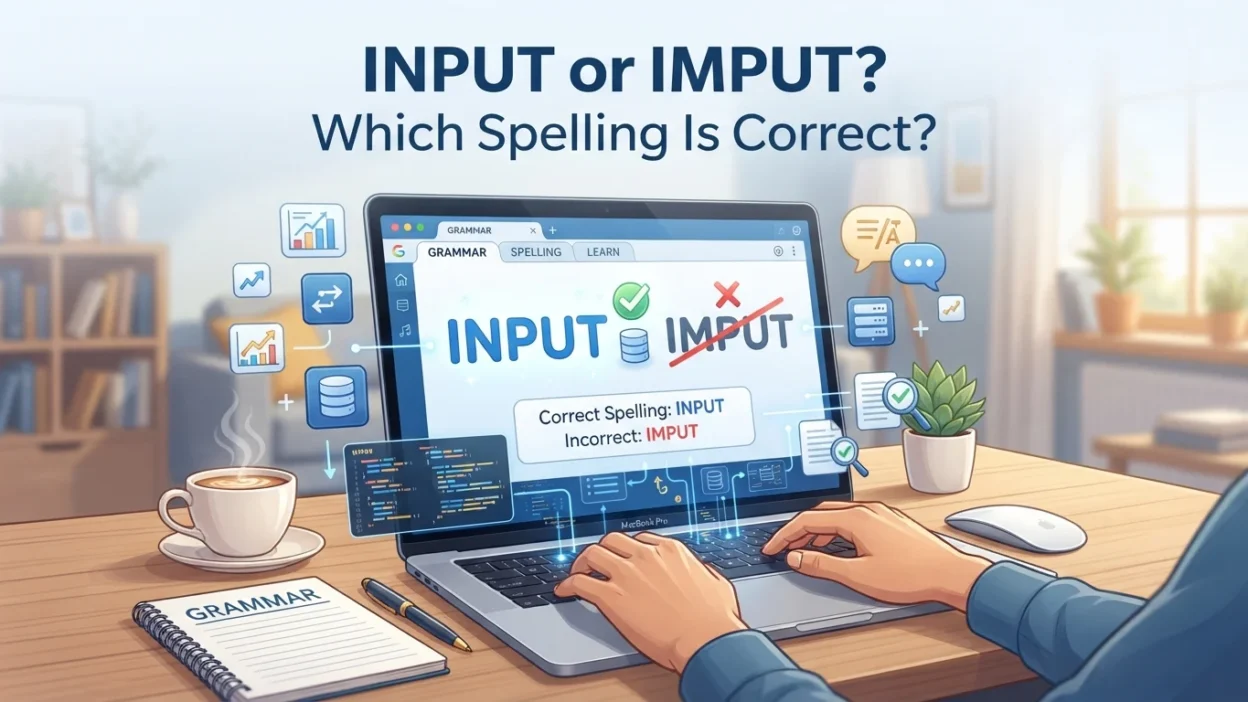
The input or imput question is a common minor spelling difference that creates confusion because both words can sound similar in everyday speech, but input is the correct spelling in standard English. It refers to data, information, or feedback that is entered into a system or shared during a discussion, while imput is a misspelling, not a valid alternative or regional variant. Some people may write “imput” because the brain processes sounds differently when a word is heard rather than seen, making the incorrect spelling seem natural. The pronunciation can therefore cause this mistake, but input remains the standard form. From my experience, remembering the word as in + put makes it easier to recognize and use consistently.
If you have ever wondered whether input or imput is correct, you are not alone. These words can sound similar in everyday speech, which makes the incorrect spelling surprisingly easy to type. However, there is a simple answer: input is the correct standard spelling in English.
Whether you are writing about computer data, customer feedback, information, or someone’s opinion, input is the word you need. In this guide, you will learn why imput is incorrect, how to use input correctly, and how to avoid making this common spelling mistake.
Quick Answer: Input or Imput?
Input is the correct spelling. Imput is a misspelling and is not a standard English word.
The word input can function as both a noun and a verb.
- Noun: We need your input before making a decision.
- Verb: Please input the information into the system.
- Technical use: The keyboard provides input to the computer.
- Business use: Customer input helped improve the product.
The incorrect form imput should not be used in standard English writing.
| Word | Correct? | Meaning | Example |
| input | ✅ Yes | Information, data, feedback, or something entered into a system | Please input your details. |
| imput | ❌ No | Misspelling of input | Avoid this spelling. |
What Does Input Mean?
Input has several related meanings, but they all involve something being supplied, entered, or contributed.
As a noun, input can mean information, ideas, opinions, advice, or data provided by someone or something.
For example:
We appreciate your input on the new proposal.
Here, input means an opinion or contribution.
In technology, input can refer to data or commands entered into a computer, application, machine, or other system.
For example:
The program receives input from the user.
As a verb, input means to enter information into a system.
Please input your password.
So, depending on the context, input can mean a contribution, information, data, feedback, or the act of entering information.
Why Is Imput Incorrect?
Imput is simply a spelling error. It does not represent a different meaning, dialect, or accepted regional spelling of input.
The mistake is understandable because spoken English does not always make every consonant sound equally obvious. When people hear a word rather than see it written, their brain may interpret the sounds in a way that leads to an incorrect spelling.
This is similar to other common spelling mistakes where pronunciation influences writing. Someone may hear input and unconsciously write imput, especially if they have rarely seen the word in written form.
The important thing to remember is:
Input = correct
Imput = incorrect
Input as a Noun
As a noun, input commonly refers to something that a person contributes or provides.
This can be an opinion, suggestion, piece of information, feedback, or technical data.
Examples of input as a noun
- Your input would be helpful before we finalize the plan.
- The manager asked for employee input.
- We received valuable customer input.
- The software processes user input.
- Her input helped us solve the problem.
- The team considered everyone’s input before voting.
In workplace communication, input often means someone’s opinion, expertise, or feedback.
For example:
I would appreciate your input on this proposal.
This sounds natural and professional in an email or business conversation.
Input as a Verb
Input can also function as a verb. In this use, it means to enter information or data into a computer, form, database, device, or other system.
Examples of input as a verb
- Please input your address into the form.
- The employee input the customer’s information.
- You can input the data manually.
- Users must input their account details.
- The technician input the required values into the system.
In some contexts, enter may sound more natural than input, especially in everyday instructions.
For example:
Please enter your email address.
is often more natural than:
Please input your email address.
Both can be grammatically correct, but enter is extremely common when talking about typing information into a form.
Input vs. Enter: Are They the Same?
The words input and enter can overlap, particularly in computing.
Input is broader. It can refer to data, information, opinions, commands, or contributions.
Enter often focuses specifically on putting information into a system.
Compare these examples:
- Please input the required data.
- Please enter your phone number.
In the first sentence, the emphasis is on supplying data. In the second, enter describes the action of putting a particular piece of information into a field.
In technical writing, input is especially useful when discussing how a system receives or processes information.
Common Mistakes With Input
Writing “imput” instead of “input”
This is the main mistake.
❌ Please imput the information.
✅ Please input the information.
Treating imput as an alternative spelling
Imput is not an alternative spelling used in British English, American English, or another standard English variety.
It is simply a misspelling.
Confusing input with feedback
Input can mean feedback, but the two words are not always interchangeable.
For example:
We need your input on the project.
Here, input can mean your opinion or contribution.
However:
We received feedback about the new website.
specifically emphasizes people’s reactions, comments, or evaluations.
Using input when enter sounds more natural
Although input is correct, it is not always the most natural choice.
For example:
Please enter your name.
is generally more natural in an online form than:
Please input your name.
Both communicate the basic action, but enter is often preferred in everyday instructions.
Input or Imput in Different Contexts
The correct spelling remains input regardless of the context.
Business
We need employee input before changing the policy.
Here, input means opinions or contributions.
Technology
The system receives input from multiple devices.
Here, input refers to information or signals supplied to a system.
Education
Students were encouraged to provide input during the discussion.
Here, input means ideas or opinions.
Customer service
Customer input helped the company improve the product.
Here, input means feedback or suggestions.
Data entry
Input the information into the database.
Here, input is being used as a verb meaning to enter data.
American vs. British English
There is no meaningful American-versus-British spelling difference between input and imput.
Both American English and British English use input as the standard spelling.
Imput is not a standard British alternative, nor is it an accepted American spelling. If you are writing for an American audience, use input. If you are writing for a British audience, use input as well.
Other vocabulary choices can vary between American and British English, but this particular spelling does not.
For professional writing, academic work, websites, emails, and technical documentation, input is the safe and correct choice.
How to Remember the Correct Spelling
One of the easiest ways to remember input is to break it into two familiar parts:
in + put = input
The word contains put, not mut.
You can also connect it with familiar technology terms:
- input
- output
- input device
- input data
- input field
- user input
Notice that input and output form a common pair in computing. This can make the correct spelling easier to remember.
If you are unsure while writing, pause and think:
“Is it in + put?”
If yes, write input.
Input vs. Imput: Comparison Table
| Feature | Input | Imput |
| Standard English word | Yes | No |
| Correct spelling | Yes | No |
| Can be a noun | Yes | No |
| Can be a verb | Yes | No |
| Used for data | Yes | No |
| Used for feedback | Yes | No |
| Used in computing | Yes | No |
| British English | Correct | Incorrect |
| American English | Correct | Incorrect |
| Recommended in formal writing | Yes | No |
Examples of Correct Sentences
Here are several natural examples to help reinforce the correct spelling:
- I would appreciate your input on this matter.
- Please input your information into the form.
- The team valued her input during the meeting.
- The computer receives input from the keyboard.
- Customer input helped us improve the service.
- Please input the correct account number.
- The manager requested employee input.
- The software converts user input into useful results.
Notice that the spelling remains input whether the word refers to an opinion, information, data, or an action.
FAQs
Is input or imput correct?
Input is correct. Imput is a misspelling and should not be used in standard English.
Is imput a real English word?
No. Imput is not a standard English word. It is a common misspelling of input.
What does input mean?
Input can mean information, data, feedback, opinions, or another contribution supplied to a person or system. As a verb, it means to enter information into a system.
Why do people spell input as imput?
The mistake usually happens because input and imput can sound similar in speech. When people rely on pronunciation rather than visual memory, they may incorrectly write imput.
Is input the same in American and British English?
Yes. Input is the standard spelling in both American and British English. Imput is not a standard regional variation.
Can input be a verb?
Yes. Input can be a verb meaning to enter data or information into a system.
For example:
Please input the customer’s details.
What is the past tense of input?
The past tense can be input or inputted, depending on context and style. For example, “She input the data yesterday” and “She inputted the data yesterday” can both be encountered, although usage preferences vary.
What is the easiest way to remember input?
Think of input as in + put. This simple word connection can help you avoid writing the incorrect form imput.
Summary
If you are deciding between input or imput, choose input. It is the only standard spelling, whether you are discussing data, information, feedback, opinions, computer commands, or information entered into a system. Imput is a misspelling and does not become correct because it sounds similar or appears in informal writing.
The simplest way to avoid this mistake is to remember in + put = input. Use input in professional emails, academic writing, technical documents, business communication, and everyday English. When referring specifically to entering information into a form, remember that enter may often sound more natural, but the spelling of input itself never changes between American and British English.
Actionable Takeaway
Remember: Input is correct; imput is incorrect.
When proofreading, replace imput with input, and remember the phrase “in + put.”