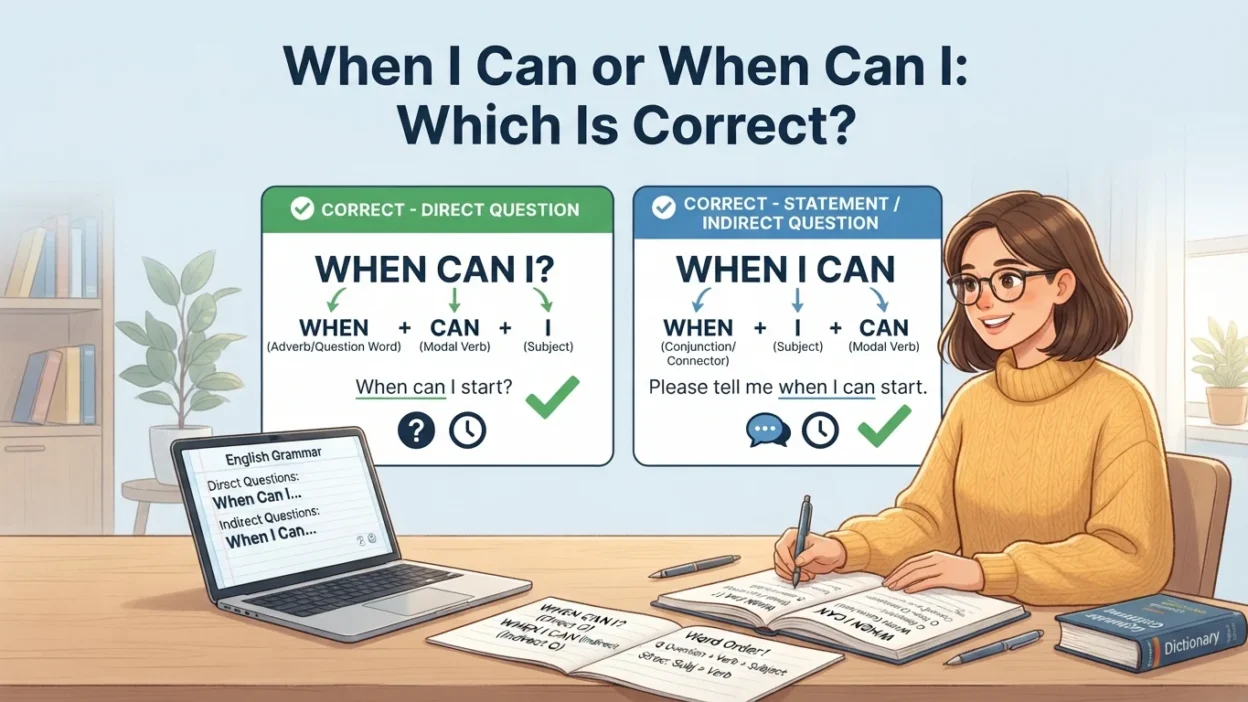
If you are confused about when I can or when can I, you are dealing with a common English word-order problem. Both phrases contain the same words, but they are used differently depending on whether you are asking a direct question or making a statement.
The key is simple: “When can I…?” is normally correct for a direct question, while “when I can…” is used inside a statement or an indirect question. Once you understand this difference, you can use both forms naturally in emails, conversations, questions, and professional writing.
Quick Answer: When I Can or When Can I?
“When can I?” is correct when you are asking a direct question about the time or opportunity to do something.
“When I can” is correct when it appears inside a statement or an indirect question.
Examples
- ✅ When can I call you?
- ✅ When can I start?
- ✅ I will call you when I can.
- ✅ Please tell me when I can start.
- ❌ When I can start? — Incorrect as a standard direct question.
- ❌ Please tell me when can I start. — Incorrect in a standard indirect question.
A quick rule to remember is:
Direct question → When can I…?
Statement or indirect question → when I can…
What Does “When Can I” Mean?
When can I is used to ask about the appropriate, possible, or available time to do something.
The structure is:
When + can + subject + base verb
For example:
When can I leave?
Here, when asks about time, can is the modal verb, I is the subject, and leave is the base verb.
Other examples include:
- When can I apply?
- When can I visit?
- When can I call?
- When can I register?
- When can I submit the form?
- When can I expect a response?
This is the natural word order for a direct question in English.
What Does “When I Can” Mean?
When I can follows normal statement or embedded-question word order.
It can mean “at the time that I am able to” or introduce an indirect question about when something is possible.
For example:
I will help you when I can.
Here, when I can means “when I am able to.”
It can also appear in an indirect question:
I want to know when I can apply.
The speaker is not directly asking, “When can I apply?” Instead, the question has been placed inside the larger sentence I want to know…
This difference in sentence structure is the main reason the two expressions cannot always be switched.
When Can I: Direct Questions
Use when can I when you are directly asking someone for information.
Examples
- When can I start the course?
- When can I speak with the manager?
- When can I pick up my order?
- When can I submit my application?
- When can I expect the results?
- When can I schedule an appointment?
These are direct questions, so the modal verb can comes before the subject I.
The basic pattern is:
Question word + modal verb + subject + verb
For example:
When + can + I + leave?
This word order is typical of English questions.
When I Can: Statements and Indirect Questions
Use when I can when the phrase is part of a larger sentence.
Statements
- I will call you when I can.
- I will help when I can.
- I will visit you when I can.
- I will finish the work when I can.
- I will respond when I can.
Here, when I can does not stand alone as a direct question.
Indirect questions
- Please tell me when I can start.
- I would like to know when I can apply.
- Can you tell me when I can visit?
- Do you know when I can collect the documents?
- She asked when I can come.
Notice something important: even though these sentences contain a question or request for information, the embedded clause uses when I can, not when can I.
When Can I vs. When I Can: Comparison Table
| Expression | Main Use | Word Order | Example |
| When can I…? | Direct question | when + can + I | When can I leave? |
| when I can… | Statement | when + I + can | I will leave when I can. |
| when I can… | Indirect question | when + I + can | Tell me when I can leave. |
| When I can…? | Usually incorrect as a direct question | when + I + can | ❌ When I can leave? |
| when can I… | Usually incorrect in an indirect question | when + can + I | ❌ Tell me when can I leave. |
The most important distinction is direct question vs. embedded or indirect question.
Why Does English Change the Word Order?
English generally changes word order when forming direct questions with modal verbs such as can, could, will, would, should, and may.
Compare:
I can leave.
This is a statement.
Turn it into a direct question:
Can I leave?
The modal verb can moves before the subject I.
When you add when, the same pattern remains:
When can I leave?
However, an indirect question keeps statement-style word order:
I want to know when I can leave.
You do not move can before I inside the embedded question.
This is one of the most useful grammar patterns to learn because it applies to many other question words.
Common Mistakes With When I Can and When Can I
1. Using “when I can” as a direct question
❌ When I can start?
✅ When can I start?
If you are directly asking someone a question, use when can I.
2. Using “when can I” inside an indirect question
❌ Please tell me when can I start.
✅ Please tell me when I can start.
The phrase is embedded inside the larger sentence, so normal statement word order is used.
3. Confusing direct and indirect questions
Compare:
When can I submit the application?
Direct question.
I would like to know when I can submit the application.
Indirect question.
The meaning is closely related, but the grammar is different.
4. Adding unnecessary “do”
Because can is already a modal verb, you normally do not use do to form the question.
❌ When do I can leave?
✅ When can I leave?
Modal verbs such as can form questions by moving before the subject.
When Can I vs. When Will I?
These phrases can sometimes look similar, but can and will express different ideas.
When can I…? asks about possibility, permission, availability, or opportunity.
When can I meet you?
When will I…? asks about something expected to happen in the future.
When will I meet you?
For example:
When can I start?
asks when you are allowed or able to start.
When will I start?
asks when the starting event is expected to happen.
Choosing the correct modal verb can make your meaning much clearer.
When Can I in Professional Emails
When can I is completely natural in professional communication when you are asking about timing.
For example:
When can I expect the updated document?
Or:
When can I schedule a meeting with your team?
For a slightly more polite tone, you can use:
Could you please let me know when I can expect the updated document?
Notice that the indirect version uses when I can, not when can I.
This is an especially useful distinction in professional writing because indirect questions are common in emails.
Examples in Everyday English
Here are some natural examples showing both forms.
Direct questions
- When can I see you?
- When can I call?
- When can I leave?
- When can I start?
- When can I pay?
- When can I get my results?
Statements
- I will come when I can.
- I will help when I can.
- She will visit when she can.
- He will respond when he can.
- We will meet when we can.
Indirect questions
- Do you know when I can leave?
- Can you tell me when I can call?
- I want to know when I can apply.
- Please let me know when I can start.
- She asked when I can visit.
These examples show how naturally both forms can appear in English when they are used in the right grammatical structure.
American vs. British English
There is no significant American vs. British English difference in the basic grammar of when can I and when I can.
Both American English and British English use:
When can I…?
for direct questions.
Both also use:
when I can…
inside statements and indirect questions.
For example, an American speaker might say:
When can I pick up the documents?
A British speaker can use exactly the same structure.
Similarly:
Could you tell me when I can pick up the documents?
is grammatically natural in both varieties.
Differences may occur in vocabulary, pronunciation, or levels of formality, but the word-order rule remains essentially the same.
How to Remember the Difference
A simple way to remember the rule is to ask yourself whether you are asking directly.
If you are asking directly:
When can I…?
If the phrase is part of another sentence:
when I can…
Think of these two examples:
When can I leave?
versus:
I want to know when I can leave.
The first is a direct question, so can comes before I.
The second contains an indirect question, so I comes before can.
This same pattern works with other question words:
- Where can I go?
- I want to know where I can go.
- What can I do?
- Tell me what I can do.
- How can I help?
- Please explain how I can help.
Learning this pattern can improve both your grammar and your writing confidence.
FAQs
Is “when can I” correct?
Yes. When can I is the standard structure for a direct question asking about the time, possibility, permission, or opportunity to do something.
Is “when I can” grammatically correct?
Yes. When I can is correct inside statements and indirect questions.
For example:
I will call you when I can.
Which is correct: “when I can” or “when can I”?
Both are correct, but they have different grammatical uses. Use when can I for direct questions and when I can for statements or indirect questions.
Is “When I can go?” correct?
Not as a standard direct question. Say:
When can I go?
However, when I can go is correct inside a larger sentence:
Please tell me when I can go.
Is “Can you tell me when can I go?” correct?
No, not in standard English. The preferred form is:
Can you tell me when I can go?
The indirect question uses normal statement word order.
Why do we say “when can I” instead of “when I can”?
Because direct questions with can generally place the modal verb before the subject.
When + can + I + go?
In an indirect question, the normal word order returns:
when + I + can + go.
Is there a difference in American and British English?
No important difference exists for this grammar rule. Both varieties use when can I for direct questions and when I can in statements and indirect questions.
Can “when I can” mean “whenever I am able to”?
Yes. For example:
I help my family when I can.
Here, when I can means “whenever I am able to.”
Summary
If you are deciding between when I can or when can I, remember that both expressions are correct in the right context. When can I…? is the correct structure for a direct question, such as “When can I start?” or “When can I call?” In this structure, can comes before the subject I, following the normal word order for direct questions with modal verbs.
When I can, on the other hand, belongs inside statements and indirect questions, such as “I will call you when I can” or “Please tell me when I can start.” The easiest way to avoid mistakes is to identify whether you are asking a question directly or placing the question inside another sentence.
Actionable Takeaway
Use this simple rule:
Direct question → When can I…?
Statement or indirect question → when I can…
Before writing the phrase, check the sentence structure rather than relying on how the words sound. This small habit will help you write clearer emails, conversations, questions, and professional English.