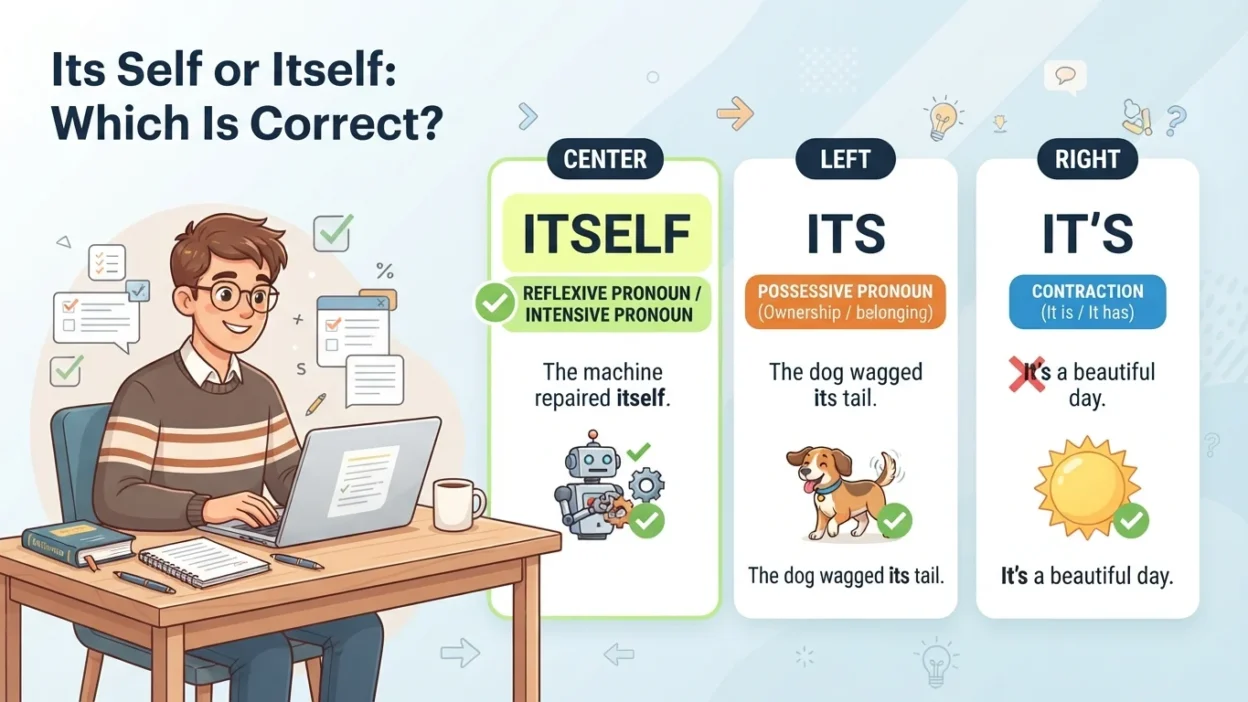
If you are unsure whether to write its self or itself, you are dealing with a common English spelling and grammar question. The two forms look almost identical, but they do not normally have the same grammatical function. In standard English, itself is the correct form when you need the reflexive pronoun.
The word itself is used when “it” refers back to a previously mentioned thing, animal, organization, idea, or situation. Its is a possessive determiner, while self is a noun, so writing its self changes the structure and meaning. In most everyday sentences, choosing itself is the natural and correct option.
Quick Answer: Its Self or Itself?
Itself is the correct spelling when you mean the reflexive pronoun referring back to “it.”
- ✅ The machine can repair itself.
- ✅ The company itself announced the decision.
- ✅ The cat cleaned itself.
- ❌ The machine can repair its self.
Its self is not normally used as a reflexive pronoun. The standard form is the single word itself.
Easy rule
Itself = reflexive pronoun
Its = possessive word
So, when you mean “the thing itself,” use itself.
What Does Itself Mean?
Itself is a reflexive pronoun. It is generally used when the subject and the object of a sentence refer to the same thing.
For example:
The dog hurt itself.
The dog is both the subject and the thing affected by the action. Therefore, itself is appropriate.
You can also use itself for emphasis:
The company itself confirmed the news.
Here, itself emphasizes the company. It does not mean that the company performed an action on itself. Instead, it highlights who confirmed the news.
This gives itself two important uses: reflexive use and emphatic use.
Why Is “Itself” Written as One Word?
English reflexive pronouns are normally written as single words:
- myself
- yourself
- himself
- herself
- itself
- ourselves
- yourselves
- themselves
The same pattern helps explain why itself is written as one word.
For example:
The child blamed himself.
You would not normally write “him self” in this meaning.
Likewise:
The machine repaired itself.
The reflexive pronoun is itself, not “its self.”
The spelling itself has become a standard single word in English.
Itself as a Reflexive Pronoun
The most basic use of itself is to refer back to a singular non-human subject.
Examples
- The cat washed itself.
- The computer restarted itself.
- The door closed itself.
- The bird injured itself.
- The machine switched itself off.
- The robot can move itself.
- The plant protects itself from extreme temperatures.
In each sentence, itself refers back to the subject.
For example:
The computer restarted itself.
The computer is the thing that restarted, and the computer is also the thing referred to by itself.
Itself for Emphasis
Itself can also emphasize a noun or pronoun.
For example:
The manager itself?
This would generally be inappropriate if the manager is a person, because itself is normally used for things and non-human entities. But with an organization or institution treated as a singular entity, itself can be appropriate:
The company itself issued the statement.
Here, the word emphasizes that the company—not merely an employee or representative—issued the statement.
Other examples include:
- The document itself contains the answer.
- The problem itself is quite simple.
- The idea itself is not difficult.
- The machine itself is very reliable.
- The website itself is easy to navigate.
In these examples, itself adds emphasis.
Itself vs. Its
One of the easiest ways to understand the difference is to compare itself with its.
Itself
Itself is a reflexive or emphatic pronoun.
The dog hurt itself.
Its
Its is a possessive determiner. It shows that something belongs to or is associated with something.
The dog wagged its tail.
The difference is important:
- itself = refers back to “it”
- its = shows possession
Compare these sentences:
The company changed its policy.
Here, the policy belongs to or is associated with the company.
The company changed the policy itself.
Here, itself emphasizes that the company personally or directly made the change.
Its Self vs. Itself: Comparison Table
| Form | Standard Use | Meaning | Example |
| itself | ✅ Correct | Reflexive or emphatic pronoun | The machine repaired itself. |
| its | ✅ Correct | Possessive determiner | The machine lost its power. |
| its self | ❌ Usually incorrect for reflexive meaning | Not the normal reflexive form | ❌ The machine repaired its self. |
The key point is that its self should not be used simply because itself looks like “its + self.”
Can “Its Self” Ever Be Correct?
There are unusual contexts in which its self can theoretically appear if self is being treated as a separate noun rather than as part of the pronoun itself. However, this is uncommon and usually belongs to specialized philosophical, literary, or highly technical writing.
For ordinary English, you should not split itself into its self.
For example:
The device can test itself.
is the normal sentence.
Writing:
The device can test its self.
would normally be considered incorrect.
If you are writing an email, article, essay, report, school assignment, or everyday message, use itself as one word when you need the reflexive pronoun.
Common Mistakes With Itself
1. Writing “its self” instead of “itself”
❌ The system can correct its self.
✅ The system can correct itself.
This is the most common mistake when people are unsure about the spelling.
2. Confusing “its” with “itself”
❌ The company updated itself website.
✅ The company updated its website.
In the second sentence, its is needed because the website belongs to or is associated with the company.
3. Confusing “it’s” with “its”
This is another very common error.
It’s is a contraction of it is or it has.
It’s a useful tool.
This means:
It is a useful tool.
Its shows possession:
The tool has its own settings.
And itself is the reflexive or emphatic form:
The tool can update itself.
Remember:
- it’s = it is / it has
- its = belonging to it
- itself = reflexive/emphatic form of it
Itself vs. It: Why Do We Need the Reflexive Form?
Sometimes English requires a reflexive pronoun because the subject and object refer to the same thing.
Compare:
The cat cleaned the cat.
This sounds unnatural if you mean that the cat cleaned its own body.
The natural sentence is:
The cat cleaned itself.
Similarly:
The machine damaged itself.
The reflexive pronoun makes the relationship clear.
This is why itself is useful: it prevents unnecessary repetition and clearly shows that the action comes back to the subject.
Examples of Itself in Everyday English
Here are some practical examples:
- The door opened itself.
- The phone turned itself off.
- The computer updated itself.
- The dog dried itself after the bath.
- The system automatically checks itself.
- The organization described itself as independent.
- The problem will resolve itself.
- The machine protects itself from overheating.
Notice that itself refers back to the singular thing or entity mentioned earlier.
Itself With Organizations and Companies
Modern English often treats companies, organizations, governments, websites, and institutions as singular entities. Therefore, itself can be used when referring back to them.
For example:
The company defended itself against the criticism.
Here, the company is the subject, and itself refers back to the company.
Another example:
The organization introduced itself to the public.
The organization introduced the same entity that the pronoun refers to.
You may also see emphatic use:
The company itself released the report.
This emphasizes that the company was directly responsible for releasing it.
Itself in Formal and Professional Writing
Itself is completely standard in formal English. You can safely use it in:
- Academic writing
- Business writing
- Professional emails
- Reports
- Technical documentation
- Websites
- Essays
- Everyday communication
For example:
The policy itself does not create any additional requirements.
This is a natural and professional sentence.
Another example:
The software can update itself automatically.
This is common technical writing.
There is no need to replace itself with “its self” simply because the writing is formal.
American vs. British English
There is no significant American vs. British English difference in the spelling of itself.
Both American English and British English use:
itself
as the standard reflexive and emphatic pronoun.
Its self is not a standard alternative spelling in either variety when you mean the reflexive pronoun.
For example, both American and British writers would normally write:
The machine can repair itself.
The spelling remains the same.
How to Remember Itself
A useful memory trick is to remember the family of reflexive pronouns:
- I → myself
- you → yourself
- he → himself
- she → herself
- it → itself
- we → ourselves
- they → themselves
When it refers back to the same thing, its reflexive form is itself.
You can also remember that reflexive pronouns such as myself, himself, and themselves are written as one word. Itself follows the same pattern.
If you mean possession, use its:
The dog wagged its tail.
If you mean the thing acting on or referring back to itself, use itself:
The dog cleaned itself.
FAQs
Is “its self” or “itself” correct?
Itself is correct when you need the reflexive pronoun. Its self is not normally used for this purpose.
Is “its self” ever grammatically correct?
In rare specialized contexts, self may be treated as a separate noun, but this is unusual. In ordinary English, use itself.
What is the difference between its and itself?
Its is a possessive determiner, while itself is a reflexive or emphatic pronoun.
For example:
The dog wagged its tail.
The dog cleaned itself.
Is “itself” one word?
Yes. Itself is normally written as one word.
Is “it’s self” correct?
No, not when you mean the reflexive pronoun. It’s means “it is” or “it has.” The correct reflexive form is itself.
Can itself refer to a company?
Yes. A company can be referred to with itself when the company is treated as a singular entity.
For example:
The company defended itself.
Is itself the same in American and British English?
Yes. Itself is the standard spelling in both American and British English.
Why do people write “its self”?
People may split the word because they recognize its and self as separate words. However, when they are forming the standard reflexive pronoun, the correct spelling is itself.
Summary
If you are choosing between its self or itself, use itself when you need the reflexive pronoun. It refers back to a singular non-human subject or can emphasize a noun, as in “The machine repaired itself” or “The company itself released the statement.” The spelling itself is standard in both American and British English.
Remember that its, it’s, and itself have different functions. Its expresses possession, it’s means “it is” or “it has,” and itself is the reflexive or emphatic form of it. In normal writing, do not split itself into its self.
Actionable Takeaway
Use this simple rule:
Itself = reflexive or emphasis
Its = possession
It’s = it is / it has
If your sentence means that something does something to itself, or you want to emphasize the thing, choose itself.