If you are confused about unregister vs deregister, you are not alone. Both words describe removing a person, device, account, or organization from a registration, but the preferred word can depend on the context and variety of English.
In most situations, unregister means to remove yourself or something from a registration, while deregister means to officially remove a person, organization, or item from an official register. Although the meanings overlap, they are not always interchangeable. Understanding the difference can help you choose the most natural word for formal, technical, academic, and everyday writing.
Quick Answer: Unregister vs Deregister
Unregister and deregister can both mean “to remove from a registration,” but they are commonly used in different contexts.
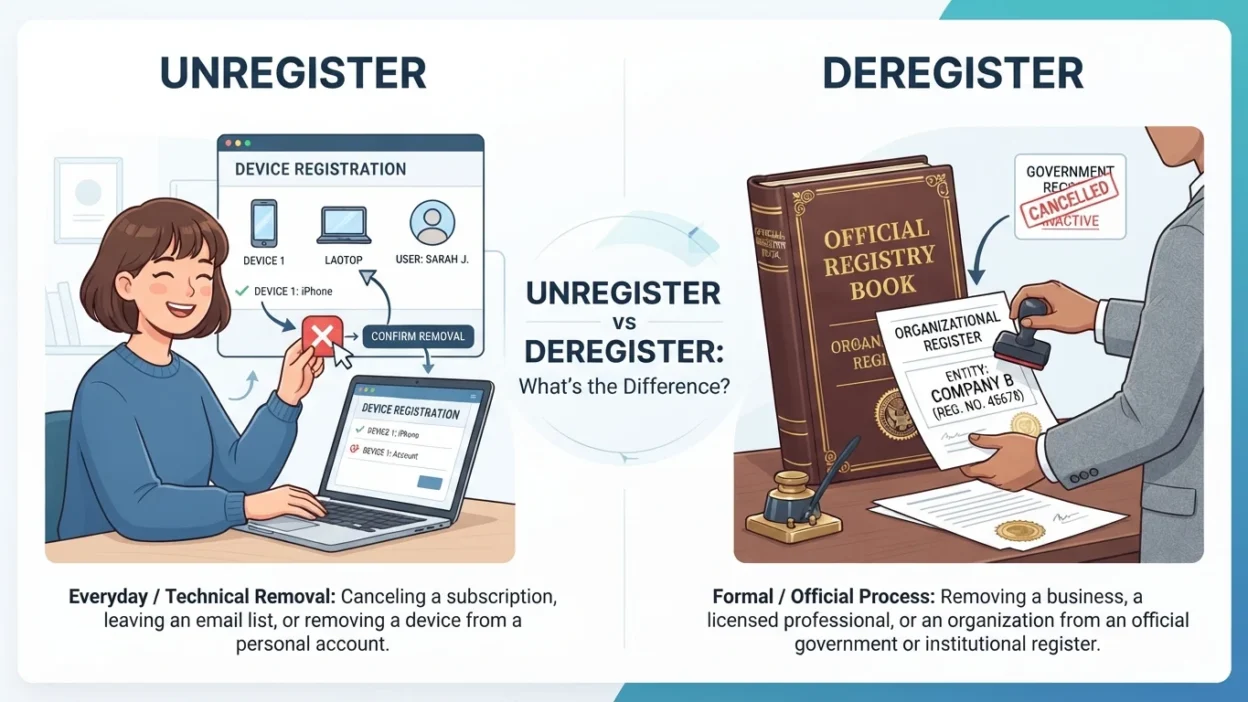
- Unregister = remove yourself, an account, device, or item from a registration or service.
- Deregister = officially remove a person, organization, vehicle, company, or item from an official register or list.
- Unregister is especially common in software, websites, subscriptions, devices, and everyday instructions.
- Deregister is more common in official, administrative, legal, educational, and regulatory contexts.
- In some situations, either word can be correct.
Simple rule: Use unregister for ordinary registration actions and deregister when the removal is formal or official.
What Does Unregister Mean?
Unregister is a verb meaning to remove someone or something from a registration, service, system, list, or account.
It is often used when a person voluntarily removes themselves or when an organization removes an item from a system.
For example:
- I want to unregister from the mailing list.
- Please unregister the device before selling it.
- She decided to unregister for the event.
- You can unregister your account through the settings menu.
- The software allows users to unregister a device remotely.
The word is especially common in technology, software, websites, online accounts, subscriptions, events, and digital services.
Unregister in Simple English
In simple terms:
Unregister means to remove yourself or something from a registration.
It is essentially the opposite of register in many everyday situations.
For example:
Register: Add your name to a class.
Unregister: Remove your name from the class.
What Does Deregister Mean?
Deregister means to officially remove someone or something from a register or registration.
The prefix de- often conveys the idea of reversing an action or removing a status. Therefore, deregister can suggest formally ending or canceling a registration.
Examples include:
- The company was deregistered after failing to meet regulatory requirements.
- Students must deregister from the course before the deadline.
- The vehicle was deregistered by the authorities.
- The organization decided to deregister as a registered charity.
- The business was officially deregistered.
The word is particularly useful when dealing with official records, government registers, institutions, legal status, businesses, educational programs, and regulatory systems.
Deregister in Simple English
Simply put:
Deregister means to officially remove someone or something from a register.
The emphasis is often on the formal status being removed rather than simply canceling a registration.
Unregister vs Deregister: Key Difference
The main difference is context and formality.
Unregister tends to sound more practical and user-focused. It is common when someone removes an account, device, subscription, or event registration.
Deregister tends to sound more formal and administrative. It is often used when an official authority, institution, or organization removes something from a register.
However, these are tendencies rather than absolute rules. Some contexts naturally accept both words.
Unregister vs Deregister Comparison Table
| Feature | Unregister | Deregister |
| Basic meaning | Remove from registration | Officially remove from a register |
| Tone | Everyday or technical | Formal or administrative |
| Common contexts | Accounts, devices, websites, events | Government, education, companies, legal records |
| Often user-initiated? | Yes | Sometimes |
| Common in technology? | Very common | Less common |
| Common in official records? | Sometimes | Very common |
| Opposite of register? | Often | Often |
| Example | Unregister your device | Deregister the company |
The important point is that neither word is universally “more correct.” The appropriate choice depends on what is being removed and from what kind of registration.
When Should You Use Unregister?
Choose unregister when you are talking about an ordinary registration or a digital system.
It works particularly well with:
- online accounts
- devices
- software
- websites
- email lists
- events
- services
- subscriptions
- user profiles
- applications
For example:
Click here to unregister your device.
This sounds natural because the action involves removing a device from a digital system.
Another example:
I need to unregister from the workshop.
This can be natural when you are simply canceling your participation.
When Should You Use Deregister?
Use deregister when the registration has a formal, official, or institutional character.
It is especially appropriate for:
- companies
- charities
- organizations
- vehicles
- official records
- professional registrations
- government registers
- educational enrollment
- regulatory systems
For example:
The organization was deregistered from the official register.
Here, deregister sounds appropriate because an official status has been removed.
Similarly:
The company was deregistered by the authorities.
The formal nature of the action makes deregister a strong choice.
Unregister vs Deregister in Education
Education is one area where both words may appear.
For example:
Students can unregister from the course before the deadline.
This sounds relatively straightforward and student-focused.
You may also see:
Students must deregister from the course before the semester begins.
This sounds more institutional and formal.
In some universities, deregister is the established administrative term. In others, withdraw, drop, or unenroll may be preferred.
Therefore, when dealing with a specific school or university, follow its official terminology.
Unregister vs Deregister in Technology
In technology, unregister is generally the more natural choice.
For example:
- Unregister the device.
- Unregister the plugin.
- Unregister the application.
- Unregister the service.
- Unregister the user account.
Software documentation frequently uses register/unregister as a pair because registration often involves adding an object to a system and unregistering removes it.
Deregister can also appear in technical contexts, particularly when a formal status or registry is involved, but unregister is usually the more familiar technical term.
Common Mistakes to Avoid
Mistake 1: Treating the Words as Completely Different
The meanings overlap significantly. It is not accurate to say that one always means “cancel” and the other always means “delete.”
Context matters.
Mistake 2: Using Deregister for Every Online Action
Although deregister is a valid word, it can sound unnecessarily formal when talking about everyday digital services.
For example:
Please unregister your device.
is generally more natural than:
Please deregister your device.
unless the system itself officially uses deregister.
Mistake 3: Assuming Unregister Is Always Informal
Unregister can also be used in technical and professional documentation. It is not an incorrect or purely casual word.
For example:
The application automatically unregisters inactive devices.
That sentence is perfectly appropriate for technical writing.
Mistake 4: Confusing Deregister With Unsubscribe
These words are not always interchangeable.
Unsubscribe usually means stopping emails, newsletters, notifications, or recurring communications.
Unregister means removing a registration.
For example:
I unsubscribed from the newsletter.
but:
I unregistered for the conference.
Unregister, Deregister, Unsubscribe, and Withdraw
These related words can be confusing, so consider their usual meanings:
- Unregister: remove from a registration or system.
- Deregister: officially remove from a register.
- Unsubscribe: stop receiving a subscription or communication.
- Withdraw: formally remove yourself from something, such as a course or application.
- Cancel: stop an event, service, booking, or arrangement.
Choosing the right verb makes your writing more precise.
American vs British English Differences
There is no strict American-versus-British spelling difference between unregister and deregister. Both forms can be found in different English-speaking regions.
However, usage preferences can vary by institution, government agency, university, and industry.
Deregister is particularly familiar in British and other varieties of international English in formal or administrative contexts. Unregister is widely understood and especially common in American English technology and software contexts.
That said, neither word should be treated as exclusively American or British.
The best approach is to consider the context, audience, and terminology used by the organization involved.
Synonyms and Related Terms
Depending on the situation, you may use:
- remove
- cancel
- withdraw
- delete
- deactivate
- unsubscribe
- terminate
- revoke
- withdraw registration
- cancel registration
- remove from the register
- end enrollment
Be careful with these alternatives because they do not always have exactly the same meaning.
For instance, deactivate may mean that an account remains registered but is no longer active. Delete may mean permanently removing data rather than merely ending registration.
FAQs
Is unregister or deregister correct?
Both are correct words. Unregister is commonly used for removing something from a registration or system, while deregister often suggests formal removal from an official register.
Is unregister a real word?
Yes. Unregister is a standard English verb. It is particularly common in technology, software, online services, accounts, devices, and event registration.
Is deregister a real word?
Yes. Deregister is a standard English verb meaning to remove someone or something from a register or official registration.
What is the opposite of register?
Depending on the context, possible opposites include unregister, deregister, withdraw, cancel, or remove from the register.
Should I say unregister or unsubscribe?
Use unsubscribe when you are stopping a subscription, newsletter, or recurring communication. Use unregister when you are removing a registration.
Is deregister more formal than unregister?
Generally, yes. Deregister often has a more formal or administrative tone, while unregister is common in everyday and technical contexts.
Is deregister British English?
Deregister is used in British English and other varieties of English, but it is not exclusively British. It is also used in American and international contexts.
Which word is better for software?
Unregister is generally the more natural choice in software and technical contexts, particularly when reversing a registration action.
Summary
The difference between unregister vs deregister is mainly one of context, emphasis, and formality. Unregister commonly refers to removing a person, device, account, or item from a registration or system. It is especially common in technology, online services, events, and everyday instructions.
Deregister, meanwhile, often refers to the formal or official removal of something from a register. It is frequently used for companies, organizations, vehicles, educational enrollment, government records, and regulatory matters. Both words are correct, and neither is universally better than the other.
Actionable Takeaway
Use this simple rule:
Use “unregister” for systems, devices, accounts, services, and everyday registration actions.
Use “deregister” for formal registers, official records, organizations, companies, and administrative processes.
When both are possible, choose the term that matches the terminology used by the relevant website, institution, software, or authority. That will usually be the clearest and most natural choice.