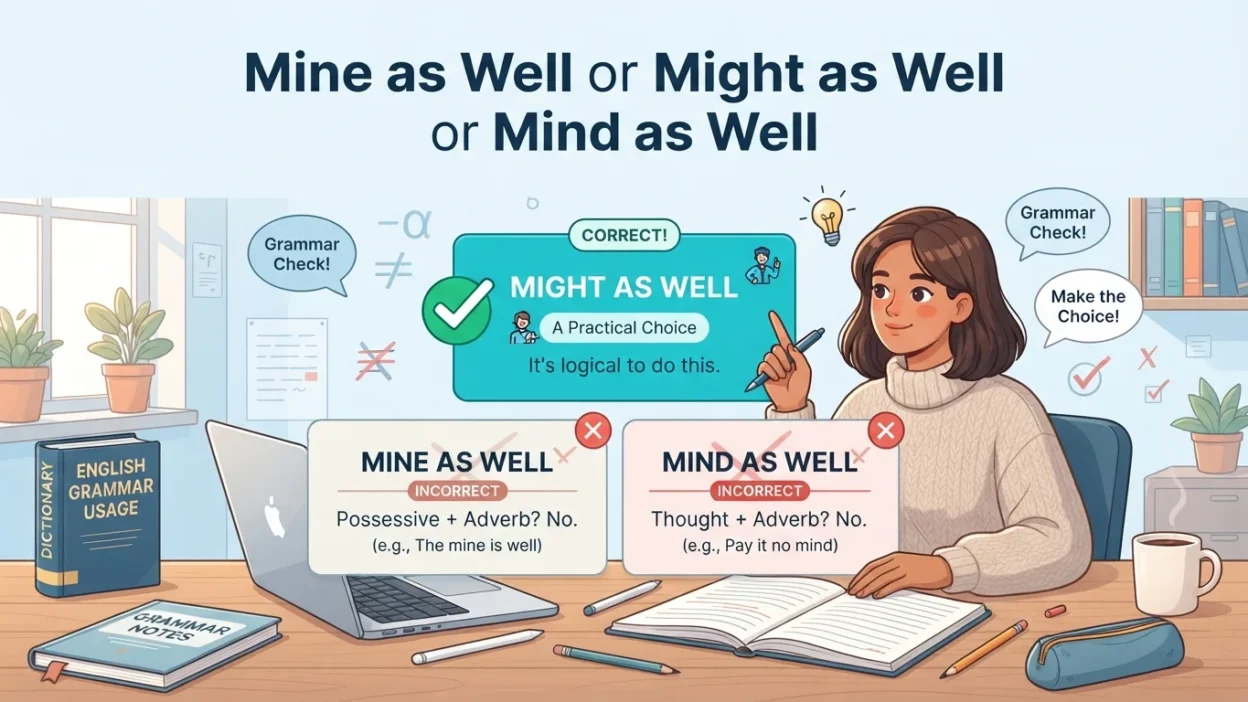
If you have ever wondered whether the correct phrase is mine as well or might as well or mind as well, you are dealing with a very common English expression mix-up. The three phrases sound somewhat similar in fast speech, but only one is the standard expression used to mean that an action is reasonable or has little downside.
The correct phrase is might as well. The expressions mine as well and mind as well are usually misspellings caused by hearing the phrase incorrectly. Once you understand what might as well means and how it works in a sentence, this confusion becomes much easier to avoid.
Quick Answer: Mine as Well or Might as Well or Mind as Well?
Might as well is the correct phrase when you mean that someone should do something because there is no strong reason not to do it.
- ✅ We are already here, so we might as well stay.
- ✅ You have finished your work, so you might as well relax.
- ❌ We are already here, so we mine as well stay.
- ❌ We are already here, so we mind as well stay.
Mine as well and mind as well are generally incorrect when you intend to use the common expression might as well.
Quick rule
Might as well = it makes sense to do it because there is little reason not to.
What Does “Might as Well” Mean?
Might as well is an idiomatic expression used when an action seems reasonable, convenient, or worthwhile because there is no better alternative.
It can also suggest that a situation has already led you toward a particular action.
For example:
We are already at the store, so we might as well buy some groceries.
The speaker is saying that since they are already at the store, buying groceries is a sensible thing to do.
Another example is:
The movie has already started, so we might as well watch it.
The expression does not necessarily mean that the speaker is excited about the action. Sometimes it suggests acceptance, resignation, or a practical decision.
Why Is “Might as Well” Correct?
The phrase comes from the modal verb might, followed by as well.
In this expression, might does not necessarily express ordinary uncertainty about whether something will happen. Instead, might as well has developed an idiomatic meaning similar to:
- It would be reasonable to…
- There is no reason not to…
- We may as well…
- It makes sense to…
- Since we are already doing this, we can also…
For example:
We have another hour before the meeting, so we might as well get some coffee.
The speaker is making a practical suggestion based on the situation.
Why Do People Say “Mine as Well”?
Mine as well is usually a phonetic spelling mistake.
When people hear might as well spoken quickly, the sounds can blend together. The phrase may sound less distinct than it looks when written.
Because mine is already a familiar English word, someone who is unsure of the spelling may write mine as well instead of might as well.
However, mine as well does not have the same idiomatic meaning.
The word mine normally refers to possession:
That book is mine.
It can also refer to a place where minerals are extracted:
The workers entered the mine.
Neither meaning fits the expression might as well.
Why Is “Mind as Well” Incorrect?
Mind as well is another common spelling mistake.
The word mind is a real English word, but it does not belong in the standard idiom might as well.
Mind can mean the part of a person associated with thoughts, feelings, and awareness:
Keep that idea in your mind.
It can also function as a verb:
Do you mind waiting?
But neither meaning creates the standard expression mind as well.
Therefore:
❌ I mind as well go home.
✅ I might as well go home.
Might as Well vs. May as Well
You may also hear may as well, which is closely related to might as well.
Both expressions can mean that an action is reasonable because there is no particular reason not to do it.
For example:
We are already here, so we might as well eat.
and:
We are already here, so we may as well eat.
Both can be correct.
In everyday conversation, might as well is extremely common. May as well is also natural and can sometimes sound slightly more direct or matter-of-fact depending on the context.
The important point is that neither mine as well nor mind as well replaces these expressions.
Comparison Table
| Phrase | Correct? | Meaning | Example |
| might as well | ✅ Yes | It is reasonable to do something | We might as well leave now. |
| may as well | ✅ Yes | It is reasonable to do something | We may as well start. |
| mine as well | ❌ Usually incorrect | Common misspelling of might as well | ❌ We mine as well go. |
| mind as well | ❌ Usually incorrect | Common misspelling of might as well | ❌ We mind as well go. |
How to Use “Might as Well” in a Sentence
The most common structure is:
Subject + might as well + base verb
Examples:
- I might as well leave.
- We might as well start.
- You might as well ask.
- She might as well try.
- They might as well stay.
Notice that the verb following might as well remains in its base form.
Correct
We might as well go.
Incorrect
We might as well went.
Incorrect
We might as well going.
Because might is a modal verb, it is followed by the base form of the main verb.
Examples of “Might as Well”
Here are practical examples you can use in everyday English.
When there is no better option
The bus is delayed, so we might as well walk.
The speaker sees walking as a reasonable alternative.
When you are already doing something
Since you’re already at the store, you might as well buy some milk.
The extra action is convenient because the person is already there.
When accepting an unavoidable situation
The rain has already started, so we might as well continue the trip.
The speaker accepts the situation and decides to continue.
When making a casual suggestion
We have some free time, so we might as well watch a movie.
The action seems worthwhile because there is nothing better to do.
“Might as Well” Can Express Resignation
One subtle feature of might as well is that it can sometimes express resignation.
Consider:
The restaurant is closed, so we might as well go home.
The speaker may not particularly want to go home. Instead, going home appears to be the logical option because the restaurant is closed.
Similarly:
Nobody else is coming, so we might as well start without them.
This can sound practical, accepting, or slightly resigned depending on tone.
Understanding this emotional nuance can help you use the phrase more naturally.
Common Mistakes With Might as Well
1. Writing “mine as well”
❌ I mine as well call him.
✅ I might as well call him.
The incorrect version usually comes from confusing the pronunciation of might with mine.
2. Writing “mind as well”
❌ We mind as well stay here.
✅ We might as well stay here.
Although mind is a legitimate English word, it is not part of this idiom.
3. Using the wrong verb form
❌ We might as well went home.
✅ We might as well go home.
After might, use the base form of the verb.
4. Confusing “might as well” with “as well”
As well can simply mean also:
She is coming as well.
But might as well is an idiomatic expression with a different meaning:
She might as well come with us.
The first means “also.” The second suggests that coming is a reasonable choice.
Might as Well vs. Should
These expressions can overlap, but they do not always have exactly the same tone.
Should can express advice, obligation, or what is considered the right thing to do.
You should call your mother.
Might as well usually sounds more casual and practical:
You might as well call your mother while you have your phone out.
The second sentence suggests that calling is convenient or reasonable under the circumstances.
This difference is useful in natural conversation because might as well often carries a softer or more resigned tone than should.
American vs. British English
There is no major American-versus-British spelling difference here.
Might as well is standard in both American and British English. May as well is also used in both varieties.
The incorrect forms mine as well and mind as well are not standard alternatives in either variety.
You may notice differences in pronunciation, accent, or conversational frequency, but the standard written phrase remains:
might as well
How to Remember the Correct Phrase
A simple memory trick is to focus on the word might.
Think:
I might do it, so I might as well do it.
For example:
I have nothing else to do, so I might as well clean my room.
You can also remember that mine relates to possession:
The phone is mine.
And mind relates to thoughts or attention:
Keep it in mind.
Neither meaning fits the common idiom.
Therefore, when you mean “there is no reason not to,” use:
might as well
FAQs
Is it “mine as well” or “might as well”?
The correct expression is might as well when you mean that doing something is reasonable because there is little or no reason not to do it.
Is “mind as well” correct?
Not as the standard idiom. Mind as well is generally a misspelling of might as well.
Is “mine as well” a correct phrase?
Mine as well is not the standard expression used to mean “it is reasonable to do something.” Use might as well instead.
What does “might as well” mean?
Might as well means that an action is reasonable or worthwhile because there is no strong reason not to do it.
Is “may as well” also correct?
Yes. May as well is a standard expression with a meaning very similar to might as well.
What comes after “might as well”?
Use the base form of a verb after might as well.
Correct:
We might as well leave.
Incorrect:
We might as well leaving.
Is “might as well” formal or informal?
It can be used in both casual and neutral contexts, but it is particularly common in everyday conversation. In highly formal writing, alternatives such as “it would be reasonable to” may sometimes be more appropriate.
Is “might as well” the same in American and British English?
Yes. Might as well is standard in both American and British English, with no spelling difference.
Summary
If you are choosing between mine as well or might as well or mind as well, the correct standard expression is might as well. It means that an action is reasonable because there is no strong reason not to do it, or because the circumstances make that action the practical choice. Mine as well and mind as well are usually spelling mistakes caused by the similar sound of the words in natural speech.
Remember that might, mine, and mind have different meanings. Might as well is the idiom you need when making a practical suggestion or accepting an unavoidable situation. Once you connect the phrase with its meaning—“there is no reason not to”—the correct spelling becomes much easier to remember.
Actionable Takeaway
When you mean “it is reasonable to do this” or “there is no reason not to,” always write:
Might as well.
Use mine when talking about possession and mind when referring to thoughts, attention, or concern. This simple distinction will help you avoid all three common forms being mixed up.