The to fast or too fast difference matters because to fast is usually ungrammatical, while too fast is a common adverbial phrase that describes excessive speed. Understanding this difference helps you write accurately because too is an adverb that intensifies and modifies fast, while to can work as a preposition or infinitive marker. For example, to run uses to as an infinitive marker, whereas to the store uses it as a preposition before a noun. In the sentence, “He drove to fast” is incorrect because to does not function as an intensifier; the correct form is “He drove too fast.” Here, fast is an adverb, and too fast means someone ran or drove at an excessive speed. When checking verb tense, subject–verb agreement, and other parts of speech, sample sentences can reveal common mistakes because nouns, verbs, adjectives, adverbs, prepositions, conjunctions, and pronouns have different roles. Contextual examples throughout this article can help writers and editors diagnose errors, compare American and British tendencies, recognize idiomatic uses, and apply practical tips. Keep modifiers close to the words they modify, check verb forms, correct tense, and agreement, then revise any awkward phrasing so your prose stays precise and natural.
Quick Answer: To Fast or Too Fast?
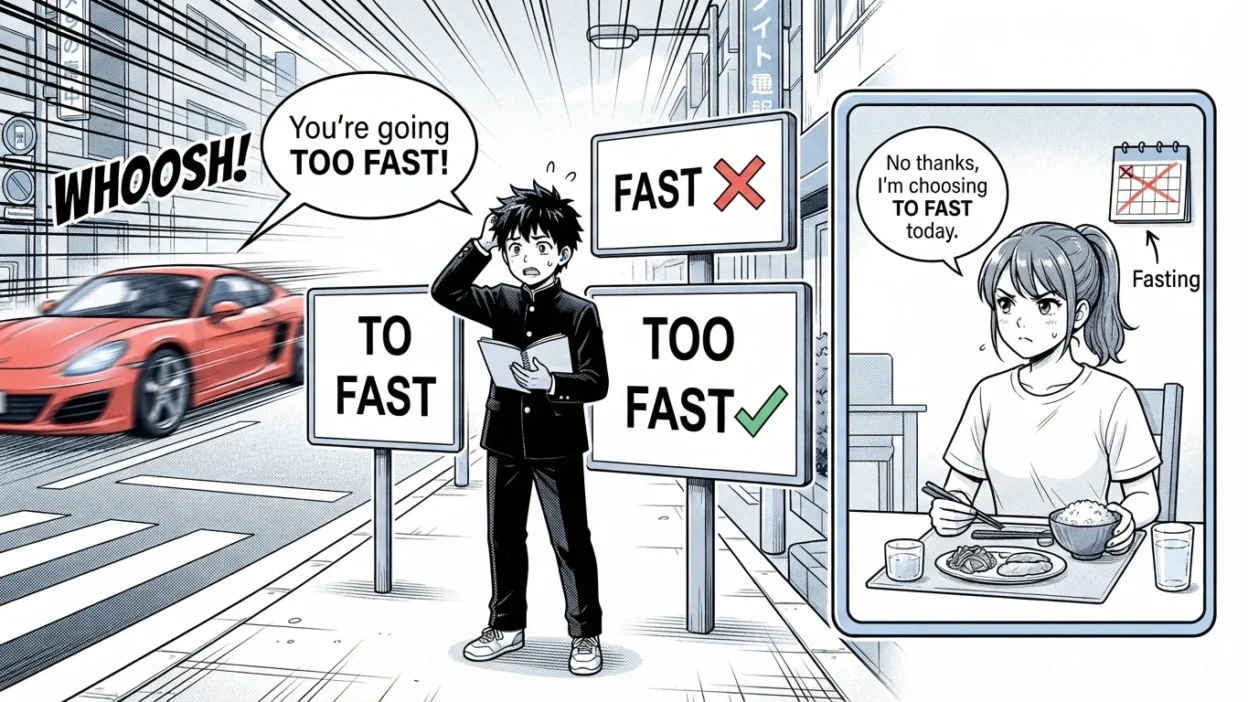
Too fast is correct when you mean “at a speed that is excessive” or “more quickly than is appropriate.”
- ✅ The car is going too fast.
- ✅ You are speaking too fast.
- ✅ He ran too fast for me to catch him.
- ❌ The car is going to fast.
The word too means “more than necessary,” “more than desirable,” or “excessively.”
The word to is usually a preposition or part of an infinitive verb:
- I went to school.
- I want to run.
- She likes to swim.
Therefore, if you are describing speed, the usual expression is too fast, not to fast.
What Does Too Fast Mean?
Too fast means that something is moving, happening, or progressing at a speed greater than what is appropriate, comfortable, safe, or desirable.
The word fast describes speed, while too adds the idea of excess.
For example:
The car is going too fast.
This means the car is moving faster than it should.
Similarly:
You are talking too fast.
This means the person is speaking at a speed that makes it difficult for someone else to understand.
The phrase can describe physical movement, speech, learning, changes, processes, or even the passage of time.
Why Is “To Fast” Usually Incorrect?
The confusion happens because to and too are pronounced similarly in many varieties of English. This makes them easy to confuse when writing.
However, their grammatical jobs are different.
To commonly shows direction, destination, or purpose:
- We went to the store.
- She walked to the office.
- I want to learn English.
Too can mean “also” or “excessively”:
- I want to come too.
- The coffee is too hot.
- He drives too fast.
When too comes before an adjective or adverb, it often means “more than is appropriate.”
That is exactly what happens in too fast.
Too Fast: Correct Examples
Here are some practical examples of too fast in everyday English:
- You are driving too fast.
- The train is moving too fast.
- She speaks too fast for beginners.
- He ran too fast and fell.
- The water is flowing too fast.
- This computer is processing the file too fast to catch the error.
- The lesson moved too fast for me.
- Time seems to pass too fast when I am having fun.
In every example, too indicates an excessive or unsuitable degree of speed.
Can “To Fast” Ever Be Correct?
Yes, but this is where the grammar becomes interesting.
To fast can be grammatically correct when fast is being used as a verb meaning to abstain from food, usually for a period of time.
For example:
She decided to fast for one day.
Here, to is part of the infinitive to fast. It has nothing to do with speed.
Another example is:
He plans to fast during the morning.
In these sentences, fast means not eating, rather than moving quickly.
This distinction is important because to fast is not always a spelling error. It is simply a different grammatical construction.
To Fast vs. Too Fast: Comparison Table
| Expression | Correct? | Meaning | Example |
| too fast | ✅ Yes | At an excessive speed | You are driving too fast. |
| to fast | ✅ Sometimes | To abstain from food | She decided to fast. |
| to fast for speed | ❌ No | Incorrect expression | ❌ The car is going to fast. |
| too fast for fasting | ❌ No | Wrong meaning | ❌ He decided too fast. |
The important point is that to fast and too fast are not simply two spellings of the same phrase.
Too Fast in Different Situations
Driving and transportation
Too fast is frequently used when discussing safety.
The driver was going too fast.
This means the driver was traveling at an excessive speed.
Speaking
The phrase can also describe speech.
You are speaking too fast.
Here, the problem is not physical movement. The person’s speech is happening at an excessive rate.
Learning
You can use too fast to describe a pace that is difficult to follow.
The teacher explained the topic too fast.
This suggests that the lesson progressed more quickly than the learner could comfortably understand.
Change or development
Too fast can also describe something developing or changing rapidly.
The company is growing too fast.
This means the growth is happening at a rate that may be difficult to manage.
Too Fast vs. Very Fast
One common source of confusion is the difference between too fast and very fast.
Very fast simply means extremely fast.
Too fast means faster than is appropriate or desirable.
Compare:
The athlete runs very fast.
This is usually a positive or neutral statement.
The athlete is running too fast.
This suggests that the speed has become excessive for the situation.
Another example:
She speaks very fast.
This describes her speaking speed.
She speaks too fast.
This suggests that her speed causes a problem, such as making her difficult to understand.
Common Mistakes With To Fast and Too Fast
1. Writing “to fast” when you mean excessive speed
❌ You are driving to fast.
✅ You are driving too fast.
When you mean “more quickly than appropriate,” always use too.
2. Thinking “to” and “too” are interchangeable
They are not interchangeable.
To often indicates direction or forms an infinitive.
Too means “also” or “excessively.”
For example:
- I went to work.
- I want to work.
- I work too much.
3. Assuming “too fast” always means physical movement
It does not.
You can speak too fast, learn too fast, grow too fast, change too fast, or work too fast.
The expression describes an excessive rate or pace, not only physical speed.
4. Forgetting the special meaning of “to fast”
To fast can be correct when fast is a verb.
They chose to fast.
Here, fast means to avoid eating.
So, do not automatically assume every occurrence of to fast is a spelling mistake. Look at the meaning and grammatical structure first.
American vs. British English
There is no meaningful American-versus-British spelling difference between too fast and to fast.
American English and British English use too fast when describing excessive speed or pace.
For example:
- American English: You are driving too fast.
- British English: You are driving too fast.
The spelling and grammar are the same.
The pronunciation of to and too can vary slightly depending on sentence position and accent, but this does not change their written meanings.
If you are writing for either American or British readers, use too fast when you mean “excessively fast.”
How to Remember Too Fast
A simple memory trick can help:
Too = more than needed.
If something is moving more quickly than it should, use too fast.
Think:
Too much → too fast
Both expressions describe excess.
You can also remember:
To = direction or infinitive
Too = also or excessive
For example:
- I went to the store.
- I want to run.
- I run too fast.
- She is too tired.
This simple distinction can prevent many common grammar and spelling mistakes.
More Examples of Too Fast
Here are additional examples to make the usage clear:
- The car was traveling too fast.
- Don’t walk too fast.
- The baby is growing too fast.
- The speaker talked too fast.
- The movie moved too fast for me to understand the plot.
- You are typing too fast.
- The river is flowing too fast after the storm.
- The project is moving too fast without proper planning.
- He learns too fast for the current class.
- The days seem to go too fast.
Each sentence describes an excessive rate, speed, or pace.
Examples of “To Fast”
Now compare those examples with sentences where to fast is genuinely correct:
- She decided to fast before the ceremony.
- He plans to fast tomorrow.
- They agreed to fast for a short period.
- I am not prepared to fast for several days.
Here, fast is a verb meaning to abstain from food. The word to introduces the infinitive.
The meaning changes completely depending on the context.
FAQs
Is it “to fast” or “too fast”?
too fast when you mean “faster than appropriate” or “at an excessive speed.” To fast is used when fast is a verb meaning to abstain from food.
Is “to fast” grammatically correct?
Yes, but only in the appropriate context. For example, “I decided to fast” is grammatically correct because fast is a verb.
Is “too fast” one word?
No. Too fast is written as two separate words. Too modifies the adverb fast.
Why do people confuse to and too?
They are pronounced similarly, so writers may confuse them when relying on sound rather than spelling. Their grammatical functions, however, are different.
What does too fast mean?
Too fast means moving, speaking, changing, or progressing at a speed or rate that is greater than appropriate or desirable.
Is “very fast” the same as “too fast”?
No. Very fast describes a high speed without necessarily suggesting a problem. Too fast indicates that the speed is excessive for the situation.
Is too fast correct in American English?
Yes. Too fast is the standard expression in American English when describing excessive speed or pace.
Is too fast correct in British English?
Yes. British English also uses too fast for excessive speed or pace. There is no spelling difference between the two varieties in this expression.
Summary
If you are wondering whether to fast or too fast is correct when talking about excessive speed, the answer is too fast. Use too when something is happening at a greater speed or rate than is appropriate, comfortable, safe, or desirable. This applies to driving, speaking, learning, working, growing, changing, and many other situations.
However, to fast can be correct when fast functions as a verb meaning to abstain from food. The easiest way to avoid confusion is to focus on meaning: if you mean “excessively,” choose too; if to introduces the verb fast, then to fast can be correct. This rule works in both American and British English.
Actionable Takeaway
Remember this simple rule:
Too fast = excessively fast.
To fast = to abstain from food.
Before choosing between them, ask yourself what fast means in your sentence. If you are talking about speed or pace that is excessive, write too fast.