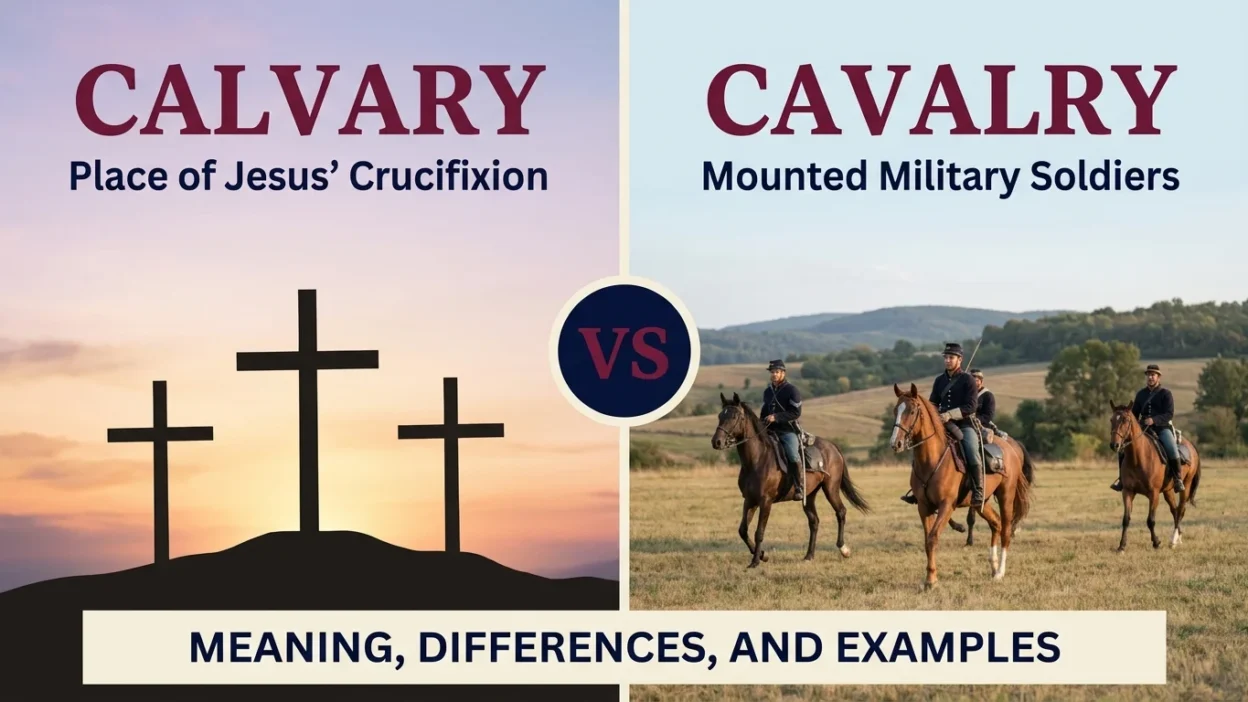
Have you ever confused calvary vs cavalry while reading a book, writing an essay, or checking your spelling? You are not alone. These two words look and sound very similar, but they have completely different meanings. Using the wrong one can change the meaning of your sentence entirely.
The good news is that learning the difference between calvary and cavalry is simple once you understand what each word represents. One is associated with Christianity and the crucifixion of Jesus Christ, while the other refers to soldiers who traditionally fought on horseback. In this guide, you will learn their meanings, pronunciation, correct usage, examples, and easy ways to remember the difference.
Quick Answer: Calvary vs Cavalry
Calvary refers to the place where Jesus Christ was crucified. It can also symbolize suffering, sacrifice, or a difficult experience.
Cavalry refers to a military unit traditionally made up of soldiers who fought on horseback. In modern military contexts, the term can also describe certain armored or reconnaissance units.
Easy memory trick: Calvary has an L, like the hill associated with the crucifixion of Jesus. Cavalry has an A, like an army that historically rode horses into battle.
Examples:
- Correct: The painting showed Jesus carrying the cross toward Calvary.
- Correct: The cavalry advanced across the battlefield.
- Incorrect: The cavalry is where Jesus was crucified.
- Incorrect: The calvary charged toward the enemy.
What Does Calvary Mean?
Calvary is a proper noun that refers to the place outside Jerusalem where Jesus Christ was crucified, according to Christian tradition. The name is especially important in Christianity because it represents Jesus’ suffering, sacrifice, and death.
The word comes through Latin Calvaria, meaning “skull,” from the name traditionally associated with the place of crucifixion, known in the Bible as Golgotha.
Calvary is often used in religious discussions, sermons, literature, hymns, and historical accounts of the crucifixion. In figurative language, it can also describe a period of intense suffering or a painful personal struggle.
Examples of Calvary in Sentences
Here are some examples that show how to use calvary correctly:
- Religious context: The church displayed a painting of Jesus on Calvary.
- Biblical context: The story describes Jesus’ journey to Calvary before his crucifixion.
- Historical context: The guide explained the religious significance of Calvary to the visitors.
- Literary context: The poet compared the character’s suffering to a personal Calvary.
- Figurative context: After months of hardship, she felt she had finally passed through her own Calvary.
Notice that Calvary usually appears in religious, historical, or figurative contexts. Because it is the name of a specific biblical place, it is normally capitalized when referring to that place.
Synonyms and Related Words for Calvary
Calvary does not have a perfect synonym when referring to the biblical location. However, several related words can help explain its meaning:
- Golgotha: The biblical name associated with the place of Jesus’ crucifixion.
- Crucifixion: The execution method by which Jesus was put to death.
- Sacrifice: Giving something up or suffering for a greater purpose.
- Suffering: The experience of physical or emotional pain.
- Ordeal: A difficult or painful experience, especially in figurative usage.
Remember that these words are related in meaning but are not always interchangeable with Calvary.
What Does Cavalry Mean?
Cavalry is a noun referring to a military unit traditionally composed of soldiers who rode horses into battle. Historically, cavalry units were valued for their speed, mobility, reconnaissance, and ability to attack quickly.
Before modern mechanized warfare, cavalry played an important role in many armies around the world. Mounted soldiers could move across large areas, deliver rapid attacks, pursue retreating forces, and gather information about enemy positions.
Although horses are no longer the primary means of transportation for most cavalry units, the term remains in use in modern military organizations. Some units called cavalry operate armored vehicles or perform reconnaissance missions.
Cavalry is also used informally in the expression “send in the cavalry,” meaning to bring help, reinforcements, or additional support when a situation becomes difficult.
Examples of Cavalry in Sentences
Here are some practical examples of cavalry in different contexts:
- Historical context: The cavalry crossed the open field to reach the enemy.
- Military context: The general ordered the cavalry to protect the army’s flank.
- Battlefield context: The cavalry moved quickly to reinforce the infantry.
- Modern context: The cavalry unit used armored vehicles during the training exercise.
- Figurative context: We were struggling to finish the project until our manager sent in the cavalry.
- Everyday conversation: I need someone to come to the rescue and send in the cavalry before the deadline.
These examples show that cavalry is associated with military forces, mounted soldiers, armored units, or the idea of coming to someone’s rescue.
Synonyms and Related Words for Cavalry
Depending on the context, these words may be related to cavalry:
- Mounted troops: Soldiers who travel or fight on horseback.
- Horsemen: People who ride horses, particularly in a military setting.
- Mounted soldiers: Military personnel traditionally equipped with horses.
- Armored unit: A military formation using armored vehicles; not a universal synonym for cavalry.
- Reinforcements: Additional personnel or support sent to assist an existing force.
- Rescue team: A group that provides help in a difficult situation, particularly in figurative usage.
Not every related word is a direct substitute. For example, reinforcements may include infantry or other military personnel rather than cavalry specifically.
Calvary vs Cavalry: Key Differences
Calvary vs Cavalry: Key Differences
Although calvary and cavalry look almost identical, their meanings, origins, and uses are different. Understanding these differences will help you choose the right word when writing.
| Feature | Calvary | Cavalry |
| Part of speech | Noun | Noun |
| Main meaning | Place of Jesus’ crucifixion | Traditionally horse-mounted soldiers |
| Word origin | Latin Calvaria | Italian cavalleria, through French |
| Common context | Christianity, religion, suffering | Military history, warfare, rescue |
| Example | They discussed the events at Calvary. | The cavalry moved toward the battlefield. |
| Figurative use | A painful or difficult experience | Help arriving in a crisis |
| Capitalization | Usually capitalized for the biblical place | Usually lowercase unless part of a formal name |
The easiest way to distinguish the words is to look at the subject of your sentence. If you are discussing Jesus, the Bible, or religious sacrifice, Calvary is generally the correct choice. If you are discussing soldiers, horses, military history, or a group coming to the rescue, use cavalry.
Common Mistakes When Using Calvary and Cavalry
Because these words have similar spellings and pronunciations, even experienced writers can mix them up. Here are some mistakes to avoid.
1. Using Cavalry in a Religious Context
Incorrect: Jesus was crucified on Cavalry.
Correct: Jesus was crucified at Calvary.
Why? Calvary is the name traditionally given to the place of Jesus’ crucifixion. Cavalry refers to military troops.
2. Using Calvary to Describe Soldiers
Incorrect: The calvary arrived to reinforce the army.
Correct: The cavalry arrived to reinforce the army.
Why? The sentence describes military support, so cavalry is the appropriate word.
3. Confusing the Expression “Send in the Cavalry”
Incorrect: We need someone to send in the calvary.
Correct: We need someone to send in the cavalry.
Why? This familiar expression means bringing help or support when it is urgently needed. It does not refer to a religious place.
4. Assuming the Words Are Different Spellings of the Same Term
Incorrect: Calvary and cavalry are interchangeable words.
Correct: Calvary and cavalry have different meanings and cannot normally replace each other.
Why? Similar spelling does not mean identical meaning. Always consider the context before selecting a word.
5. Forgetting Capitalization
Incorrect: The pilgrims visited calvary to learn about the crucifixion.
Preferred: The pilgrims visited Calvary to learn about the crucifixion.
Why? When referring to the specific biblical location, Calvary is normally capitalized. Cavalry, when used as a general military term, is lowercase unless it begins a sentence or forms part of a proper name.
Is There a Difference Between American and British English?
There is no meaningful difference between American and British English in the spelling or basic meaning of calvary and cavalry.
Both varieties use Calvary for the biblical place associated with Jesus’ crucifixion and cavalry for military units traditionally mounted on horses. The expression “send in the cavalry” is also understood in both varieties of English.
Examples in American English:
- The soldiers studied the history of the cavalry.
- The church organized a service remembering Calvary.
Examples in British English:
- The museum displayed uniforms worn by cavalry soldiers.
- The painting portrayed Jesus’ journey to Calvary.
In either variety, choosing the correct word depends on its meaning rather than a regional spelling rule.
FAQs
1. Is it Calvary or cavalry?
Both are correct words, but they have different meanings. Calvary refers to the biblical place of Jesus’ crucifixion, while cavalry refers to traditionally horse-mounted soldiers.
2. What is the easiest way to remember Calvary vs Cavalry?
Remember Calvary = crucifixion and cavalry = soldiers. You can also associate the L in Calvary with the tall shape of a cross and cavalry with an army riding into battle.
3. Does Calvary mean suffering?
Yes, Calvary can be used figuratively to describe a period of intense suffering, hardship, or personal struggle. This meaning comes from its religious association with the suffering and crucifixion of Jesus Christ.
4. What does cavalry mean in modern English?
Cavalry can refer to a traditional mounted military force or, in modern military usage, certain units responsible for reconnaissance and armored operations. Informally, it can also mean help arriving in a difficult situation.
5. Why do people confuse Calvary and cavalry?
The words have similar spellings and sounds, with only a small difference in their letters. Because both are associated with historical or dramatic situations, writers sometimes choose the wrong one without checking its meaning.
6. Is “send in the cavalry” a correct expression?
Yes. “Send in the cavalry” is a common expression meaning to bring help, reinforcements, or extra support when a situation becomes difficult.
Example: We were falling behind schedule, so our supervisor sent in the cavalry to help us finish the work.
7. Is Calvary always capitalized?
Calvary is capitalized when it refers to the specific biblical place associated with Jesus’ crucifixion. When used figuratively, capitalization may depend on whether the word is being treated as a proper name or a general metaphor, although the capitalized form is common.
8. Can I use cavalry in a sentence about Christianity?
You can use cavalry in a sentence about Christianity if you are genuinely discussing soldiers or using the term metaphorically. However, if you mean the place where Jesus was crucified, use Calvary.
Summary: Calvary vs Cavalry
The difference between calvary and cavalry becomes easy to understand once you connect each word to its central meaning. Calvary refers to the biblical place where Jesus Christ was crucified and can symbolize suffering or sacrifice. Cavalry refers to military units traditionally made up of soldiers on horseback and can also describe help arriving in a difficult situation. Although these words look similar, their meanings are distinct, and they should not be used interchangeably.
To improve your spelling and writing, pause whenever you encounter these commonly confused words. Ask yourself whether the sentence refers to religion and the crucifixion or to soldiers and military support. Use Calvary for the former and cavalry for the latter. This simple habit will help you avoid spelling mistakes, communicate more clearly, and choose the right word with confidence.
Actionable takeaway: Before publishing an article, essay, or email, search for both words and check each sentence. If it refers to Jesus’ crucifixion, choose Calvary. If it refers to mounted troops or military help, choose cavalry.