Have you ever wondered whether to say “so do I” or “so am I” when you want to agree with someone in English? Both expressions are correct, but they are not interchangeable. Choosing the right one depends on the verb used in the original statement. This small grammar difference can make your conversations sound more natural and help you avoid common English mistakes.
The easiest way to understand so do I vs so am I is to look at the sentence you are responding to. Use “so do I” when agreeing with a statement that uses the verb do or an ordinary verb in the present simple. Use “so am I” when agreeing with a statement that uses the verb am, usually as part of a description or a continuous tense. Once you learn this pattern, choosing the correct expression becomes much easier.
Quick Answer: So Do I vs So Am I
“So do I” and “so am I” both express agreement, but they follow different grammatical patterns.
- So do I: Used to agree with a positive statement that uses an ordinary verb in the present simple.
- So am I: Used to agree with a positive statement in which am is the appropriate form of the verb be.
Examples:
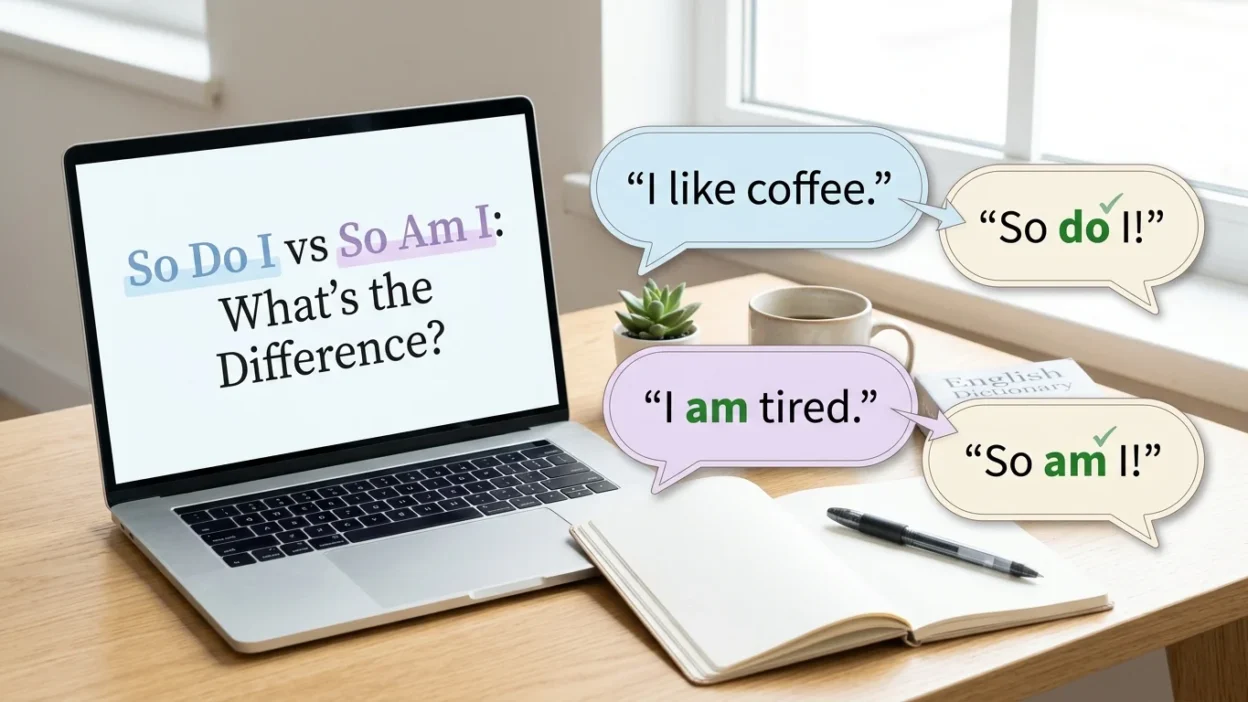
- “I like coffee.” — “So do I.”
- “I am tired.” — “So am I.”
- “I work from home.” — “So do I.”
- “I am working from home.” — “So am I.”
The key rule is simple: match the helping verb to the original statement.
What Does “So Do I” Mean?
“So do I” means “I do too” or “I share the same feeling, habit, preference, or action.” It is commonly used to agree with positive statements in the present simple.
When someone uses an ordinary verb such as like, enjoy, want, or need, you can often agree by saying “so do I.”
For example:
- “I love reading.” — “So do I.”
- “I enjoy learning English.” — “So do I.”
- “I need a break.” — “So do I.”
- “I play football on weekends.” — “So do I.”
- “I prefer tea to coffee.” — “So do I.”
In these examples, the original statements use ordinary verbs rather than the verb be. The word do acts as an auxiliary verb in the agreement expression.
When Should You Use So Do I?
Use “so do I” when the original speaker makes a positive statement in the present simple and you want to say that the same thing applies to you.
For example:
Person A: “I watch English movies.”
Person B: “So do I.”
The full meaning is “I watch English movies too.” The shorter expression avoids repeating the entire sentence.
What Does “So Am I” Mean?
“So am I” means “I am too” or “the same is true of me.” It is used when the original statement requires the verb am for the speaker agreeing with it.
This often happens when someone describes a condition, feeling, identity, or an action in progress.
Examples:
- “I am happy.” — “So am I.”
- “I am tired.” — “So am I.”
- “I am ready.” — “So am I.”
- “I am learning English.” — “So am I.”
- “I am waiting for the bus.” — “So am I.”
Notice that am is used in the response because the corresponding full statement would be “I am happy too,” “I am ready too,” or “I am learning English too.”
When Should You Use So Am I?
Use “so am I” when agreeing with a positive statement that uses am in the original sentence.
For example:
Person A: “I am excited about the trip.”
Person B: “So am I.”
The complete meaning is “I am excited about the trip too.”
So Do I vs So Am I: Comparison Table
| Feature | So Do I | So Am I |
| Main purpose | Express agreement | Express agreement |
| Verb pattern | Do + subject | Am + subject |
| Common original statement | Present simple with an ordinary verb | A statement using am |
| Example statement | I like music. | I am hungry. |
| Correct response | So do I. | So am I. |
| Full meaning | I like music too. | I am hungry too. |
Both expressions are positive agreement structures. The main difference is the verb used in the original statement.
Examples of So Do I and So Am I in Conversations
Seeing the phrases in natural conversations can help you remember which one to use.
Conversation 1: Agreeing With a Preference
Ali: “I love chocolate.”
Sara: “So do I.”
Why? The original sentence uses the ordinary verb love in the present simple.
Conversation 2: Agreeing With a Feeling
Ali: “I am nervous about the exam.”
Sara: “So am I.”
Why? The original statement uses am to describe a feeling.
Conversation 3: Agreeing With a Habit
Ali: “I exercise every morning.”
Sara: “So do I.”
Why? The original statement uses the present simple verb exercise.
Conversation 4: Agreeing With an Action in Progress
Ali: “I am preparing for my interview.”
Sara: “So am I.”
Why? The original statement uses the present continuous tense, formed with am and a verb ending in -ing.
Conversation 5: Agreeing With a Need
Ali: “I need some water.”
Sara: “So do I.”
Why? The original sentence uses the ordinary verb need in the present simple.
Common Mistakes With So Do I vs So Am I
1. Saying “So Am I” After Every Statement
A common mistake is using “so am I” whenever you want to agree with someone.
Incorrect:
“I like pizza.” — “So am I.”
Correct:
“I like pizza.” — “So do I.”
The verb like is an ordinary present-simple verb, so the response uses do.
2. Saying “So Do I” After a Statement With Am
Incorrect:
“I am hungry.” — “So do I.”
Correct:
“I am hungry.” — “So am I.”
The response needs am because the original statement uses the verb be.
3. Forgetting That the Original Verb Matters
Do not choose the response based only on the meaning of the sentence. Pay attention to its grammar.
- “I enjoy swimming.” — “So do I.”
- “I am swimming.” — “So am I.”
Both sentences refer to swimming, but their verb structures are different.
4. Confusing Positive and Negative Agreement
“So do I” and “so am I” are generally used to agree with positive statements. When agreeing with a negative statement, English commonly uses “neither do I” or “neither am I.”
Examples:
- “I don’t like spicy food.” — “Neither do I.”
- “I am not ready.” — “Neither am I.”
You can also hear “Me neither” in informal conversation.
5. Using the Wrong Auxiliary Verb
English uses different auxiliary verbs depending on the original sentence.
- “I can swim.” — “So can I.”
- “I have finished.” — “So have I.”
- “I will go.” — “So will I.”
- “I was late.” — “So was I.”
This shows the broader principle: use the appropriate auxiliary verb from the original statement rather than automatically choosing do or am.
Other Expressions Similar to So Do I and So Am I
Several expressions can communicate the same basic idea, although their tone and grammar may differ.
- Me too: An informal way to agree with someone.
- I do too: Often used to emphasize agreement with an ordinary verb.
- I am too: Used to agree with a statement involving am.
- Neither do I: Used to agree with a negative statement involving do.
- Neither am I: Used to agree with a negative statement involving am.
For example:
“I love music.” — “Me too.”
“I am exhausted.” — “Me too.”
Although “me too” works in both conversations, “so do I” and “so am I” help learners practise the correct verb patterns.
American vs British English: Is There a Difference?
There is no significant difference between American and British English in the use of “so do I” and “so am I.” Both varieties follow the same basic grammatical rules.
Examples in both varieties include:
- “I like this song.” — “So do I.”
- “I am hungry.” — “So am I.”
The phrases are natural in everyday conversation in both countries. The choice depends on the verb structure of the original statement, not on whether you are speaking American or British English.
FAQs
1. Is “so do I” correct?
Yes. “So do I” is correct when you agree with a positive statement that uses an ordinary verb in the present simple, such as “I like coffee.”
2. Is “so am I” correct?
Yes. “So am I” is correct when you agree with a statement that uses am, such as “I am tired” or “I am studying.”
3. Can I use “so do I” and “so am I” interchangeably?
No. They express agreement, but the verb must match the structure of the original statement. Say “I work here” — “So do I,” but “I am working here” — “So am I.”
4. Which is correct: “I like it, so am I” or “I like it, so do I”?
“I like it, so do I” is the correct response if you mean that you also like it. More naturally, you would say: “I like it.” — “So do I.”
5. What is the negative form of “so do I”?
The common negative agreement form is “neither do I.” For example, “I don’t eat meat.” — “Neither do I.”
6. What is the negative form of “so am I”?
Use “neither am I” when agreeing with a negative statement involving am. For example, “I am not ready.” — “Neither am I.”
7. Is “me too” the same as “so do I”?
They can express the same general idea, but their grammar differs. “Me too” is a flexible, informal expression, while “so do I” uses a specific auxiliary verb pattern.
8. Do American and British speakers use these expressions differently?
Not in any major grammatical way. Both American and British English use “so do I” and “so am I” according to the same basic verb rules.
Summary
The difference between so do I vs so am I depends on the verb in the original statement. Use “so do I” to agree with positive present-simple statements that use ordinary verbs, such as “I like coffee” or “I work here.” Use “so am I” to agree with statements such as “I am tired” or “I am learning English.” Both expressions are correct, but they serve different grammatical patterns.
Remember that agreement phrases often repeat the auxiliary verb from the original sentence. You may also need forms such as “so can I,” “so have I,” or “so was I.” American and British English follow the same general rule, so once you understand the pattern, you can use these expressions confidently in conversations and writing.
Actionable Takeaway
Before replying to a positive statement, identify its verb:
- If the sentence uses an ordinary present-simple verb, use so do I.
- If it uses am, use so am I.
- If it uses another auxiliary, such as can, have, or will, use the matching form.
Remember: “I like coffee” → “So do I.” “I am tired” → “So am I.” This simple habit will help you agree naturally and avoid a common English grammar mistake.