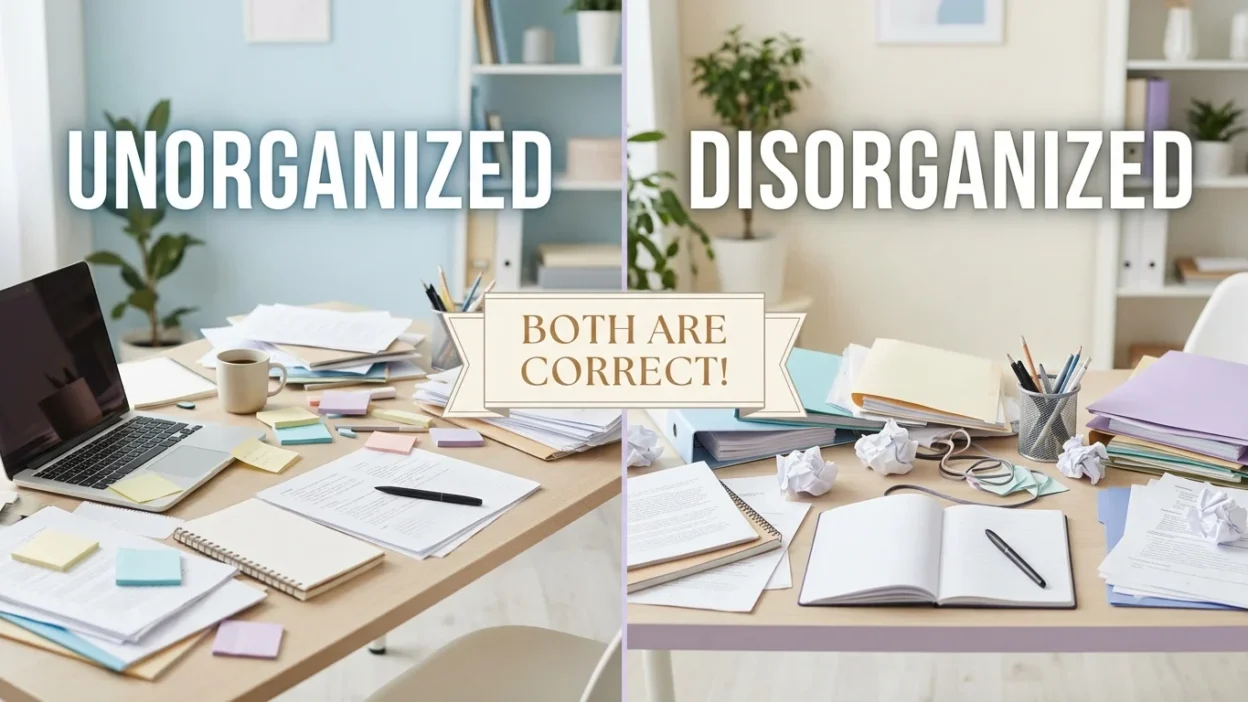
Have you ever wondered whether to write unorganized or disorganized? Both words are correct in English, and both can describe something that lacks order or structure. However, they can carry slightly different meanings depending on the situation. Choosing the right word can make your writing clearer, more natural, and easier for readers to understand.
The main difference is that unorganized often describes something that has not been arranged or structured properly, while disorganized often suggests that something lacks order, is poorly arranged, or has become messy. The meanings overlap, so either word may work in some situations. Understanding their subtle differences will help you use them confidently in everyday conversations, professional writing, and academic work.
Quick Answer: Unorganized vs Disorganized
Both “unorganized” and “disorganized” are correct spellings. The best choice depends on the meaning you want to express.
- Unorganized: Not organized, arranged, or structured properly.
- Disorganized: Lacking order, structure, or effective arrangement; sometimes suggesting that an existing order has broken down.
- Unorganized person: Someone who does not plan or arrange things well.
- Disorganized room: A room where things are scattered, untidy, or poorly arranged.
For example:
- The documents were unorganized, so I had difficulty finding the correct file.
- My desk became disorganized after a busy week.
Both sentences are correct, and in many contexts, the two adjectives are interchangeable.
What Does Unorganized Mean?
Unorganized is an adjective that describes something that lacks a proper system, arrangement, or structure. It can refer to physical objects, information, activities, groups, or people.
The prefix un- generally expresses the idea of “not.” Therefore, unorganized means “not organized.”
For example, if you collect several papers but never sort them into folders, your papers may be described as unorganized.
Examples of Unorganized in Sentences
- My notes were unorganized, making it difficult to prepare for the examination.
- The company kept its old records in an unorganized manner.
- She felt overwhelmed by her unorganized schedule.
- The books were unorganized on the shelf.
- The team had an unorganized approach to the project.
- His files remained unorganized because he had not created separate folders.
In these examples, the word emphasizes a lack of proper planning, arrangement, or structure.
What Does Disorganized Mean?
Disorganized is an adjective that describes something that lacks order, has a poor arrangement, or is not functioning according to a clear system. It can also suggest that an existing arrangement has become disrupted.
The prefix dis- can express separation, reversal, or the undoing of an action. In this word, disorganized often conveys a sense of disorder or disruption.
For example, a neatly arranged office may become disorganized when people leave papers, books, and supplies scattered around.
Examples of Disorganized in Sentences
- My desk became disorganized during the final week of the project.
- The manager complained about the disorganized meeting.
- His disorganized schedule caused him to miss an appointment.
- The kitchen looked disorganized after the family dinner.
- The event was poorly planned and felt completely disorganized.
- She apologized for sending a disorganized report.
These examples show how disorganized can describe a messy physical space, a poorly planned activity, or a lack of effective structure.
Unorganized vs Disorganized: Key Differences
The difference between unorganized and disorganized is subtle rather than absolute. Both words describe a lack of order, but they can emphasize different aspects of that condition.
Unorganized often focuses on the absence of a proper system. Disorganized can emphasize disorder, confusion, or an arrangement that has broken down.
Consider these examples:
- Unorganized files: The files have not been sorted into a clear system.
- Disorganized files: The files are scattered or arranged in a confusing way.
The difference is not a strict grammatical rule. In many everyday situations, both descriptions are natural.
| Feature | Unorganized | Disorganized |
| Basic meaning | Not properly organized | Lacking order or effective organization |
| Main emphasis | Absence of a system | Disorder, confusion, or disruption |
| Common uses | Notes, records, plans, groups | Rooms, schedules, meetings, people |
| Example | Unorganized documents | A disorganized office |
| Correct spelling? | Yes | Yes |
| Interchangeable? | Often | Often |
When Should You Use Unorganized?
Use unorganized when you want to emphasize that something has not been arranged, classified, or planned properly.
It works particularly well when discussing information, records, materials, and activities that lack a clear system.
Examples:
- The research notes were unorganized.
- We received an unorganized collection of documents.
- The volunteers were an unorganized group with no formal structure.
- My study plan was unorganized, so I created a weekly timetable.
In these examples, the focus is on the absence of a suitable arrangement or method.
When Should You Use Disorganized?
Use disorganized when you want to emphasize disorder, confusion, poor coordination, or a breakdown in an arrangement.
Examples:
- The office became disorganized after several employees left.
- The meeting was disorganized because nobody knew the agenda.
- His disorganized routine made it difficult to meet deadlines.
- The event appeared disorganized because the speakers were not coordinated.
The word can also describe a person’s working habits:
She is talented but sometimes disorganized when managing several tasks at once.
This means she may struggle to keep her activities, plans, or responsibilities in order.
Common Mistakes With Unorganized and Disorganized
1. Thinking One Word Is Incorrect
A common mistake is assuming that only disorganized is correct. This is false. Both words are standard English adjectives.
Incorrect assumption: “Unorganized is not a real word.”
Correct understanding: Both unorganized and disorganized are accepted English words.
2. Treating Their Meanings as Completely Different
The two words have overlapping meanings. Although they can emphasize different aspects of disorder, the distinction is not always clear-cut.
For example, both of these sentences are natural:
- The files are unorganized.
- The files are disorganized.
The best choice depends on context and the meaning you wish to emphasize.
3. Confusing Disorganized With Unorganised
Unorganised is a British English spelling, while unorganized is commonly used in American English. Similarly, disorganised is a British spelling, while disorganized is standard in American English.
These are spelling differences, not differences in meaning.
4. Using Disorganized When You Mean Unaffiliated
In certain contexts, unorganized can describe a group or person without a formal structure or organization. However, when discussing labor, unions, or membership, the intended meaning matters.
For example, an unorganized group may lack a formal structure, while an unaffiliated group specifically has no formal connection to another organization.
Choose the word that communicates your intended meaning precisely.
American vs British English: Unorganized or Disorganized?
Both American and British English use the words, but British English often prefers spellings ending in -ise or -ised in these forms.
| American English | British English |
| Unorganized | Unorganised |
| Disorganized | Disorganised |
| Organization | Organisation |
| Organize | Organise |
American English generally uses organized and disorganized, while British English commonly uses organised and disorganised. However, British publications may also follow styles that accept or prefer -ize spellings, so usage can vary by publication.
The meaning remains essentially the same in both varieties. For consistency, follow the spelling convention used throughout your document.
Synonyms for Unorganized and Disorganized
Several related words can help you describe different kinds of disorder more precisely.
- Messy: Untidy or dirty-looking.
- Chaotic: Extremely confused or lacking control.
- Untidy: Not neat or arranged properly.
- Disorderly: Lacking order or discipline.
- Unstructured: Without a clear framework or system.
- Unsystematic: Not following a consistent method.
- Confused: Difficult to understand or lacking clarity.
- Haphazard: Done without planning or a clear pattern.
These words are not exact replacements in every sentence. For example, chaotic usually suggests a greater degree of disorder than unorganized, while unstructured specifically emphasizes the absence of a framework.
FAQs
1. Is unorganized a correct word?
Yes. Unorganized is a correct English word meaning not organized or not arranged according to a proper system.
2. Is disorganized a correct word?
Yes. Disorganized is also correct. It describes something that lacks order, is poorly arranged, or has become disordered.
3. Which is better: unorganized or disorganized?
Neither word is universally better. Use unorganized to emphasize the absence of a proper system and disorganized to emphasize disorder or poor coordination. In many contexts, either works.
4. Are unorganized and disorganized synonyms?
Yes. They are close synonyms because both can describe a lack of organization. However, their emphasis can differ slightly depending on context.
5. Is unorganised British English?
Yes. Unorganised is a common British English spelling, while unorganized is standard in American English. Both spellings are understood internationally.
6. What is the opposite of disorganized?
Common opposites include organized, orderly, structured, and systematic. The best choice depends on the context.
7. Can you describe a person as disorganized?
Yes. A disorganized person may have difficulty managing time, keeping belongings in order, or planning tasks effectively.
8. Is unorganized or disorganized more common?
Usage varies by context and region. Both are established words, but neither is always the preferred choice. The meaning you intend and the spelling convention you follow matter more than choosing one universally.
Summary
The choice between unorganized or disorganized depends on the situation. Both are correct adjectives that describe a lack of organization. Unorganized often emphasizes that something has not been arranged or structured properly, while disorganized can emphasize confusion, disorder, or a breakdown in an existing system. Because their meanings overlap, they can often be used interchangeably without changing the main idea.
American English generally uses unorganized and disorganized, while British English commonly uses unorganised and disorganised. The difference between the two words is mainly one of emphasis, not a strict grammatical rule. By considering the context, you can choose the word that best describes the condition, person, or situation.
Actionable Takeaway
Before choosing between the two words, ask yourself what you want to emphasize:
- Use unorganized when something lacks a proper system or arrangement.
- Use disorganized when something appears disorderly, confusing, or poorly coordinated.
- Follow American or British spelling consistently throughout your writing.
Remember: Both words are correct. The best choice is the one that expresses your meaning most clearly.