If you are wondering whether to say “He is risen” or “He has risen,” you are dealing with a small but interesting difference in English grammar, style, and tradition. Both expressions are understandable, but they do not have exactly the same use or tone.
In modern English, “He has risen” follows the usual present perfect structure. However, “He is risen” is a well-established traditional expression, especially in Christian and Easter contexts. Understanding why both forms exist will help you choose the right expression for everyday writing, religious messages, and formal communication.
Quick Answer: He Is Risen or He Has Risen?
Both “He is risen” and “He has risen” can be correct, but they are used differently.
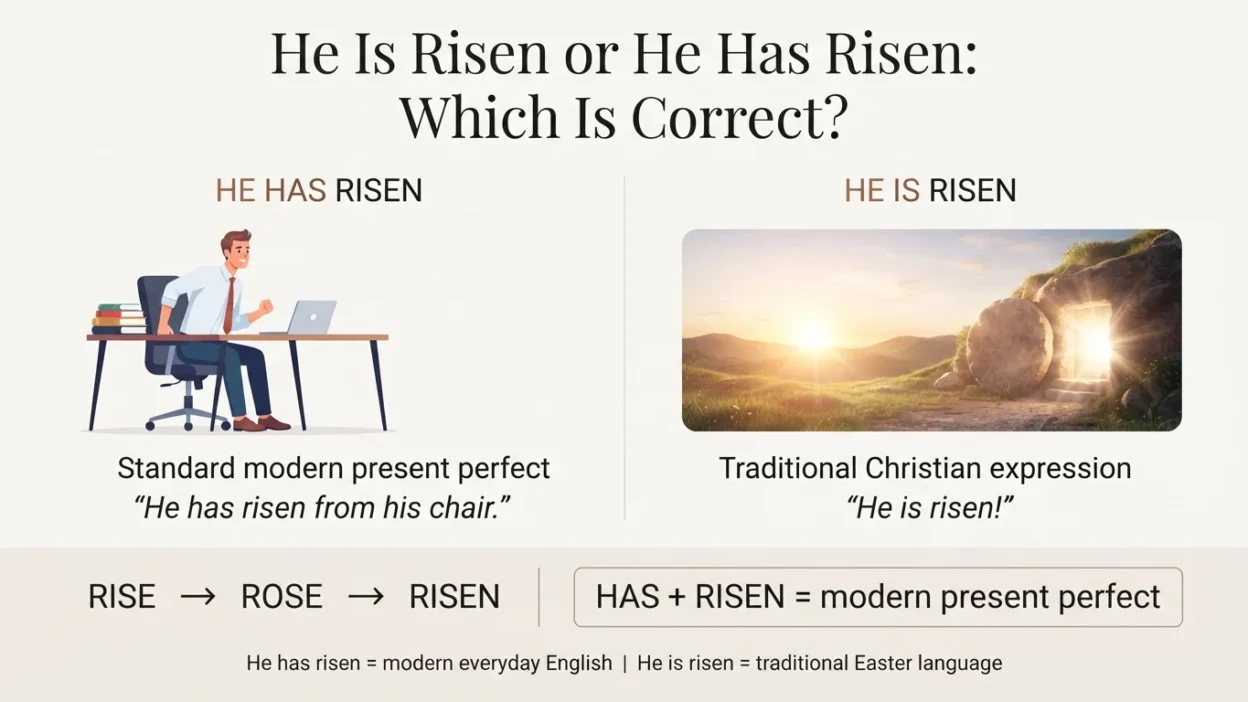
- He has risen is the standard modern present perfect construction.
- He is risen is a traditional, formal, or biblical-sounding expression.
- He has risen means that someone has risen, with the action connected to the present.
- He is risen emphasizes the person’s present state of having risen and is especially associated with Christian Easter language.
- For ordinary modern English, “he has risen” is generally the natural choice.
- For the traditional Easter proclamation, “He is risen!” is the familiar expression.
Compare:
He has risen from his chair.
This means he got up from his chair.
He is risen!
This is traditionally used to proclaim that Jesus Christ has risen from the dead.
What Does “He Has Risen” Mean?
“He has risen” uses the present perfect tense.
The present perfect is formed with:
has/have + past participle
The verb rise is irregular:
- rise — base form
- rose — simple past
- risen — past participle
Therefore, the correct present perfect form is:
He has risen.
It describes an action that happened before now and has some connection to the present.
Examples of “He has risen”
He has risen from his seat.
He got up from his seat.
He has risen early today.
He got up early, and that fact is relevant now.
He has risen to a position of leadership.
He has advanced to a higher position.
The same pattern works with things that rise:
The sun has risen.
The temperature has risen.
The water level has risen.
In all these examples, has risen follows the standard modern English present perfect structure.
What Does “He Is Risen” Mean?
“He is risen” is an older or traditional construction that remains familiar in modern English, particularly because of its religious use.
In everyday modern English, speakers usually use “has risen” rather than “is risen.”
However, “He is risen!” has become firmly established as a Christian expression referring to the resurrection of Jesus Christ.
The phrase communicates the idea that:
He has risen and is now in a risen state.
Its meaning is therefore closely connected to both an accomplished event and the resulting state.
Because of its history and religious association, “He is risen” sounds more traditional, solemn, biblical, or liturgical than ordinary conversational English.
Why Do Christians Say “He Is Risen”?
The expression “He is risen!” is strongly associated with Easter and the Christian belief in the resurrection of Jesus.
It is commonly used as an Easter proclamation:
He is risen!
A traditional response is:
He is risen indeed!
The expression can be found in Christian worship, Easter greetings, sermons, hymns, religious artwork, and other forms of Christian communication.
In this context, “He is risen” is more than an ordinary grammar choice. It is a traditional phrase with a long history in Christian language.
That is why someone might intentionally choose “He is risen” instead of the more ordinary “He has risen.”
He Is Risen vs He Has Risen: Comparison Table
| Expression | Grammar | Meaning | Common context | Tone |
| He has risen | Present perfect | He rose, with relevance to the present | Everyday and formal English | Modern/neutral |
| He is risen | Traditional older construction | He has risen and is now risen | Christian/Easter language | Traditional/formal |
| He rose | Simple past | He rose at a past time | Historical or narrative contexts | Neutral |
This table shows why both expressions can appear correct even though “he has risen” is the normal modern present-perfect construction.
Is “He Is Risen” Grammatically Correct?
Yes, but its grammar is different from the modern present perfect.
Modern English normally uses have/has + past participle to form the present perfect:
He has risen.
Historically, English sometimes used forms involving be + past participle, particularly with verbs associated with movement or a change of state. Some of these older constructions survived in traditional expressions.
“He is risen” is one such surviving expression.
Today, you are unlikely to use this construction in ordinary conversation. For example:
He is risen from his chair.
sounds old-fashioned and unnatural to most modern speakers.
Instead, we would say:
He has risen from his chair.
But:
He is risen!
sounds immediately recognizable in a Christian Easter context because tradition has preserved the expression.
Rise, Rose, and Risen: Understanding the Verb
One of the most important grammar points in this topic is knowing the three forms of rise.
| Verb form | Correct word | Example |
| Base form | rise | He will rise early. |
| Simple past | rose | He rose early yesterday. |
| Past participle | risen | He has risen early today. |
This is important because many English learners confuse rose and risen.
Remember:
rise → rose → risen
So:
❌ He has rose.
✅ He has risen.
The same rule applies to other subjects:
They have risen.
She has risen.
The prices have risen.
When Should You Use “He Has Risen”?
Use “he has risen” when you are speaking or writing in ordinary modern English.
1. Someone gets up
He has risen from the sofa.
This means he has gotten up.
2. Someone leaves a seated position
He has risen from his chair.
The action has happened recently or is relevant now.
3. Someone moves upward
He has risen above the crowd.
The phrase describes upward movement.
4. Someone advances in status
He has risen to become the company’s director.
Here, the verb is being used figuratively to describe advancement.
5. Describing an increase
Although the subject does not have to be a person:
The price has risen significantly.
The temperature has risen by five degrees.
This is the normal present-perfect use of rise.
When Should You Use “He Is Risen”?
Use “He is risen” mainly when the context is religious, traditional, biblical, or intentionally old-fashioned.
The most recognizable example is:
He is risen!
This is appropriate for:
- Easter greetings
- Christian worship
- religious messages
- church services
- sermons
- Easter cards
- Christian social media posts
- religious literature
You may also encounter:
He is risen indeed!
This traditional response confirms the Easter proclamation.
Outside these contexts, “he has risen” will normally sound more natural.
Common Mistakes to Avoid
Mistake 1: Writing “He has rose”
This is one of the most common mistakes with the verb rise.
❌ He has rose.
✅ He has risen.
Why? Because has requires the past participle, and the past participle of rise is risen.
Mistake 2: Assuming “He is risen” is always the normal modern form
It is not.
For ordinary situations:
❌ He is risen from bed.
✅ He has risen from bed.
The first sentence sounds archaic or unusual.
Mistake 3: Assuming “He is risen” is incorrect
It is not necessarily incorrect.
In a Christian context:
He is risen!
is a traditional and recognizable expression.
Calling it simply “wrong” ignores its established religious usage.
Mistake 4: Confusing “rise” and “raise”
Rise normally does not take a direct object:
He rose from his chair.
Raise normally takes an object:
He raised his hand.
Therefore:
❌ He has raised from his chair.
✅ He has risen from his chair.
This distinction is important because rise and raise are often confused.
American English vs British English
There is no significant American-versus-British English difference in the basic use of “he is risen” and “he has risen.”
Both American and British English use:
He has risen.
as the normal modern present perfect.
Both varieties also recognize:
He is risen!
as a traditional Christian expression.
The main difference is therefore register and context, not geography.
In modern American and British English, “he has risen” is natural for ordinary situations. “He is risen” is most likely to appear in religious, literary, historical, or deliberately traditional language.
He Is Risen vs He Has Risen: More Examples
Here are some examples to reinforce the distinction:
- He has risen from his chair.
- He has risen early this morning.
- The sun has risen.
- The temperature has risen considerably.
- The athlete has risen to the top of the rankings.
- He rose from his seat yesterday.
- He is risen! — traditional Christian Easter proclamation.
- He is risen indeed! — traditional Christian response.
- He has risen to a position of authority.
- The water level has risen after heavy rainfall.
How to Remember “He Is Risen” vs “He Has Risen”
A simple memory trick can make this distinction easy.
For modern English:
HAS + RISEN
Think:
He has risen.
This is the standard present perfect.
For traditional Easter language:
IS RISEN
Think:
He is risen!
This is the traditional Christian proclamation.
You can also remember the three forms:
RISE → ROSE → RISEN
If you see has or have, you need risen:
He has risen.
They have risen.
FAQs
Is “He is risen” correct English?
Yes. “He is risen” is an established traditional expression, particularly in Christian and Easter contexts. It is not the normal modern present-perfect construction, but it remains widely recognized.
Is “He has risen” correct?
Yes. “He has risen” is the standard modern present-perfect form of the verb rise.
Which is better: “He is risen” or “He has risen”?
For ordinary modern English, “He has risen” is generally better. For the traditional Christian Easter proclamation, “He is risen!” is the conventional expression.
Why do Christians say “He is risen”?
It is a traditional Christian expression associated with the resurrection of Jesus Christ. Its religious and historical use has preserved the older-sounding construction.
Is “He has rose” correct?
No. The correct form is “He has risen.” The verb forms are rise – rose – risen.
What does “He is risen indeed” mean?
“He is risen indeed” is a traditional Christian response to “He is risen!” It affirms the resurrection of Jesus Christ.
Is “He is risen” used in American English?
Yes. It is recognized in American English, particularly in Christian contexts. It is not generally used as an ordinary modern present-perfect construction.
Is “He has risen” used in British English?
Yes. “He has risen” is standard modern English in British English as well as American English.
Summary
The choice between “he is risen” and “he has risen” depends largely on context. “He has risen” is the standard modern present-perfect construction and is appropriate when describing someone or something that has risen. The correct verb forms are rise, rose, risen, so you should say “he has risen,” not “he has rose.”
“He is risen” is different because it has survived as a traditional expression, especially in Christian language. “He is risen!” is the familiar Easter proclamation associated with the resurrection of Jesus, and “He is risen indeed!” is a traditional response. Therefore, neither expression should simply be labeled wrong: “he has risen” is the modern grammatical choice, while “He is risen” has a special traditional and religious use.
Actionable Takeaway
Use “he has risen” when you are writing ordinary modern English and need the present perfect. If your sentence is about Easter, the resurrection of Jesus, or traditional Christian language, “He is risen!” is the familiar and appropriate expression.
Finally, remember the irregular verb pattern rise → rose → risen. This one rule will prevent the most common mistake: “He has rose.” The correct modern form is “He has risen,” while the traditional Easter expression remains “He is risen!”