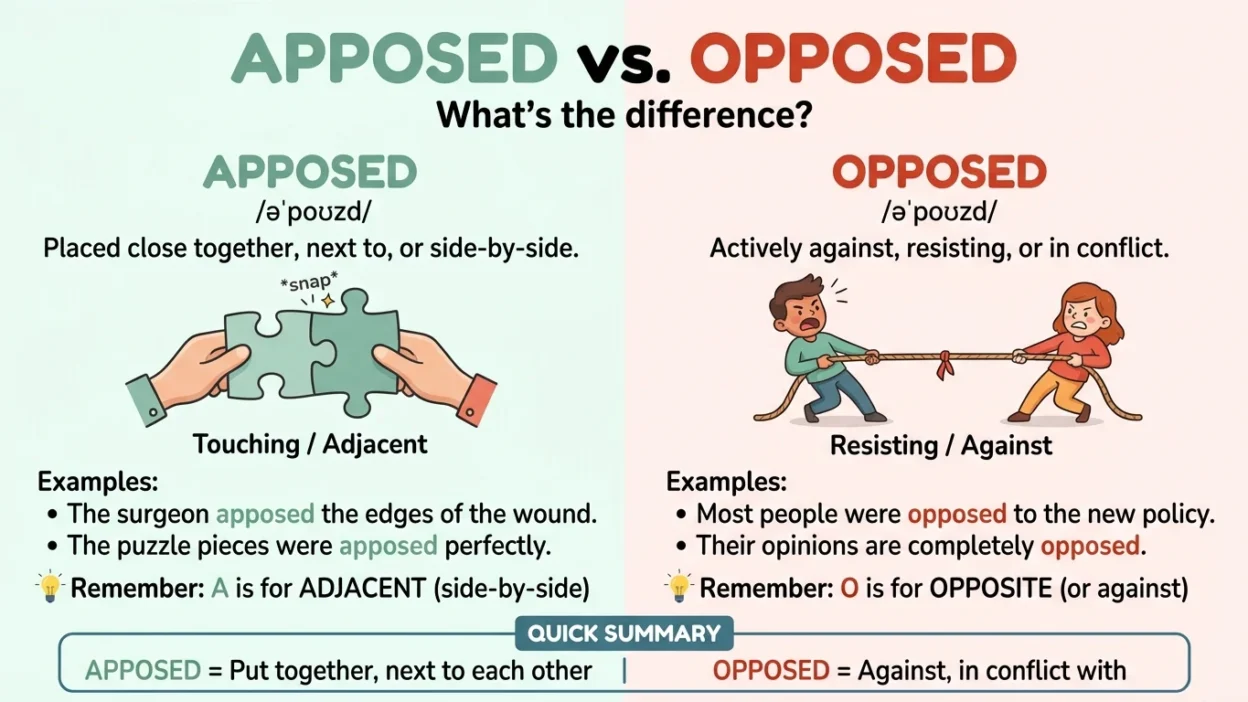
Have you ever written apposed vs opposed and wondered whether these two words mean the same thing? They look and sound similar, but they have completely different meanings and are used in very different contexts. This makes them easy to confuse, especially when writing quickly.
The good news is that the difference becomes simple once you understand what each word means. Opposed is common and usually means being against something, while apposed is a specialized term that means placed or positioned next to something. In this guide, we will explain both words with clear examples so you can confidently choose the right one.
Quick Answer: Apposed vs Opposed
Opposed is the word you probably need when you mean against, contrary to, or disagreeing with something.
Apposed is a much less common technical word meaning placed next to, beside, or in close position to something else.
| Word | Meaning | Common Use | Example |
| Opposed | Against, disagreeing with, or resisting | Everyday and formal English | “They are opposed to the proposal.” |
| Apposed | Placed next to or in contact with something | Technical, linguistic, or scientific contexts | “The two structures are apposed to each other.” |
Simple rule
If you mean against, use opposed.
If you mean placed beside or next to, use apposed.
What Does “Opposed” Mean?
Opposed is the past tense and past participle of the verb oppose. It means to disagree with, resist, reject, or be against something.
It is one of the much more common words in everyday English.
For example:
- “Many residents are opposed to the new construction.”
- “She opposed the plan from the beginning.”
- “The committee is opposed to changing the policy.”
- “He was strongly opposed to the decision.”
The word can describe opposition to an idea, proposal, decision, person, action, policy, or situation.
Opposed to
One of the most common structures is:
be opposed to + noun
or
be opposed to + -ing verb
Examples:
- “I am opposed to the proposal.”
- “They are opposed to raising taxes.”
- “She is opposed to working late.”
- “We are opposed to the changes.”
A common mistake is using an infinitive after opposed to. In this structure, to is a preposition, so it is normally followed by a noun or gerund.
Correct:
“I am opposed to changing the schedule.”
Not:
“I am opposed to change the schedule.”
What Does “Apposed” Mean?
Apposed is a much less common word. It comes from appose, which means to place something next to, alongside, or in close contact with something else.
It is mainly encountered in specialized fields rather than everyday conversation.
For example:
- “The two surfaces were apposed to each other.”
- “The structures become closely apposed during development.”
- “The tissue layers are apposed along the boundary.”
- “The two terms are apposed in the sentence.”
Depending on the field, apposed may describe things that are positioned side by side, brought into contact, or placed closely together.
You are much less likely to see apposed in ordinary conversation than opposed.
Apposed vs Opposed: The Main Difference
The easiest way to remember the distinction is to focus on the direction of the meaning.
Apposed relates to position.
Opposed relates to resistance or disagreement.
Think of these examples:
“The two objects are apposed.”
They are positioned next to each other.
“The two groups are opposed.”
They disagree with each other.
This small difference in spelling represents a major difference in meaning.
Comparison at a glance
| Feature | Apposed | Opposed |
| Basic meaning | Placed beside or against | Against or in disagreement |
| Root verb | Appose | Oppose |
| Frequency | Rare | Very common |
| Everyday English | Uncommon | Very common |
| Technical writing | Commoner | Also common |
| Describes position? | Yes | Sometimes, but usually metaphorically |
| Describes disagreement? | No | Yes |
Examples of “Opposed” in Sentences
Here are some natural examples of opposed:
- The residents are opposed to the new development.
- She was opposed to the idea from the start.
- Many employees are opposed to the proposed changes.
- He strongly opposed the decision.
- The organization is opposed to unnecessary restrictions.
- I am not opposed to trying something new.
- They were opposed by a much stronger team.
- The senator opposed the bill during the debate.
Notice that opposed can be followed by to when it describes someone’s attitude toward something.
It can also be used directly as the past tense of oppose:
“She opposed the proposal.”
Examples of “Apposed” in Sentences
Because apposed is specialized vocabulary, its examples tend to appear in technical or academic writing.
- The two surfaces were closely apposed.
- The tissue layers remained apposed during the procedure.
- The structures are apposed along their borders.
- The two objects were carefully apposed before examination.
- The linguistic elements are apposed within the construction.
The exact use of apposed can vary somewhat by discipline, but the central idea remains being placed next to or closely against something else.
Appose vs Oppose
Understanding the base verbs makes this spelling difference much easier.
Appose
Appose means to place something next to or alongside something else.
Example:
“The researcher apposed the two samples for comparison.”
Its forms include:
- appose
- apposed
- apposing
- apposition
Oppose
Oppose means to resist, disagree with, or be against something.
Example:
“The group opposed the proposed change.”
Its forms include:
- oppose
- opposed
- opposing
- opposition
Memory trick
Try this:
APPOSE = ADJOIN
OPPOSE = AGAINST
The A in appose can remind you of alongside.
The O in oppose can remind you of opposition.
Common Mistakes With Apposed and Opposed
1. Using “apposed” when you mean “against”
This is the most important mistake to avoid.
Incorrect:
“I am apposed to the proposal.”
Correct:
“I am opposed to the proposal.”
If you mean against or disagreeing with, always use opposed.
2. Assuming “apposed” is simply a misspelling
Although apposed is sometimes used incorrectly in place of opposed, the word itself is real.
It is a legitimate but relatively specialized term meaning placed beside or in contact with something.
3. Confusing “opposed to” with “apposed to”
The phrase opposed to is extremely common.
Examples:
- “She is opposed to the plan.”
- “They are opposed to the policy.”
- “He is opposed to smoking.”
Apposed to has a different, technical meaning related to physical or structural positioning.
4. Assuming the words are interchangeable
They are not interchangeable.
Changing one word can completely change the meaning of a sentence.
Compare:
“The groups are opposed.”
They are against each other.
“The structures are apposed.”
They are positioned next to each other.
Is “Apposed” Common in English?
No. Apposed is considerably less common than opposed.
You are most likely to encounter it in:
- Medicine
- Biology
- Anatomy
- Linguistics
- Academic writing
- Scientific descriptions
- Technical documentation
In everyday English, opposed is far more useful and frequent.
If you are writing a general-audience article or ordinary email, you will probably need opposed rather than apposed.
American vs British English: Apposed vs Opposed
There is no significant American-versus-British spelling difference between apposed and opposed.
Both words have the same basic meanings in American and British English.
For example:
- American English: “She is opposed to the proposal.”
- British English: “She is opposed to the proposal.”
Likewise, the technical use of apposed does not normally change based on whether the text follows American or British English.
Therefore, this is a meaning and vocabulary distinction, not a regional spelling difference.
Synonyms for “Opposed”
If you mean against or disagreeing with, useful synonyms include:
- Against
- Resistant
- Hostile to
- Unfavorable toward
- Disapproving
- Objecting to
- Antagonistic toward
- In disagreement with
- Adverse to
For example:
“They are opposed to the proposal.”
can become:
“They object to the proposal.”
or:
“They are against the proposal.”
The best synonym depends on the level of formality and the exact context.
Synonyms and Related Terms for “Apposed”
Because apposed is technical, its alternatives depend on context.
Possible related expressions include:
- Adjacent
- Side by side
- Next to
- Abutting
- Closely positioned
- In contact
- Aligned
- Juxtaposed
However, these words are not always exact substitutes. In technical writing, apposed may describe a particular relationship between structures that a general synonym does not fully capture.
How to Choose the Correct Word
Before using apposed or opposed, ask yourself one simple question:
Am I talking about disagreement or position?
If you mean disagreement:
Use opposed.
“She is opposed to the plan.”
If you mean physical or structural position:
Use apposed.
“The two surfaces were apposed.”
This quick test will solve most cases immediately.
FAQs
1. Is it “apposed” or “opposed”?
Both are real words, but they have different meanings. Opposed means against or in disagreement, while apposed means placed beside or closely against something.
2. Is “apposed” a correct English word?
Yes. Apposed is a legitimate but uncommon word, mainly used in technical, scientific, medical, or linguistic contexts.
3. What does “opposed to” mean?
Opposed to means against, resistant to, or disagreeing with something.
Example: “They are opposed to the proposed changes.”
4. What does “apposed” mean in medical writing?
In medical or anatomical contexts, apposed can describe structures that are positioned closely together or brought into contact.
5. Is “apposed to” grammatically correct?
Yes, when you are describing something positioned next to or closely against something else. It is much less common than opposed to.
6. Are apposed and opposed homophones?
They can sound very similar in many varieties of English, which contributes to the confusion. However, they are different words with different meanings and spellings.
7. Is “I am apposed to it” correct?
If you mean “I am against it,” the correct sentence is “I am opposed to it.” Using apposed would change the meaning.
8. Which word is more common: apposed or opposed?
Opposed is much more common. Apposed is a specialized term that appears mainly in technical and academic contexts.
Summary: Apposed vs Opposed
The difference between apposed vs opposed is mainly a difference in meaning. Opposed is the common word used when someone is against, resists, rejects, or disagrees with something. It appears frequently in everyday conversation, professional writing, news, academic writing, and formal discussions. For example, “She is opposed to the proposal” means she does not support it.
Apposed, on the other hand, is a specialized word meaning placed next to, alongside, or closely against something. It is much less common and is mainly found in scientific, medical, anatomical, linguistic, and technical contexts. If you are unsure which word to choose, remember: apposed relates to position, while opposed relates to opposition.
Actionable Takeaway
Use this simple rule whenever you encounter apposed or opposed:
- Opposed = against or disagreeing
- Apposed = placed beside or closely together
- Opposed is much more common.
- Apposed is mainly technical or specialized.
- There is no important American/British spelling difference between them.
Quick memory trick: APPOSE = ALONGSIDE; OPPOSE = AGAINST.