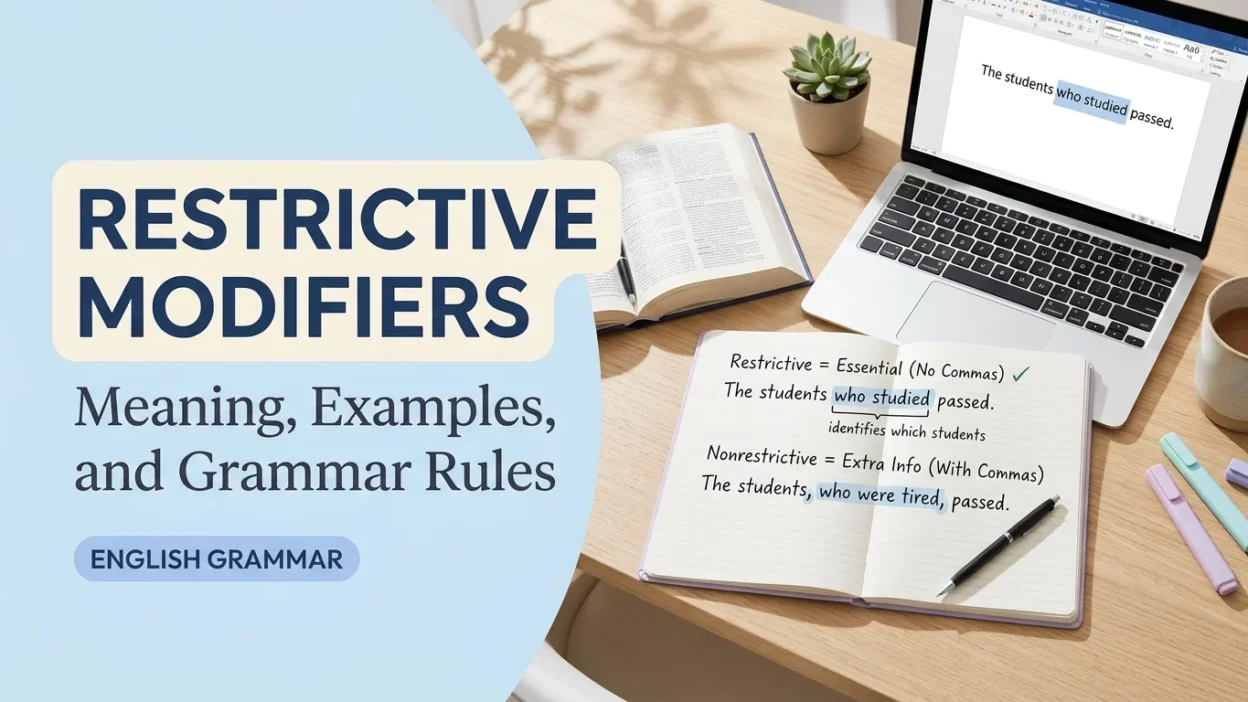
A restrictive modifier is a word or group of words that provides information essential to identifying or defining the noun it modifies. Without that information, the meaning of the sentence may become broader or change significantly. This grammar concept can seem complicated at first, but the basic idea is quite simple: a restrictive modifier limits or narrows the meaning of a noun.
Understanding restrictive modifiers can help you write clearer sentences and use commas correctly. They are especially important when working with restrictive and nonrestrictive clauses, adjective phrases, and modifying phrases. In this guide, we will explain what a restrictive modifier means, how to recognize one, and how to use it naturally in everyday and formal English.
Quick Answer: What Is a Restrictive Modifier?
A restrictive modifier is a word, phrase, or clause that limits the meaning of a noun by identifying which particular person, thing, or group you mean.
Because the information is essential to the intended meaning, a restrictive modifier is not normally separated from the noun by commas.
For example:
The students who studied passed the exam.
The phrase “who studied” is restrictive because it tells us which students passed: the students who studied.
Compare this with:
The students, who studied, passed the exam.
Here, the commas suggest that all the students studied and all of them passed. The information is presented as additional rather than identifying information.
What Does “Restrictive Modifier” Mean?
A modifier is a word, phrase, or clause that describes, identifies, qualifies, or gives more information about another word.
A restrictive modifier goes one step further: it restricts the meaning of the noun.
In simple terms:
Restrictive = necessary to identify the noun
For example:
The book on the table is mine.
The phrase “on the table” identifies which book you mean. There could be several books, but you are talking specifically about the one on the table.
Therefore, “on the table” is a restrictive modifier.
Another example is:
People who exercise regularly often improve their fitness.
The clause “who exercise regularly” limits the noun people. The sentence is not necessarily talking about all people; it is talking about people who exercise regularly.
How Does a Restrictive Modifier Work?
A restrictive modifier narrows a broad noun into a more specific group.
Consider this sentence:
The employee who arrived early received a bonus.
The noun employee could refer to many people.
The modifier:
who arrived early
restricts the meaning. It identifies the particular employee who received the bonus.
Without the modifier:
The employee received a bonus.
The sentence no longer gives us the same specific identification.
This is why restrictive modifiers are considered essential modifiers.
Examples of Restrictive Modifiers
Restrictive modifiers can appear in several forms.
Restrictive adjective
The red car belongs to Sarah.
The adjective red restricts which car is being discussed.
Restrictive prepositional phrase
The man in the blue jacket is my uncle.
The phrase “in the blue jacket” identifies which man.
Restrictive relative clause
The students who completed the assignment can leave.
The clause “who completed the assignment” identifies which students can leave.
Restrictive participial phrase
The woman sitting near the window is our manager.
The phrase “sitting near the window” identifies which woman.
Restrictive infinitive phrase
The first person to arrive received a prize.
The phrase “to arrive” helps identify which person is being described.
Restrictive vs Nonrestrictive Modifiers
One of the most important grammar distinctions is between restrictive and nonrestrictive modifiers.
A restrictive modifier provides information needed to identify the noun.
A nonrestrictive modifier provides additional information that can be removed without changing which noun is being discussed.
Compare these sentences:
The employees who worked overtime received extra pay.
This means only the employees who worked overtime received extra pay. The modifier is restrictive.
Now consider:
The employees, who worked overtime, received extra pay.
The commas suggest that the employees all worked overtime and that this fact is additional information.
Comparison table
| Feature | Restrictive Modifier | Nonrestrictive Modifier |
| Main purpose | Identifies or limits the noun | Adds extra information |
| Essential to intended meaning? | Yes | No |
| Usually uses commas? | No | Yes |
| Meaning | Narrows the noun | Describes an already identified noun |
| Example | “The car that I bought is blue.” | “My car, which I bought last year, is blue.” |
The comma difference can sometimes change the meaning of an entire sentence.
Why Commas Matter
A common mistake is treating commas as optional when using restrictive modifiers.
They are not always optional because punctuation can affect meaning.
Compare:
The teachers who attended the meeting received certificates.
This suggests that only the teachers who attended the meeting received certificates.
Now:
The teachers, who attended the meeting, received certificates.
This suggests that the teachers attended the meeting, and the information is simply an additional detail.
The comma changes the relationship between the modifier and the noun.
A simple test
Ask yourself:
“Do I need this information to know exactly which person or thing I mean?”
If the answer is yes, the modifier is probably restrictive.
If the answer is no, it may be nonrestrictive.
Restrictive Relative Clauses
Restrictive relative clauses are among the most common examples of restrictive modifiers.
A restrictive relative clause usually begins with words such as:
- who
- that
- which
- whose
- whom
For example:
The woman who lives next door is a doctor.
The clause “who lives next door” identifies which woman.
Another example:
The laptop that I bought yesterday is already broken.
The clause “that I bought yesterday” identifies which laptop.
In American English, that is commonly used for restrictive clauses referring to things:
The book that I recommended is excellent.
Which can also occur in restrictive clauses in various styles of English, although usage preferences differ by style guide and region.
Restrictive Modifier vs Restrictive Clause
These terms are closely related but are not exactly identical.
A modifier is a broad grammatical category. It can be a word, phrase, or clause.
A restrictive clause is specifically a clause that limits the meaning of a noun.
For example:
The student wearing glasses won the competition.
“Wearing glasses” is a restrictive participial phrase.
But:
The student who was wearing glasses won the competition.
“Who was wearing glasses” is a restrictive relative clause.
Both function as restrictive modifiers.
Common Mistakes With Restrictive Modifiers
1. Adding unnecessary commas
Incorrect:
The students, who submitted their work, received feedback.
If you mean only the students who submitted their work received feedback, the commas can incorrectly suggest that all the students submitted their work.
Better:
The students who submitted their work received feedback.
2. Removing essential information
Consider:
The house that has a red door belongs to my aunt.
Removing “that has a red door” may make it unclear which house you mean.
3. Confusing restrictive and nonrestrictive meaning
The most important question is not simply whether a clause “looks like extra information.”
Ask whether it identifies the noun.
4. Assuming every modifier needs commas
Not every descriptive phrase is nonrestrictive.
For example:
The man wearing a black hat is my brother.
The phrase “wearing a black hat” may be essential to identifying the man, so commas are unnecessary.
5. Creating ambiguous sentences
Sometimes a modifier can technically be restrictive but still leave the reader unsure what it modifies.
For example:
She spoke to the teacher in the hallway.
Is the teacher in the hallway, or did she speak in the hallway?
Rewriting can make the intended relationship clearer.
Restrictive Modifiers and “That” vs “Which”
The words that and which can cause confusion in restrictive relative clauses.
In traditional American style guidance, that is often preferred for restrictive clauses:
The car that I bought is reliable.
The information identifies which car.
A nonrestrictive clause commonly uses which with commas:
My car, which I bought last year, is reliable.
However, actual usage varies across English varieties, publishers, and style guides. British English can use which in restrictive clauses more freely than some American style guides prefer.
The key principle is still the same:
Restrictive information identifies; nonrestrictive information adds information.
American vs British English
The underlying concept of restrictive modification is the same in both American and British English.
The main differences involve punctuation and style preferences, especially around relative clauses using that and which.
American English style guides often make a stronger distinction between restrictive that and nonrestrictive which.
British English commonly permits which in some restrictive constructions where American editors may prefer that.
For example:
The book which I bought yesterday is excellent.
This can be acceptable in British English and in some broader English usage.
In American edited prose, many style guides would prefer:
The book that I bought yesterday is excellent.
The underlying grammatical concept remains unchanged.
Synonyms and Related Grammar Terms
Understanding related terminology can make restrictive modifiers easier to recognize.
Useful related terms include:
- Essential modifier
- Restrictive clause
- Restrictive relative clause
- Essential clause
- Defining clause
- Defining relative clause
- Modifying phrase
- Relative clause
- Adjective clause
- Noun modifier
- Nonrestrictive modifier
- Nonessential modifier
- Parenthetical information
In British English, defining relative clause is especially common as a term for what American grammar resources often call a restrictive relative clause.
How to Identify a Restrictive Modifier
Use these three steps:
Step 1: Find the noun
Identify the person, place, thing, or idea being described.
Step 2: Find the modifier
Look for a word, phrase, or clause that gives more information about that noun.
Step 3: Remove it mentally
Ask whether removing the modifier changes which noun or group the sentence refers to.
If removing it makes the meaning less specific or changes the intended reference, the modifier is likely restrictive.
For example:
The customers waiting outside need assistance.
Remove the modifier:
The customers need assistance.
The meaning becomes broader. Therefore, “waiting outside” is restrictive.
FAQs
1. What is a restrictive modifier?
A restrictive modifier is a word, phrase, or clause that provides essential information needed to identify or limit the noun it modifies.
2. Does a restrictive modifier need commas?
Usually, no. Restrictive modifiers are generally written without commas because the information is essential to the intended meaning.
3. What is an example of a restrictive modifier?
In “The students who studied passed the test,” the phrase “who studied” is a restrictive modifier because it identifies which students passed.
4. What is the difference between restrictive and nonrestrictive modifiers?
A restrictive modifier identifies or limits the noun, while a nonrestrictive modifier adds information that is not essential for identifying the noun.
5. Are restrictive modifiers the same as restrictive clauses?
Not exactly. A restrictive clause is one type of restrictive modifier. Modifiers can also be individual words or phrases.
6. Is “that” used with restrictive clauses?
Yes. That is commonly used in restrictive relative clauses, particularly in American English.
Example: “The movie that we watched was excellent.”
7. Can “which” be used in a restrictive modifier?
Yes, depending on the variety of English and style guide. British English generally permits restrictive which more freely than many American style guides.
8. What is another name for a restrictive modifier?
It may also be called an essential modifier, defining modifier, or, in some contexts, a defining clause.
Summary: Restrictive Modifier
A restrictive modifier is an important part of sentence structure because it narrows or identifies the noun it modifies. It tells readers exactly which person, thing, or group you mean. Restrictive modifiers can appear as adjectives, phrases, participial phrases, infinitive phrases, or relative clauses. For example, in “The students who studied passed the exam,” the clause “who studied” restricts the meaning of “students.”
The most important practical point is the difference between restrictive and nonrestrictive information. Restrictive modifiers are generally written without commas, while nonrestrictive modifiers are usually set off with commas. Once you ask whether the modifier is necessary to identify the noun, choosing the correct structure and punctuation becomes much easier.
Actionable Takeaway
When you see a modifier, ask:
- Does it identify which noun I mean? → It is likely restrictive.
- Is it simply extra information? → It is likely nonrestrictive.
- Restrictive modifier → usually no commas.
- Nonrestrictive modifier → usually commas.
- American and British English share the same basic concept, although style preferences for that and which can differ.
Easy memory trick: Restrictive = restricts the noun. If it narrows the meaning, it is essential.