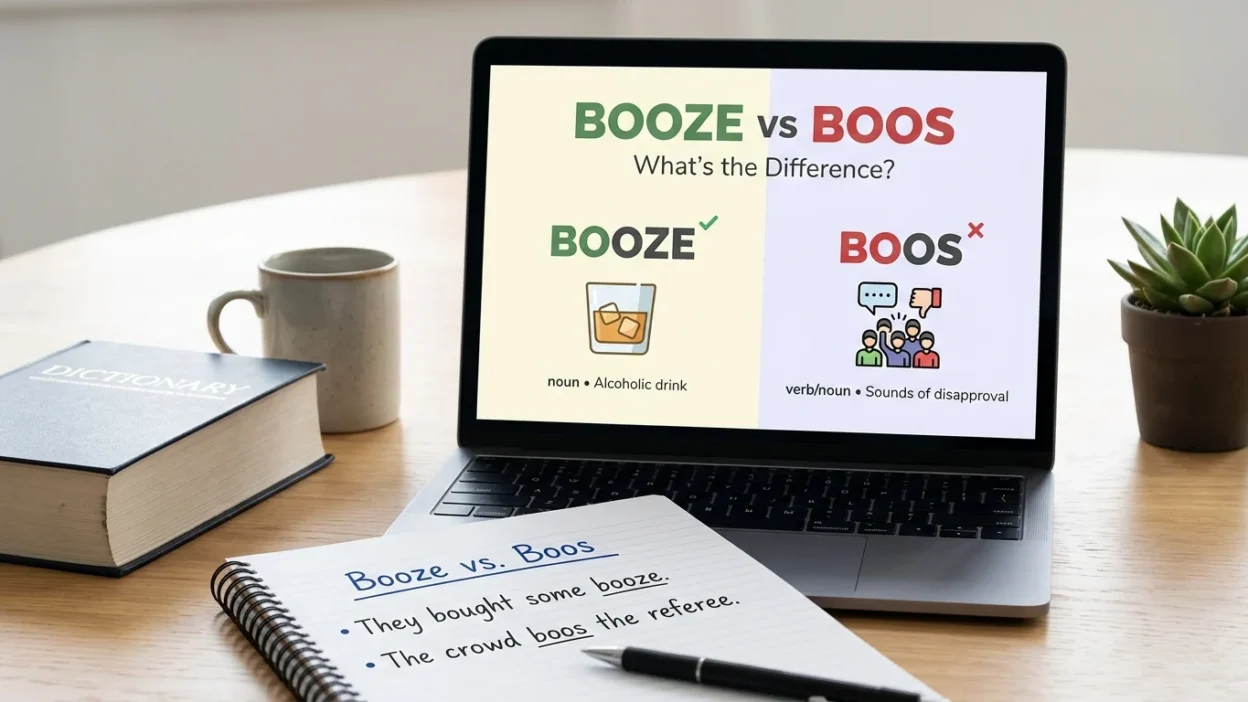
The booze vs boos difference can create confusion because these words sound almost identical in everyday speech, yet their meanings are different.
Booze is an informal word for alcoholic drinks, while boos are expressions of disapproval from an audience. From my experience with writing and communication, context makes this difference much easier to recognize. In conversations and online communication, pronunciation can sometimes cause confusion, so it helps to notice what the speaker means. You may choose booze when discussing drinks or alcohol, but boos when describing an audience’s reaction. The two words have different functions, even though they sound almost identical.
Their grammatical roles also make the distinction clearer. Booze rhymes with choose and news, while boos is the plural of boo and the third-person singular form of the verb “boo.” In different contexts, simple examples can make the meaning obvious: a party may have booze, while a player may receive loud boos. This guide uses a simple memory trick to help you remember the difference: think of booze with drinks, and boos with speech or an audience showing disapproval. This easy approach can prevent common mistakes in casual conversations and formal writing, without relying only on memorizing definitions.
Quick Answer
Booze means alcoholic drinks or alcohol, usually in informal English.
Boos can mean:
- The plural of boo, meaning sounds of disapproval.
- The third-person singular form of the verb boo, meaning to express disapproval by shouting “boo.”
Simple examples
- We bought some booze for the party.
- The singer received loud boos from the crowd.
- He does not drink booze.
- The fans boo the player, and their boos fill the stadium.
Memory trick: Booze = alcohol. Boos = disapproval.
What Does Booze Mean?
Booze is an informal noun meaning alcoholic drinks or alcohol. It is a casual term rather than a formal one, so you are more likely to hear it in everyday conversation than in formal or academic writing.
The word can refer to alcoholic drinks generally rather than one particular type. Depending on the context, booze may mean beer, wine, spirits, cocktails, or other alcoholic beverages.
Examples of booze
- They brought some booze to the party.
- He decided to give up booze for a month.
- There was plenty of booze at the celebration.
- The store sells different kinds of booze.
- She does not usually drink booze.
In these sentences, booze is connected with alcohol or alcoholic beverages.
Is booze formal or informal?
Booze is generally informal. In professional, academic, or formal writing, words such as alcohol, alcoholic drinks, or alcoholic beverages are usually more appropriate.
For example:
- Informal: The party had plenty of booze.
- More formal: The event offered a selection of alcoholic beverages.
This distinction matters because choosing the right word is not only about spelling. It is also about tone, context, and audience.
What Does Boos Mean?
Boos has a completely different meaning from booze. It is related to the word boo, which can be used as a noun or verb.
As a noun, a boo is a shout or sound used to show that someone does not approve of something. The plural is boos.
For example:
- The actor heard loud boos from the audience.
- The referee received several boos from the fans.
- The politician was greeted with boos.
- The crowd responded with cheers and boos.
As a verb, boo means to express disapproval by shouting or making a similar sound.
The word boos can therefore also be the third-person singular form of the verb:
- The crowd boos the player.
- The audience boos whenever he appears.
So, boos can refer either to multiple sounds of disapproval or to the action performed by one subject using the verb boo.
Booze vs Boos: Key Differences
| Word | Meaning | Part of Speech | Example |
| booze | Alcohol or alcoholic drinks | Noun | He stopped drinking booze. |
| boo | A sound of disapproval | Noun/Verb | The crowd began to boo. |
| boos | Multiple sounds of disapproval | Plural noun | The player heard loud boos. |
| boos | Third-person singular of “boo” | Verb | The crowd boos the referee. |
The easiest way to separate them is to think about the subject of the sentence. If you are talking about alcohol, the correct word is booze. If you are talking about an audience showing disapproval, the word is usually boos.
Booze vs Boos Pronunciation
Pronunciation is one of the main reasons people confuse these words. Booze and boos sound very similar, and in many varieties of English they are pronounced alike or nearly alike.
However, their spelling and meaning are different.
- Booze → related to alcohol
- Boos → related to “boo” and disapproval
Booze rhymes with words such as choose and news. Boos also has a similar ending sound because it is formed from boo.
When you hear either word without seeing it written, context becomes especially important. If someone says, “There was a lot of ___ at the party,” the meaning is likely booze. If someone says, “The player received loud ___,” the correct word is boos.
American vs British English: Is There a Difference?
There is no major spelling difference between booze and boos in American and British English. Both varieties use booze for alcohol and boos for expressions of disapproval.
The main difference may be how often certain informal expressions are used in different social settings. Booze is familiar in both American and British English, although speakers may choose other informal terms depending on region, age, and situation.
For formal writing in either variety, alcohol or alcoholic beverages is generally more suitable than booze.
Common Mistakes With Booze and Boos
Because these words sound similar, spelling mistakes are understandable. Here are some common errors to watch for.
1. Using boos when you mean alcohol
Incorrect:
- We bought some boos for the party.
Correct:
- We bought some booze for the party.
Here, the sentence is about alcoholic drinks, so booze is correct.
2. Using booze for audience disapproval
Incorrect:
- The singer received loud booze from the crowd.
Correct:
- The singer received loud boos from the crowd.
The crowd is expressing disapproval, so the correct word is boos.
3. Confusing boo with boos
Remember that boo can be a noun or verb.
- One sound: a boo
- Several sounds: boos
- Present-tense verb with he/she/it: boos
For example:
- The audience gave one loud boo.
- The audience gave several loud boos.
- The audience boos the performer.
4. Using booze in formal writing
Although booze is a standard informal English word, it may sound too casual in a formal report or professional document.
Instead of:
- The event included free booze.
A formal version could be:
- The event included complimentary alcoholic beverages.
How to Remember Booze vs Boos
A simple memory trick can make this distinction much easier.
Think:
Booze → booze is something you drink.
Boos → boos are sounds you hear from an unhappy crowd.
You can also connect boos with the word boo. When an audience says “boo,” it is showing disapproval. When several people do it, you hear boos.
Try these two questions whenever you are unsure:
- Am I talking about alcohol? → Use booze.
- Am I talking about audience disapproval? → Use boos.
This quick test works well in writing, conversation, and online communication.
Booze vs Boos Examples in Sentences
Here are more examples to make the difference clear:
Booze
- There was no booze at the family event.
- He decided to avoid booze during the week.
- They bought some booze before the celebration.
- The restaurant does not serve booze.
- Too much booze can affect your judgment.
Boos
- The referee walked away to a chorus of boos.
- The actor received both cheers and boos.
- Loud boos came from the back of the stadium.
- The team heard boos after losing the match.
- The singer was surprised by the audience’s boos.
These examples show that the two words belong to entirely different contexts even though their pronunciation can cause confusion.
FAQs
Is booze the same as alcohol?
Yes. Booze is an informal word commonly used to mean alcohol or alcoholic drinks. It can refer to beer, wine, spirits, cocktails, or alcoholic beverages generally.
Are boos and booze pronounced the same?
They can sound very similar and may be pronounced the same or nearly the same in many varieties of English. Their meanings and spellings are different, so context is important.
What does boos mean?
Boos can mean several sounds of disapproval. It can also be the third-person singular form of the verb boo, as in “The crowd boos the player.”
Is booze a formal word?
No. Booze is generally informal. In formal writing, alcohol or alcoholic beverages is usually a better choice.
What is the plural of boo?
The plural noun is boos. For example: “The performer received loud boos from the audience.”
Is “boos” a verb?
Yes. Boos can be the third-person singular present form of the verb boo. For example: “The crowd boos the referee.”
How can I easily remember booze vs boos?
Remember booze = alcohol and boos = sounds of disapproval. If you can drink it, think booze; if an unhappy audience makes the sound, think boos.
Summary: Booze vs Boos
The main difference between booze vs boos is meaning. Booze is an informal word for alcohol or alcoholic drinks, while boos refers to sounds of disapproval or functions as the third-person singular form of the verb boo. Although their pronunciation can be very similar, their spelling, grammatical roles, and contexts are different.
The easiest way to remember the distinction is to connect booze with drinking and boos with an unhappy audience. When writing or speaking, look at the meaning of the sentence before choosing the spelling. This simple habit can help you avoid confusion and use both words naturally and accurately.
Actionable Takeaway
- Use booze when you mean alcohol or alcoholic drinks.
- Use boos for sounds of disapproval.
- Use boos as the verb form in sentences such as “The crowd boos the player.”
- Remember: booze = alcohol; boos = disapproval.
- Use alcohol or alcoholic beverages instead of booze in formal writing.