If you have ever typed damnit or dammit when you were frustrated, annoyed, surprised, or disappointed, you may have wondered which spelling is actually correct. Both forms are commonly seen in informal English, and the difference can be confusing because they sound almost identical.
The short answer is that dammit is the more established and widely recognized spelling, while damnit is also used as an informal variant. Both are expressions of frustration or annoyance, but they are generally considered mild profanity and are best avoided in formal or professional writing.
Quick Answer: Damnit or Dammit?
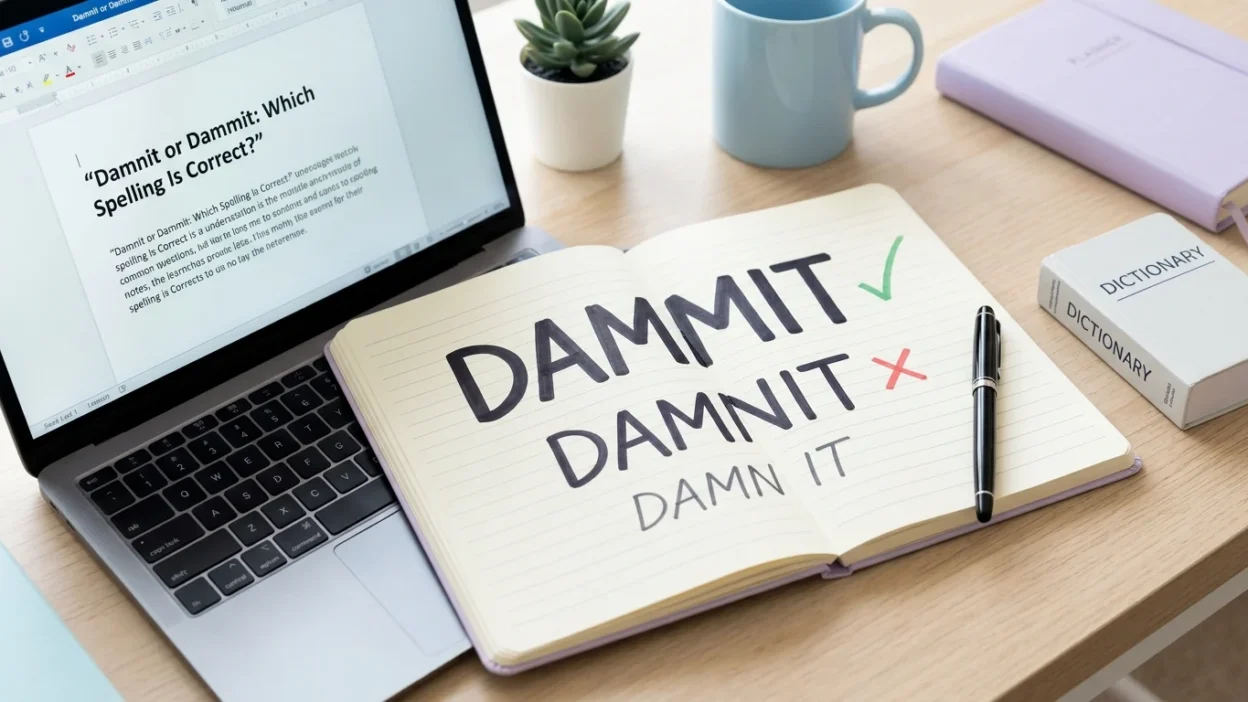
Dammit is the more standard and commonly recognized spelling.
Damnit is also widely used as an informal alternative, particularly in casual online writing and dialogue.
| Spelling | Status | Typical Use | Example |
| dammit | Common, established spelling | Informal speech and writing | “Dammit, I forgot my keys.” |
| damnit | Informal variant | Casual writing, texting, dialogue | “Damnit, that was my last chance.” |
If you are writing an article, story, email, or dialogue and want the more conventional spelling, dammit is generally the safer choice.
What Does “Dammit” Mean?
Dammit is an informal exclamation used to express anger, frustration, irritation, disappointment, or annoyance.
It is derived from the phrase “damn it.” Over time, the phrase became commonly written as one word in informal usage.
For example:
- “Dammit, I missed the bus.”
- “Dammit! The computer crashed again.”
- “Oh, dammit, I forgot to call her.”
- “Dammit, that hurt.”
The word does not usually communicate a complete idea by itself. Instead, it expresses an emotional reaction to something that has happened.
Depending on the situation and tone, dammit can express anything from mild irritation to strong anger.
What Does “Damnit” Mean?
Damnit has essentially the same meaning as dammit.
It is an alternative spelling that developed from the same expression, “damn it.” You will often encounter it in informal internet conversations, text messages, social media posts, fictional dialogue, and casual writing.
Examples include:
- “Damnit, I left my phone at home.”
- “Damnit! We were so close.”
- “I knew I had forgotten something. Damnit.”
- “Damnit, why won’t this thing work?”
Although damnit is recognizable to most English speakers, dammit is generally the more established spelling.
Dammit vs. Damnit: What Is the Difference?
The main difference is spelling, not meaning.
Both words function as emotional interjections. Both are used to express frustration or annoyance. The pronunciation is also very similar.
The important distinction is that dammit has stronger dictionary and conventional usage support, while damnit is generally treated as a variant or informal spelling.
Think of it this way:
Dammit = conventional spelling
Damnit = informal variant
Neither form should normally be confused with “damn it,” which consists of two separate words.
“Damn It” vs. “Dammit” vs. “Damnit”
There are actually three forms you may encounter:
Damn it
“Damn it” is the original two-word expression.
Example:
“Damn it, I forgot the appointment.”
It can be used when you want to preserve the phrase as two separate words.
Dammit
“Dammit” is the established one-word informal spelling.
Example:
“Dammit, I should have checked the address.”
This is probably the safest one-word form to use in casual writing.
Damnit
“Damnit” is an informal variant.
Example:
“Damnit, I dropped the glass.”
It is understandable, but many writers would choose dammit instead.
Examples of “Dammit” in Sentences
Here are some natural examples showing how dammit is used:
- Dammit, I forgot my wallet.
- Dammit! The train just left.
- I was so close to winning, dammit.
- Dammit, this isn’t what I ordered.
- Oh, dammit, I made the same mistake again.
- “Dammit,” she whispered after seeing the result.
- Dammit, why didn’t anyone tell me?
- I can’t believe I lost the file. Dammit!
Notice that the word often appears at the beginning or end of a sentence, especially when it is being used as an emotional reaction.
Examples of “Damnit” in Sentences
Because damnit is an informal variant, you may see it in similar situations:
- Damnit, I forgot the password.
- Damnit! That was my favorite shirt.
- I missed the deadline, damnit.
- Damnit, I thought you had already sent it.
- Why did this happen, damnit?
These sentences have essentially the same meaning as their dammit versions.
Is “Damnit” a Misspelling?
This depends on the context.
It is common to describe damnit as a variant spelling rather than simply calling it an ordinary spelling mistake. English speakers do use it intentionally, especially in casual digital communication and creative writing.
However, if you want the more conventional one-word spelling, choose dammit.
For example:
❌ Damnit, I forgot the tickets.
✅ Dammit, I forgot the tickets.
The second version is generally preferable in edited writing.
That said, if a character in a novel, movie script, comic, or online conversation naturally writes damnit, changing it may not always be necessary. Informal language often reflects individual writing habits.
Is “Dammit” a Bad Word?
Dammit is considered mild profanity or an expletive.
It comes from damn, a word that can function as a swear word or an expression of condemnation. The intensity of dammit depends heavily on the speaker, audience, and situation.
In everyday conversation between friends, it may be relatively mild. In a professional environment, classroom, formal presentation, customer-service interaction, or official document, it may sound inappropriate.
For formal writing, alternatives include:
- Oh no
- Unfortunately
- What a shame
- That’s frustrating
- I can’t believe it
- This is frustrating
- What a disappointment
For example:
Informal:
“Dammit, I missed the deadline.”
Professional:
“Unfortunately, I missed the deadline.”
The second version communicates the situation without profanity.
Common Mistakes With Dammit and Damnit
1. Treating “damnit” as the only correct spelling
Some writers assume that damnit is the standard form because it looks like a natural combination of “damn” and “it.”
However, dammit is the more established spelling.
2. Using “dammit” in formal writing
Even though dammit is widely understood, it is still an informal exclamation.
Avoid it in:
- Academic essays
- Formal reports
- Business correspondence
- Job applications
- Professional documents
- Formal presentations
3. Confusing “dammit” with “damn it”
Damn it is written as two words, while dammit is the established informal one-word form.
Both can appear in English, but they have different spelling structures.
4. Assuming “damnit” and “dammit” have different meanings
They generally do not.
The difference is primarily conventional spelling and usage.
5. Overusing the expression
Because dammit is an emotional exclamation, using it repeatedly can make writing sound angry, dramatic, or unnatural.
Use it when the context genuinely calls for frustration or emphasis.
American vs. British English: Dammit or Damnit
There is no major American-versus-British meaning difference between dammit and damnit.
Both forms can be encountered in informal English on both sides of the Atlantic.
British English also commonly uses “damn it” as two words, while dammit appears in informal writing and dialogue. American English likewise uses dammit frequently in casual contexts.
So this is not primarily a case like color/colour or center/centre, where the spelling clearly follows a regional convention.
Instead:
- Dammit → established informal spelling
- Damnit → informal variant
- Damn it → two-word expression
Dammit Synonyms and Alternatives
If you need to express frustration without using profanity, several alternatives work well.
Informal alternatives
- Oh no!
- Ugh!
- Seriously?
- What the heck!
- For goodness’ sake!
- Come on!
- That’s frustrating!
Stronger emotional alternatives
- I can’t believe this!
- This is ridiculous!
- What a disaster!
- That’s incredibly frustrating!
Professional alternatives
- Unfortunately
- That’s disappointing
- This is frustrating
- I regret that
- What a setback
The best choice depends on your audience and the emotional intensity you want to communicate.
When Should You Use “Dammit”?
Use dammit mainly in informal situations when you want to show a clear emotional reaction.
It can work well in:
- Casual conversations
- Text messages
- Social media
- Fictional dialogue
- Informal storytelling
- Personal writing
For example:
“Dammit, I knew I should have checked twice.”
However, avoid it when you need a polished, professional, or respectful tone.
A Simple Memory Trick
If you are trying to remember dammit or damnit, use this simple trick:
Damn + it → Dammit
The established one-word spelling ends with -mit, giving you:
DAM + MIT = DAMMIT
If you are unsure, choose dammit.
FAQs
1. Is “dammit” or “damnit” correct?
Dammit is the more established and conventional one-word spelling. Damnit is also used as an informal variant.
2. Is “damnit” a real word?
Yes, damnit is a recognized informal variant used to express frustration or annoyance. However, dammit is generally the more conventional spelling.
3. Is “dammit” one word?
Yes. Dammit is commonly written as one word. The related expression “damn it” is written as two words.
4. Is “dammit” considered profanity?
Yes, it is generally considered mild profanity or an expletive. Whether it is acceptable depends on the audience and situation.
5. Can I use “dammit” in formal writing?
It is best to avoid dammit in formal writing. Choose a neutral expression such as “unfortunately,” “that’s frustrating,” or “what a disappointment.”
6. Do Americans say “dammit” more than British people?
Both American and British speakers use the expression. There is no strict regional rule that makes dammit American and damnit British.
7. Does “damnit” mean something different from “dammit”?
No. They are generally used to express the same feelings, including frustration, anger, irritation, and disappointment.
8. Which spelling should I use?
If you need the conventional one-word spelling, choose dammit. Use damnit mainly when reproducing informal speech, personal writing, or a particular writing style.
Summary: Damnit or Dammit?
When choosing between damnit or dammit, dammit is generally the better choice if you want the established informal spelling. It comes from the expression “damn it” and is commonly used as an exclamation of frustration, irritation, anger, or disappointment. Damnit has the same basic meaning and is widely recognizable, but it is better treated as an informal variant.
Neither spelling is usually appropriate for formal or professional writing because dammit and damnit are mild profanity. In polished writing, alternatives such as “unfortunately,” “that’s frustrating,” or “what a disappointment” can communicate the same emotion more appropriately.
Actionable Takeaway
When you are unsure, remember:
- Dammit = preferred conventional one-word spelling
- Damnit = informal variant
- Damn it = two-word expression
- All express frustration or annoyance
- Avoid them in formal or professional writing
Best choice: If you need one word, use dammit.