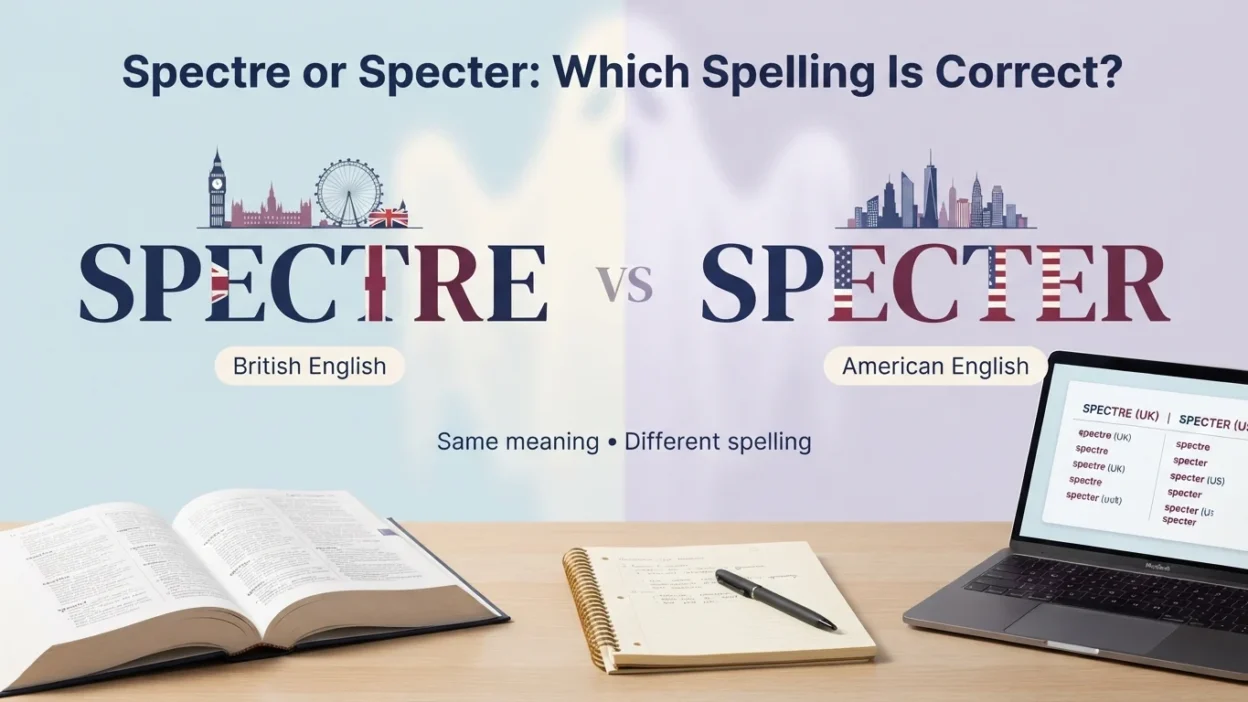
Have you ever written the word for a ghostly figure and wondered whether it should be “spectre” or “specter”? Both spellings are correct, which can make this particular English spelling difference confusing. The good news is that the choice is usually determined by the variety of English you are using.
Spectre and specter have the same meaning and pronunciation. Spectre is the traditional spelling used mainly in British English, while specter is the standard spelling in American English. Both words can refer to a ghost or frightening apparition, but they can also describe a disturbing possibility, threat, or fear that seems to hang over a situation.
Quick Answer: Spectre or Specter?
Both “spectre” and “specter” are correct. The difference is mainly American vs British English spelling.
- Spectre → British English
- Specter → American English
- Both mean essentially the same thing.
- Both are pronounced approximately /ˈspɛktər/.
- Both can refer to a ghost, apparition, or frightening possibility.
Simple rule
British English → spectre
American English → specter
For example:
- British: The castle is said to be haunted by a spectre.
- American: The castle is said to be haunted by a specter.
The meaning remains unchanged.
What Does Spectre Mean?
Spectre is a noun traditionally used in British English to describe a ghost, spirit, or frightening apparition.
It can also be used figuratively to describe an unpleasant possibility, danger, or problem that causes fear or concern.
For example:
A strange spectre appeared in the old house.
Here, “spectre” refers to a supernatural figure.
But consider:
The spectre of unemployment continues to worry many workers.
Here, “spectre” is figurative. It does not mean an actual ghost. Instead, it refers to the frightening possibility of unemployment.
Examples of Spectre in Sentences
- A mysterious spectre appeared in the old castle.
- The villagers believed the spectre haunted the forest.
- The novel describes a terrifying spectre.
- The spectre of war frightened the population.
- The company faced the spectre of financial collapse.
- The old building was associated with a ghostly spectre.
- The spectre of failure made him nervous.
- She claimed to have seen a spectre late at night.
- The documentary explored legends about a mysterious spectre.
- The spectre of disease created widespread concern.
What Does Specter Mean?
Specter is the American English spelling of the same word.
Like “spectre,” it can refer to a ghostly apparition or a frightening supernatural figure. It can also be used figuratively for something unpleasant or threatening that people fear.
For example:
A pale specter appeared at the end of the hallway.
Here, “specter” means a ghost-like figure.
In a figurative sentence:
The specter of inflation continues to concern consumers.
The word refers to a troubling possibility rather than a literal ghost.
Examples of Specter in Sentences
- A strange specter appeared outside the window.
- The story begins with a mysterious specter.
- The house was supposedly haunted by a specter.
- The specter of war affected the entire region.
- The specter of poverty worried many families.
- He was haunted by the specter of failure.
- The film features a terrifying specter.
- The specter of bankruptcy threatened the company.
- A ghostly specter appeared in the painting.
- The community feared the specter of another crisis.
Spectre vs Specter: Comparison Table
| Feature | Spectre | Specter |
| Meaning | Ghost, apparition, or frightening possibility | Ghost, apparition, or frightening possibility |
| Main variety | British English | American English |
| Spelling | Spectre | Specter |
| Pronunciation | Approximately /ˈspɛktər/ | Approximately /ˈspɛktər/ |
| Part of speech | Noun | Noun |
| Literal use | A ghost or apparition | A ghost or apparition |
| Figurative use | A threatening possibility | A threatening possibility |
| Correct spelling? | Yes | Yes |
The most important point is that spectre and specter are spelling variants, not different words with different meanings.
Spectre or Specter: British vs American English
The biggest difference between these words is regional spelling.
British English: Spectre
British English traditionally retains the -re ending:
The spectre of war haunted the nation.
This spelling fits a broader pattern of British words such as:
- Centre
- Theatre
- Metre
American English often uses the -er spelling in these types of words:
- Center
- Theater
- Meter
This does not mean that every word ending in “-re” follows exactly the same pattern, but it can help explain why British English uses spectre while American English generally uses specter.
American English: Specter
American English generally uses:
The specter of war haunted the nation.
The spelling specter is standard in American writing, including journalism, fiction, academic writing, and professional communication.
Literal vs Figurative Meaning of Spectre and Specter
One of the most useful things to understand about these words is that they have both literal and figurative meanings.
Literal Meaning
A literal spectre or specter is a ghost-like or supernatural figure.
Example:
The witness claimed to see a specter in the abandoned house.
The speaker is describing an apparition.
Figurative Meaning
The figurative meaning describes something unpleasant, frightening, or threatening that may happen.
Example:
The specter of unemployment worried thousands of workers.
There is no actual ghost. “Specter” represents the fear or possibility of unemployment.
Common figurative expressions include:
- The specter of war
- The specter of poverty
- The specter of failure
- The specter of disease
- The specter of recession
- The specter of disaster
- The specter of death
In British English, these would generally be written with spectre instead.
Common Mistakes With Spectre and Specter
Mistake 1: Thinking One Spelling Is Incorrect
It is incorrect to assume that “spectre” or “specter” is universally wrong.
Both are standard spellings.
The correct choice depends on your variety of English.
Mistake 2: Mixing British and American Spelling
If you are writing consistently in British English, use spectre.
If you are writing consistently in American English, use specter.
For example, a British English article might use:
The spectre of climate change continues to influence public discussion.
An American English article might use:
The specter of climate change continues to influence public discussion.
Mistake 3: Assuming They Have Different Pronunciations
Despite their different spellings, “spectre” and “specter” are generally pronounced the same.
The spelling difference does not normally create a difference in pronunciation.
Mistake 4: Using the Word Only for Ghosts
Both words can describe a literal ghost, but their figurative use is extremely common.
For example:
The specter of failure prevented him from taking risks.
Here, the word refers to a feared possibility, not a supernatural being.
Spectre/Specter Synonyms and Related Words
Depending on the context, several words can communicate a similar idea.
When referring to a ghost
- Ghost
- Apparition
- Phantom
- Spirit
- Haunting
- Wraith
- Shade
- Spirit figure
Example:
A mysterious apparition appeared in the hallway.
When used figuratively
- Threat
- Fear
- Possibility
- Danger
- Risk
- Menace
- Concern
- Prospect
For example:
The specter of economic collapse
can be expressed as:
The threat of economic collapse.
However, “specter” often adds a stronger sense of something frightening or looming over a situation.
Spectre vs Phantom vs Apparition
These words are related, but they are not always interchangeable.
Spectre/specter often emphasizes something frightening or haunting. It is also commonly used metaphorically.
Phantom can refer to a ghost or an illusion and is sometimes used figuratively.
Apparition usually emphasizes a supernatural figure or appearance.
Compare:
- A specter of war threatened the region.
- A phantom appeared in the dream.
- A strange apparition appeared in the doorway.
The context determines which word sounds most natural.
Is Spectre or Specter More Formal?
Both forms are standard and can be used in formal writing.
Your choice should depend on the variety of English you are following.
British English
Use spectre in:
- Academic writing
- News articles
- Business writing
- Literature
- Formal essays
American English
Use specter in:
- Academic writing
- News articles
- Business writing
- Fiction
- Formal essays
Neither form is inherently more formal than the other.
How to Remember Spectre vs Specter
A simple way to remember the difference is to connect each spelling with a regional spelling pattern.
Spectre → British English
Specter → American English
You can also remember the familiar British/American pair:
- British: centre
- American: center
- British: theatre
- American: theater
- British: spectre
- American: specter
The extra “re” in the British spelling can serve as your visual reminder.
FAQs
1. Is spectre or specter correct?
Both are correct. Spectre is the standard British English spelling, while specter is the standard American English spelling.
2. What is the meaning of spectre?
“Spectre” can mean a ghost or frightening apparition. It can also describe a threatening or worrying possibility, such as the spectre of war or poverty.
3. What is the difference between spectre and specter?
There is no significant difference in meaning. The main difference is spelling: “spectre” is mainly British, while “specter” is mainly American.
4. Are spectre and specter pronounced the same?
Yes. They are generally pronounced the same, approximately /ˈspɛktər/.
5. Can specter be used to mean a ghost?
Yes. In American English, “specter” can refer to a ghost, apparition, or supernatural figure.
6. Is spectre British English?
Yes. “Spectre” is the traditional standard spelling in British English and is also used in other varieties influenced by British English.
7. Can spectre be used figuratively?
Yes. Figurative use is very common. For example, “the spectre of war” means the frightening possibility or threat of war.
8. Which spelling should I use in American English?
Use specter in American English. If you are following British English conventions, use spectre.
Summary: Spectre or Specter
The difference between spectre or specter is primarily a matter of regional spelling. Both words have the same basic meanings and can refer to a ghost, apparition, or frightening supernatural figure. They can also be used figuratively to describe a troubling possibility or threat, such as “the specter of war” or “the spectre of poverty.” The pronunciation is essentially the same in both varieties.
The easiest rule is simple: use spectre when writing British English and specter when writing American English. Neither spelling is more correct overall. What matters most is staying consistent with the variety of English you have chosen. Actionable takeaway: Remember spectre = British English and specter = American English, and choose the spelling that matches your audience.