Choosing between thank you both or thanks to both of you may seem like a small detail, but using the right phrase can make your gratitude sound more natural and meaningful. Whether you’re writing an email, sending a text message, giving a speech, or thanking friends in person, understanding the difference helps you communicate with confidence.
The good news is that both expressions are correct, but they are used in different situations. One is a direct expression of appreciation, while the other usually explains who deserves credit. In this guide, you’ll learn the meanings, grammar, examples, common mistakes, and the best situations for using each phrase.
Quick Answer
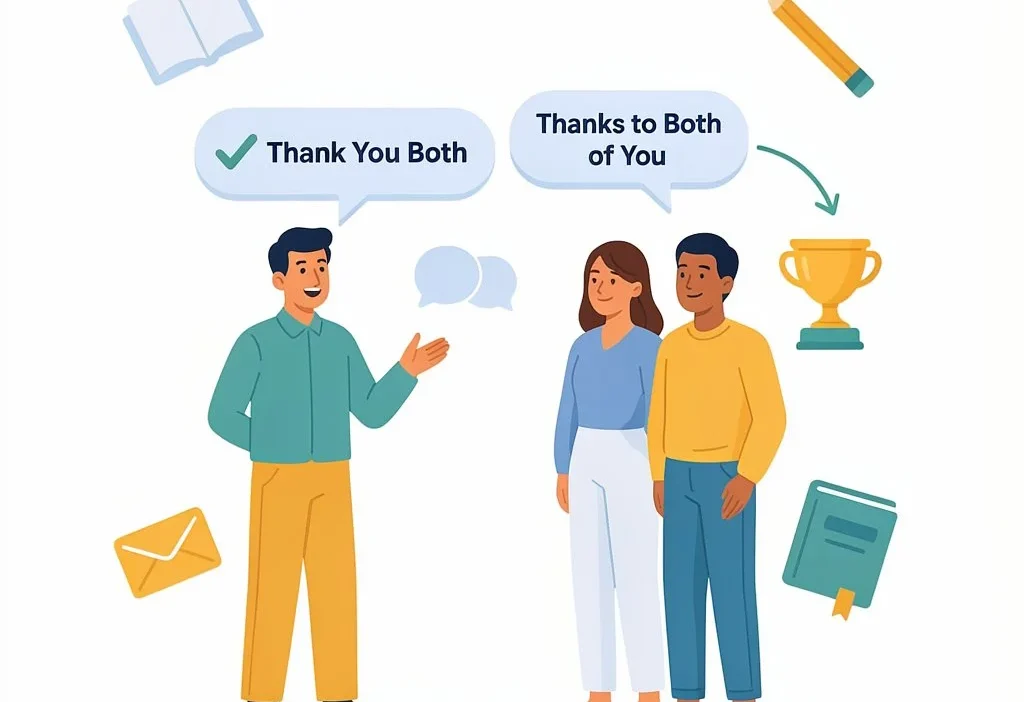
- Thank you both is a direct way to express gratitude to two people.
- Thanks to both of you usually means appreciation is being given because of the efforts of two people or introduces the reason for a positive outcome.
- Both phrases are grammatically correct, but they are not always interchangeable.
Examples:
- ✅ Thank you both for helping me move.
- ✅ Thanks to both of you, we finished the project early.
What Does “Thank You Both” Mean?
Thank you both is a direct expression of gratitude addressed to two people at the same time.
It is friendly, polite, and commonly used in everyday conversations, emails, meetings, classrooms, and family settings.
Examples:
- Thank you both for your support.
- Thank you both for coming today.
- Thank you both for your patience.
- Thank you both for believing in me.
The word both clearly tells the listener that your appreciation is directed equally to two individuals.
What Does “Thanks to Both of You” Mean?
Thanks to both of you can also express gratitude, but it often emphasizes that two people are responsible for a positive result.
It frequently introduces the cause of a successful outcome.
Examples:
- Thanks to both of you, the presentation was a success.
- Thanks to both of you, everything was ready on time.
- Thanks to both of you, I felt much more confident.
- Thanks to both of you, we solved the problem quickly.
Notice that the focus is slightly different. Instead of simply thanking two people, the phrase highlights their contribution.
The Key Difference
Although both expressions show appreciation, their purpose is slightly different.
| Expression | Primary Use | Example |
| Thank you both | Directly thanking two people | Thank you both for your help. |
| Thanks to both of you | Showing that two people deserve credit | Thanks to both of you, we succeeded. |
A simple way to remember the difference is:
- Thank you both = speaking directly to two people.
- Thanks to both of you = explaining why something good happened.
When to Use “Thank You Both”
Use thank you both when speaking directly to two people.
Common situations include:
- After receiving help
- During presentations
- At family gatherings
- In business meetings
- In emails
- In thank-you cards
- At school
- During interviews
Examples:
- Thank you both for attending.
- Thank you both for your advice.
- Thank you both for staying late.
- Thank you both for your kindness.
This expression sounds warm, personal, and sincere.
When to Use “Thanks to Both of You”
Choose thanks to both of you when you want to explain who made something possible.
Examples:
- Thanks to both of you, the event went smoothly.
- Thanks to both of you, we reached our goal.
- Thanks to both of you, the children enjoyed the trip.
- Thanks to both of you, our customers were happy.
Here, the phrase connects appreciation with a successful outcome.
Can You Use Them Interchangeably?
Sometimes yes—but not always.
Consider these examples:
Correct:
- Thank you both for your hard work.
- Thanks to both of you, the work was completed early.
Less natural:
- Thanks to both of you for your hard work.
Although people may say this in casual conversation, thank you both for your hard work is usually the smoother choice when speaking directly.
Examples in Everyday Conversations
At Work
Manager: Thank you both for completing the report before the deadline.
Colleague: Thanks to both of you, the client accepted our proposal.
At School
Teacher: Thank you both for helping your classmates.
Student: Thanks to both of you, I finally understood the lesson.
With Friends
- Thank you both for coming.
- Thanks to both of you, the party was unforgettable.
With Family
- Thank you both for always supporting me.
- Thanks to both of you, our vacation was amazing.
Common Mistakes
Many learners confuse these expressions because both contain the word thanks.
Avoid these mistakes:
1. Using the Wrong Purpose
❌ Thanks to both of you for listening.
✅ Thank you both for listening.
2. Forgetting the Result
❌ Thanks to both of you.
This is not wrong, but it often feels incomplete.
Better:
✅ Thanks to both of you, everything worked perfectly.
3. Mixing Sentence Structures
❌ Thank you to both of you because we won.
Better:
✅ Thanks to both of you, we won.
Or:
✅ Thank you both for helping us win.
Formal vs Informal Usage
| Situation | Better Choice |
| Business email | Thank you both |
| Academic writing | Thanks to both of you |
| Speech | Both work |
| Personal message | Thank you both |
| Thank-you note | Thank you both |
| Explaining success | Thanks to both of you |
Synonyms and Related Expressions
You can vary your wording using similar expressions:
- Thank you to both of you
- Many thanks to both of you
- I appreciate you both
- I appreciate both of you
- I’m grateful to both of you
- My sincere thanks to both of you
- Thanks to you both
- Thank you both so much
- I can’t thank you both enough
- You both have my gratitude
These alternatives keep your writing fresh while expressing the same appreciation.
American vs British English
There is no meaningful difference between American and British English when using thank you both or thanks to both of you.
Both expressions are natural and widely accepted in:
- American English
- British English
- Canadian English
- Australian English
The choice depends on the meaning you want to express rather than regional spelling or grammar.
Why These Expressions Matter
Showing gratitude strengthens relationships in both personal and professional life.
Choosing the correct expression helps you:
- Sound more natural.
- Communicate clearly.
- Avoid awkward wording.
- Improve your English fluency.
- Write more confidently.
Whether you’re thanking coworkers, teachers, family members, or friends, the right phrase leaves a positive impression.
FAQs
Is “thank you both” grammatically correct?
Yes. It is a correct and common way to thank two people directly.
Is “thanks to both of you” correct?
Yes. It is grammatically correct and often introduces the people responsible for a positive outcome.
Which sounds more natural?
For direct gratitude, thank you both is usually more natural.
Can I use “thank you to both of you”?
Yes. It is correct, although thank you both is shorter and more common in everyday English.
Is “thanks to both of you” always about giving credit?
Most of the time, yes. It commonly explains that two people contributed to a successful result.
Are these phrases formal?
Both can be used in formal and informal situations, depending on the context.
Can I use them in professional emails?
Absolutely. Thank you both is especially common in workplace communication.
Summary
If you’re deciding between thank you both or thanks to both of you, remember that both are correct but serve different purposes. Thank you both directly expresses appreciation to two people, making it ideal for conversations, emails, cards, and speeches. Thanks to both of you usually emphasizes that two people deserve credit for a positive outcome or achievement.
Choosing the right phrase depends on what you want to say. If you’re speaking directly to two people, thank you both is usually the best choice. If you’re explaining why something succeeded, thanks to both of you fits naturally. Understanding this subtle difference will make your English sound clearer, warmer, and more natural.