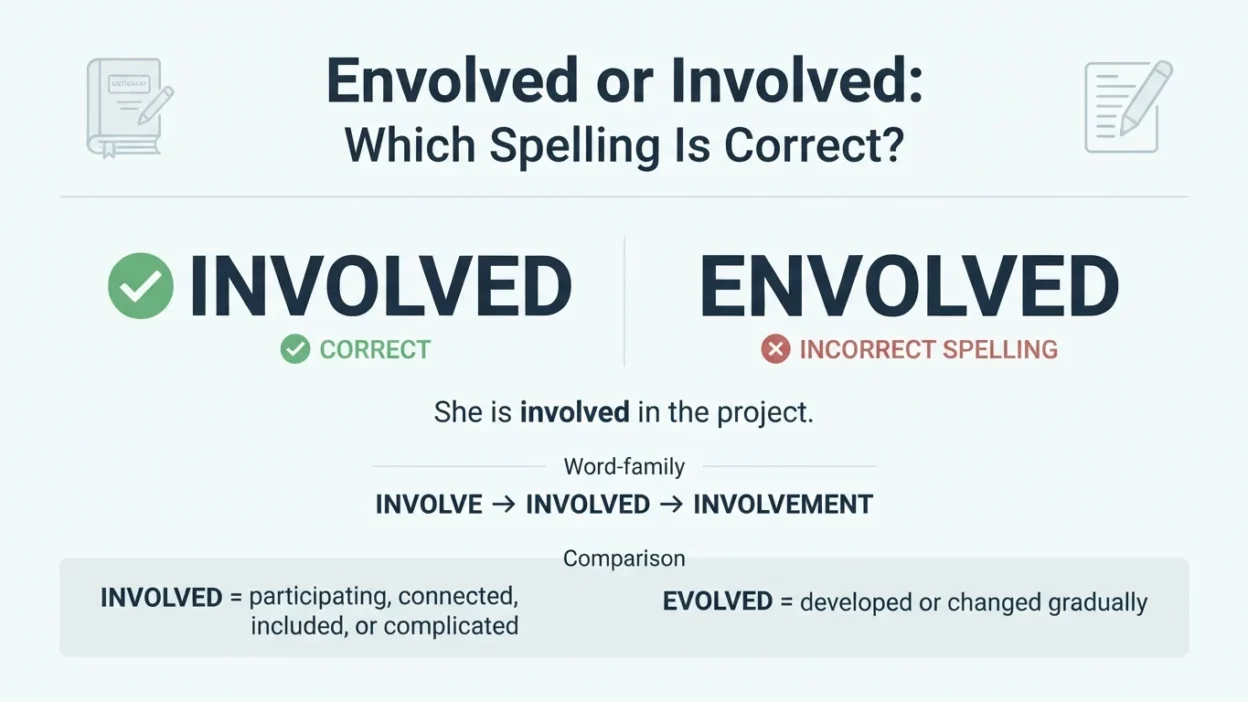
If you are wondering whether the correct spelling is “envolved” or “involved,” the answer is simple: involved is the correct standard English spelling. Envolved is generally a misspelling and should not be used in formal or professional writing.
This confusion is understandable because involved is not pronounced exactly as it is spelled, and English has many words beginning with “en-.” However, when you mean “participating,” “connected,” “included,” or “complicated,” the correct word is always involved. Learning its meaning and common uses can help you avoid this frequent spelling mistake.
Quick Answer: Envolved or Involved?
Involved is the correct spelling. Envolved is not the standard spelling of the word.
- ✅ Involved — correct
- ❌ Envolved — incorrect spelling in standard English
- Involved can mean participating in something.
- Involved can mean connected with or affected by something.
- Involved can also mean complicated or difficult to understand.
- Involvement is the related noun.
Simple example
She was involved in the school project.
Not:
She was envolved in the school project.
The first sentence is correct because involved is the standard English word.
What Does “Involved” Mean?
Involved is the past tense and past participle of the verb involve. It is also commonly used as an adjective.
The word has several meanings depending on context.
1. Participating in something
Involved can mean taking part in an activity, project, event, or situation.
I am involved in several community projects.
This means the speaker actively participates in those projects.
Another example:
She is heavily involved in the school debate club.
Here, involved means actively participating.
2. Connected with something
Involved can also mean being connected with or associated with a particular situation.
Several people were involved in the investigation.
This means those people were connected to the investigation in some way.
For example:
He was involved in the decision-making process.
The person participated in or had a connection to the process.
3. Including someone or something
The word can indicate that someone or something is included in a situation.
Everyone was involved in the discussion.
This means everyone participated or had some role in the discussion.
4. Complicated or difficult
Involved can also describe something that is complicated, detailed, or difficult to understand.
The instructions are too involved for beginners.
Here, involved does not mean participating. It means complicated or elaborate.
Another example:
The legal process is quite involved.
This means the process has many complicated details or steps.
Envolved vs Involved: Comparison Table
| Word | Correct? | Meaning | Example |
| Involved | ✅ Yes | Participating, connected, included, or complicated | She is involved in the project. |
| Envolved | ❌ No | Not a standard spelling of “involved” | ❌ She is envolved in the project. |
| Involve | ✅ Yes | To include, require, or engage | The project will involve several teams. |
| Involvement | ✅ Yes | Participation or connection | His involvement was important. |
The key takeaway is simple: involved is the correct form.
Why Is “Envolved” a Common Mistake?
The spelling envolved may look reasonable because English contains many words beginning with en-, such as:
- encourage
- enable
- enlarge
- enrich
- enroll
- enforce
A writer may therefore assume that envolve is the verb behind envolved.
However, the correct word is based on involve:
involve → involved → involvement
There is no standard verb envolve corresponding to involved in this context.
Pronunciation can also contribute to the confusion. When people hear the word quickly, the initial vowel sound may not make the spelling obvious. This can lead someone to write envolved instead of involved.
Involve, Involved, and Involvement
Understanding the related forms makes the spelling much easier to remember.
Involve
Involve is the base form of the verb.
The project will involve several departments.
Involved
Involved is the past tense and past participle of involve.
She involved her colleagues in the discussion.
It is also commonly used as an adjective:
She is involved in the project.
Involvement
Involvement is the noun form.
Her involvement helped the project succeed.
The word family is:
involve → involved → involvement
There is no need to introduce an e at the beginning.
When Should You Use “Involved”?
Use involved whenever you mean that someone participates in, connects with, or is affected by something.
1. Involved in a project
Tom is involved in the new marketing project.
This means Tom participates in the project.
2. Involved in an activity
The students were involved in several extracurricular activities.
They participated in those activities.
3. Involved in a decision
Parents should be involved in important school decisions.
They should participate in the decision-making process.
4. Involved in an investigation
The police interviewed everyone involved in the case.
The people had some connection to the case.
5. Involved in a relationship
They have been involved for several years.
Depending on context, this can mean they have a romantic relationship or another significant personal connection.
6. An involved process
Applying for the permit is an involved process.
Here, involved means complicated or requiring many steps.
Common Phrases With “Involved”
Involved appears in many common English expressions.
Some useful examples include:
- involved in a project
- involved in a discussion
- involved in a decision
- involved in an activity
- involved in a case
- involved in an investigation
- involved in a relationship
- involved in the process
- heavily involved
- actively involved
- directly involved
- personally involved
- emotionally involved
- financially involved
Examples
She is actively involved in community work.
He was directly involved in the project.
They became emotionally involved with the organization.
Several companies were financially involved in the deal.
These phrases are common in both everyday and professional English.
Common Mistakes to Avoid
Mistake 1: Writing “envolved”
❌ She is envolved in the project.
✅ She is involved in the project.
This is the most important spelling correction.
Mistake 2: Writing “envolve”
❌ The project will envolve five employees.
✅ The project will involve five employees.
The base verb is involve, not envolve.
Mistake 3: Confusing “involved” and “evolved”
This is another possible source of confusion.
Involved means participating, connected, included, or complicated.
She is involved in the project.
Evolved means developed or changed gradually over time.
The technology has evolved rapidly.
These words sound and look somewhat similar, but their meanings are completely different.
Mistake 4: Confusing “involved” with “included”
The two words can sometimes overlap, but they are not always interchangeable.
Included usually means something or someone is part of a group or set.
Breakfast is included in the price.
Involved often suggests participation or connection.
She was involved in organizing the event.
Involved vs Evolved
Because envolved may result from mixing involved and evolved, it is useful to compare them.
| Word | Meaning | Example |
| Involved | Participating or connected | He is involved in the project. |
| Evolved | Developed or changed gradually | The plan has evolved over time. |
| Envolved | ❌ Incorrect spelling for these meanings | Avoid this form. |
A useful memory trick is:
Involved = included or participating
Evolved = developed or changed
American English vs British English
There is no significant American-versus-British English difference in the spelling of involved.
Both American English and British English use:
involved
and both reject envolved as the standard spelling when the intended word is involved.
For example, these are correct in both varieties:
She is involved in the project.
He was involved in the discussion.
The process is highly involved.
There may be regional differences in pronunciation or particular expressions, but the spelling involved remains the same.
How to Remember the Correct Spelling
The easiest way to remember the correct spelling is to memorize the word family:
INVOLVE → INVOLVED → INVOLVEMENT
Notice that every form begins with in-.
You can also connect it with the common phrase:
involved in
Whenever you want to say that someone participates in something, think:
involved in, not envolved in.
Quick memory trick
IN + VOLVE = INVOLVE
IN + VOLVED = INVOLVED
The first two letters are IN, not EN.
Is “Involved” Always About Participation?
No. This is an important point because involved has several meanings.
Consider these examples:
She is involved in the charity.
Here, it means participation.
He was involved in the accident.
Here, it means connected with the event.
The instructions are very involved.
Here, it means complicated.
Therefore, you should determine the meaning from the context.
Synonyms for “Involved”
Depending on the intended meaning, you can use different synonyms.
When “involved” means participating:
- participating
- engaged
- active
- taking part
- contributing
- associated
When “involved” means connected:
- connected
- associated
- related
- concerned
- implicated
When “involved” means complicated:
- complex
- complicated
- elaborate
- detailed
- intricate
Choosing the right synonym can make your writing more precise and natural.
FAQs
Is “envolved” a correct English word?
No. Envolved is not the standard spelling when you mean participating, connected, or included. The correct word is involved.
Is it “involved in” or “envolved in”?
The correct phrase is “involved in.”
For example:
She is involved in the project.
“Envolved in” is an incorrect spelling.
What is the correct spelling: involved or envolved?
Involved is the correct spelling. It comes from the verb involve.
What is the difference between involved and evolved?
Involved means participating, connected, included, or complicated. Evolved means developed or changed gradually.
For example:
He is involved in the project.
The project has evolved over time.
What is the verb form of involved?
The base verb is involve.
Its forms include:
- involve
- involves
- involved
- involving
For example:
The job involves working with customers.
What is the noun form of involved?
The related noun is involvement.
Her involvement in the project was valuable.
Is “involved” the same in American and British English?
Yes. Involved is spelled the same and has essentially the same meanings in both American and British English.
Can “involved” mean complicated?
Yes. Involved can describe something complicated, detailed, or difficult to understand.
For example:
The legal procedure is quite involved.
Summary
When choosing between envolved or involved, the correct standard English spelling is involved. It is the past tense and past participle of involve, and it can also function as an adjective. Depending on context, involved can mean participating in something, connected with something, included in a situation, or complicated.
Envolved is a common spelling mistake, often caused by pronunciation or confusion with English words that begin with en-. It may also result from mixing up involved and evolved. Remember that the correct word family is involve → involved → involvement, and the phrase you will commonly use is involved in.
Actionable Takeaway
If you are unsure whether to write “envolved” or “involved,” always choose involved when you mean participating, connected, included, or complicated. The simplest memory trick is to remember “involved in”: She is involved in the project.
Also keep involved and evolved separate in your mind. Involved is about participation or connection, while evolved is about gradual development or change. Once you remember the correct word family—involve, involved, involvement—this spelling mistake becomes much easier to avoid.