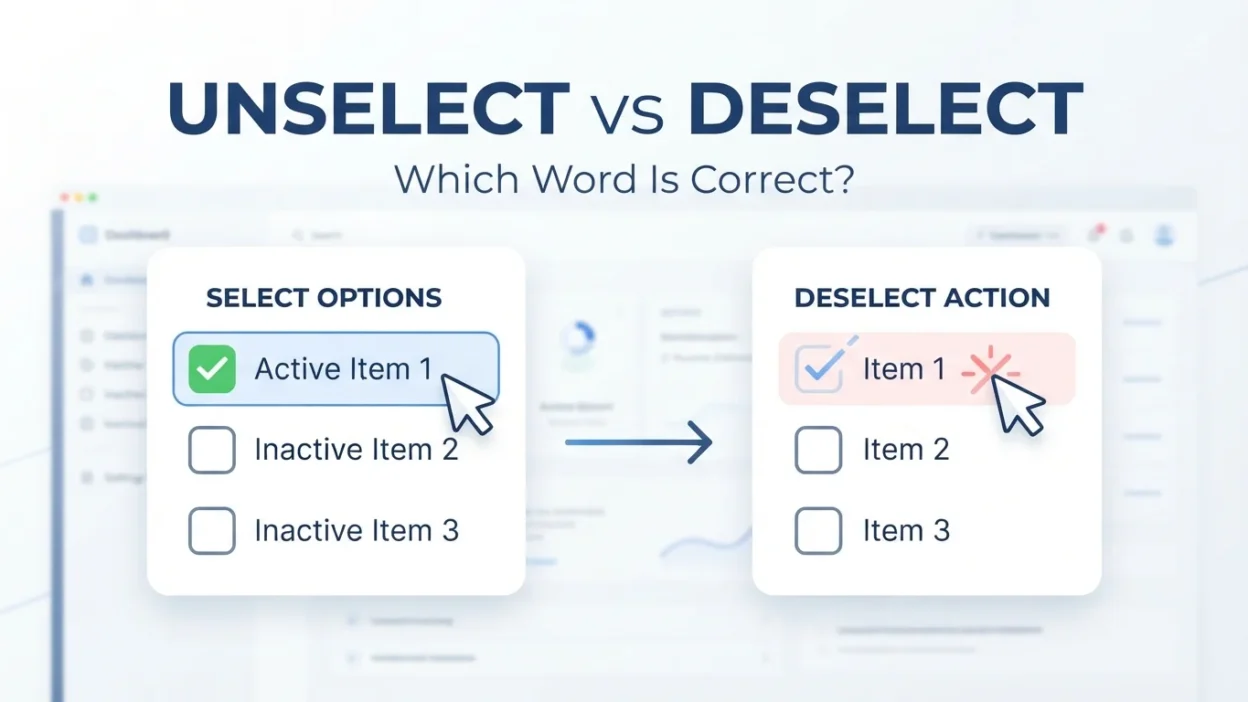
Unselect or deselect—which word should you use when you want to remove a selection? Both forms can be found in modern English, especially in computer interfaces, software, forms, and digital applications. However, they are not always equally natural or equally common in every context.
If you are writing instructions such as “unselect the option” or “deselect the option,” choosing the right word can make your writing sound clearer and more professional. In most standard technical and user-interface writing, deselect is the safer and more established choice. Unselect is also used, particularly in computing and informal digital language, but its acceptability and preferred usage can depend on context.
Quick Answer: Unselect or Deselect?
Deselect is generally the preferred and more widely established word when you mean to remove a selection or cancel an existing selection.
- Deselect = remove something from a current selection.
- Unselect = also used to mean remove something from a selection, especially in computing and informal digital contexts.
- Best choice for formal instructions: deselect
- Common UI phrase: “Deselect the option.”
- Less formal but understandable: “Unselect the option.”
For example:
Deselect the checkbox if you do not want to receive notifications.
While unselect is understandable and appears in dictionaries and technical usage, deselect is usually the more natural choice when writing polished software instructions, documentation, or professional content.
What Does Deselect Mean?
Deselect means to remove something from a selection after it has already been selected.
The prefix de- often conveys the idea of reversing an action, removing something, or moving away from a previous state. Therefore:
select → deselect
For example:
- Select the files you want to delete.
- Deselect any files you want to keep.
You might see deselect when working with:
- Checkboxes
- Radio buttons
- Menus
- Images
- Text
- Files
- Spreadsheet cells
- Search filters
- Software settings
- Graphic design programs
- Online forms
Examples of Deselect
Here are some natural examples:
- Deselect the checkbox to disable this feature.
- Click the image again to deselect it.
- Deselect all unnecessary options before submitting the form.
- You can deselect a file by clicking it again.
- Deselect the filter to see all available products.
In each example, something was already selected, and the user is being instructed to remove that selection.
What Does Unselect Mean?
Unselect can also mean to remove something from a selection. It is especially associated with computers, software, websites, and other digital interfaces.
For example:
- Unselect the option if you do not need it.
- Unselect the files you do not want to download.
- Click here to unselect all items.
The word is understandable because English commonly uses un- to indicate reversal or removal. However, when talking specifically about selection, deselect is generally the more conventional term.
This does not mean unselect is always wrong. Rather, deselect tends to be the safer choice for formal, polished, and standardized writing.
Unselect vs Deselect: Comparison Table
| Word | Meaning | Common Context | Formality | Recommended? |
| Deselect | Remove something from a selection | Software, forms, documentation | Standard/professional | Yes |
| Unselect | Remove something from a selection | Computing, interfaces, informal usage | Less standard | Sometimes |
| Select | Choose or mark something | General and digital contexts | Standard | Yes |
| Re-select | Select something again | Software and instructions | Standard | Yes |
The important point is that deselect and unselect can communicate essentially the same idea in many computing contexts. The difference is mainly one of conventional usage and style.
Deselect vs Unselect in Computer and UI Language
This is where you are most likely to encounter both words.
Imagine a website with several checkboxes:
☑ Email updates
☑ Special offers
☐ Text messages
If the user no longer wants email updates, an instruction might say:
“Deselect Email updates.”
You may also encounter:
“Unselect Email updates.”
Both are understandable, but deselect usually sounds more polished and natural in technical documentation.
For software developers, UX writers, technical writers, and content creators, consistency is especially important. If your interface uses select for an action, deselect creates a clear pair:
Select → Deselect
This is often preferable to:
Select → Unselect
The de- construction directly establishes the opposite of select in many technical contexts.
When Should You Use Deselect?
Use deselect when you want your writing to sound clear, professional, and consistent, particularly in instructions.
It works especially well in:
- User manuals
- Software documentation
- Help-center articles
- Website instructions
- Technical writing
- UX/UI copy
- Online forms
- Educational materials
Examples
Deselect the checkbox before continuing.
Deselect any options that do not apply to you.
To remove an item from the group, deselect it.
Deselect the current filter to display all results.
These sentences sound natural because deselect is widely understood in digital and technical contexts.
When Can You Use Unselect?
Unselect can be used when the context is clearly about digital selection and your audience is familiar with the term.
For example:
- Unselect all the files you don’t need.
- Unselect the option to turn off automatic renewal.
- You can unselect an item by clicking it again.
You may also encounter unselect in software interfaces, online discussions, help pages, and informal instructions.
However, if you are deciding which word to use in professional writing and there is no special reason to choose unselect, deselect is usually the better option.
Is Unselect a Real Word?
Yes, unselect is used as a real English word, particularly in computing and other contexts involving selections. It is not simply meaningless or incomprehensible.
The issue is that deselect is generally more established as the standard term for reversing a selection.
This distinction is useful because English has many words that are understandable and used in practice but are not always the preferred choice in formal writing.
So, saying “unselect is never a word” would be too strong. A better explanation is:
Unselect is used in English, but deselect is generally the preferred term when referring to removing a selection.
Common Mistakes With Unselect and Deselect
Mistake 1: Assuming Unselect Is Always Wrong
❌ “Unselect is never a real English word.”
This is too absolute. Unselect does occur in modern English, especially in computing.
A better statement is:
Deselect is generally preferred, while unselect is also used.
Mistake 2: Using Deselect When Nothing Was Selected
Deselect normally implies that something has already been selected.
For example:
Deselect the checkbox.
This makes sense because the checkbox is presumably selected.
If the user has not selected anything yet, simply say:
Select the checkbox.
Mistake 3: Switching Terms Unnecessarily
If your instructions begin with:
Select the files you need.
Then it is usually clearer to say:
Deselect any files you do not need.
This gives the reader a consistent pair of instructions.
Mistake 4: Confusing Deselect With Delete
Deselect does not mean delete.
- Deselect = remove something from a selection.
- Delete = remove something from the system, document, or collection.
For example:
Deselect the file means the file remains there but is no longer selected.
Delete the file means the file itself is removed.
This distinction is especially important in software instructions.
Deselect vs Delete vs Uncheck
These terms can sometimes appear together, but they do not always mean exactly the same thing.
Deselect
Means to remove an item from a selection.
Example:
“Deselect the image.”
Uncheck
Usually means to remove the checkmark from a checkbox.
Example:
“Uncheck the box to disable notifications.”
Delete
Means to remove something entirely.
Example:
“Delete the selected file.”
Understanding these differences helps make technical writing more precise.
American vs British English: Unselect or Deselect
There is no major American-versus-British English difference in the basic meaning of deselect and unselect.
Both American and British English use deselect in computing and technical contexts.
You may also encounter unselect in both varieties, particularly in digital environments. The bigger difference is usually style and preference rather than geography.
For professional writing intended for either American or British readers, deselect is a safe and widely understood choice.
For example:
- American English: Deselect the option.
- British English: Deselect the option.
The wording remains the same.
Why Deselect Is Usually the Better Choice
There is a simple reason deselect works so well: it creates a natural opposite to select.
Think of the pair:
select → deselect
This makes instructions easy to understand because readers immediately recognize the relationship between the two actions.
For example:
- Select the files you want.
- Deselect the files you do not want.
- Download the remaining files.
The sequence is logical and easy to follow.
In user-interface writing, this kind of consistency improves readability and reduces confusion.
How to Remember the Difference
Use this simple rule:
Select = choose it.
Deselect = stop selecting it.
Unselect = an alternative term that can also mean remove it from a selection.
If you are writing a formal sentence and are unsure which one to use, choose deselect.
For example:
❌ “Please unselect the unwanted options.”
✅ “Please deselect the unwanted options.”
The second sentence is generally the better choice for polished professional writing.
FAQs
Is “unselect” grammatically correct?
Yes, unselect is used in English, particularly in computing and digital contexts. However, deselect is generally the more conventional and preferred term for removing something from a selection.
Is deselect the opposite of select?
Yes. In many digital and technical contexts, deselect means to reverse or remove an existing selection, making it the natural counterpart to select.
Should I use “unselect” or “deselect”?
For professional writing, software instructions, documentation, and UI text, deselect is usually the better choice. Unselect can still be understood and is used in some digital contexts.
Is “unselect” a real word?
Yes. It is used, particularly in computing, although it is generally less conventional than deselect when referring to removing a selection.
What does deselect mean in computer terms?
In computing, deselect means to remove an item, option, file, object, or other element from an existing selection without necessarily deleting it.
Is “deselect” the same as “uncheck”?
Not always. Uncheck specifically refers to removing a checkmark from a checkbox, while deselect can refer to many types of selections, including files, images, text, objects, and filters.
Is “deselect” used in British English?
Yes. Deselect is used in British English as well as American English, particularly in computing, software, and technical writing.
Does deselect mean delete?
No. Deselect means to remove something from a selection. Delete means to remove the item itself. A deselected file can still remain on your computer.
Final Summary
When choosing between unselect or deselect, deselect is generally the best choice for standard, professional, and technical writing. It clearly means to remove something from an existing selection and forms a natural pair with select. You will commonly see it in software instructions, online forms, user guides, websites, and other digital environments.
Unselect is also used and can be understood, especially in computing and informal digital communication. It is not necessarily incorrect, but it is usually less conventional than deselect. If you want your writing to be clear, polished, and widely acceptable, choose “deselect” unless your specific interface or style guide prefers “unselect.”
Actionable Takeaway
When writing instructions, remember:
- Select = choose something.
- Deselect = remove something from the selection.
- Unselect = an alternative term, commonly found in digital contexts.
- Delete = remove the item itself.
- Uncheck = remove the checkmark from a checkbox.
Best professional choice: Deselect
So, if you are writing a sentence such as “___ the option you no longer want,” the safest answer is:
“Deselect the option you no longer want.”