Impatient vs inpatient is a common English word confusion because these two words look almost identical, but their meanings are completely different. One describes a person who is unable or unwilling to wait calmly, while the other is mainly used in healthcare to describe a patient who stays in a hospital or medical facility for treatment.
The difference is just one letter, but that small difference completely changes the meaning. If you are writing about someone’s behavior, impatient is probably the word you need. If you are discussing hospital care or someone admitted to a medical facility, inpatient is the correct term. Understanding the distinction can help you avoid an easy spelling and vocabulary mistake.
Quick Answer: Impatient vs Inpatient
Both impatient and inpatient are correct English words, but they have very different meanings.
- Impatient means unable or unwilling to wait calmly.
- Inpatient refers to a person who is admitted to a hospital or other healthcare facility and stays there for treatment.
- Impatient describes a person’s behavior, attitude, or lack of patience.
- Inpatient is primarily a medical or healthcare term.
Simple examples
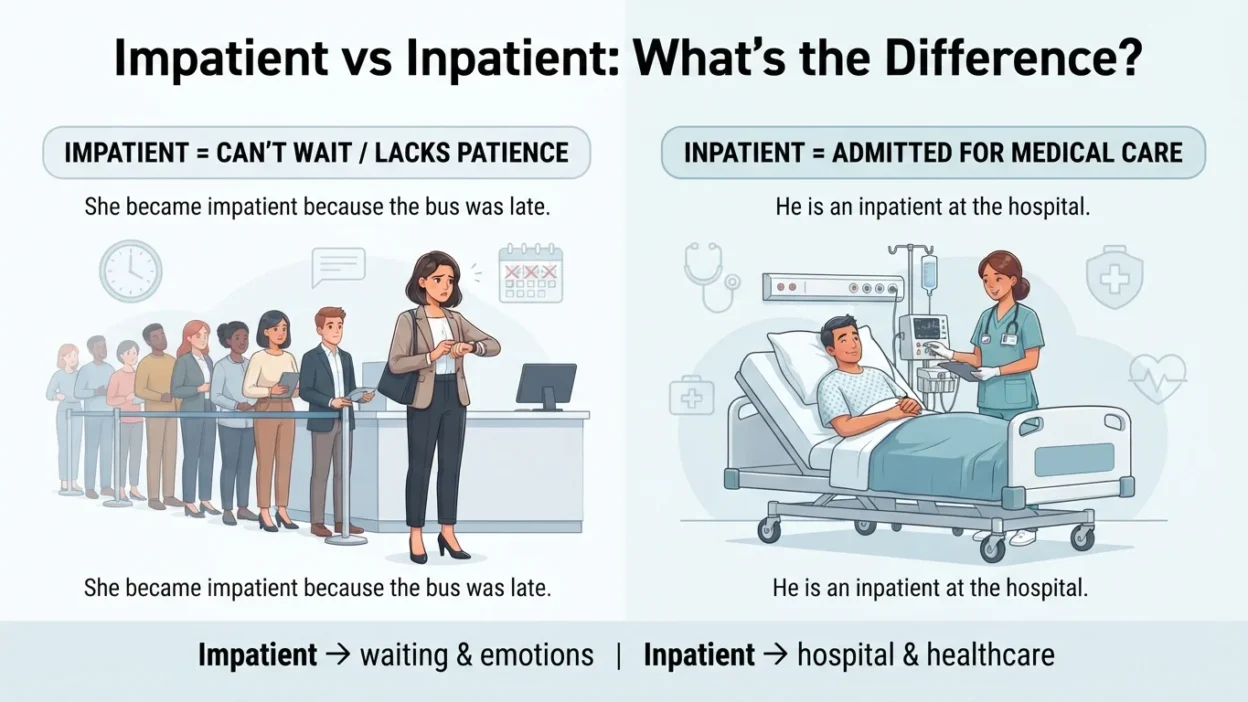
She became impatient because the bus was late.
She was annoyed or unwilling to wait.
The doctor examined the inpatient after surgery.
The patient was staying in the hospital for treatment.
A simple way to remember the difference is:
Impatient = cannot wait
Inpatient = stays in a medical facility
What Does “Impatient” Mean?
Impatient is an adjective that describes someone who does not like waiting or who becomes annoyed when something takes longer than expected.
It can also describe someone who wants something to happen immediately.
For example:
- He is impatient with slow service.
- She became impatient while waiting for the results.
- The children were impatient to open their presents.
- Don’t be impatient; we’ll be there soon.
- He is an impatient driver.
The word can describe temporary feelings or a person’s general behavior.
“Impatient” can mean two slightly different things
First, it can mean unable or unwilling to wait:
The customer was impatient after waiting for an hour.
Second, it can mean eager for something to happen:
She was impatient to start her new job.
In the second example, the person is not necessarily angry. She is simply very eager and does not want to wait.
Synonyms for “impatient”
Depending on the context, useful synonyms include:
- restless
- annoyed
- eager
- frustrated
- hasty
- intolerant
- anxious
- hurried
- irritable
Not every synonym has exactly the same meaning, so choose one that fits the context.
What Does “Inpatient” Mean?
Inpatient is primarily a healthcare term.
An inpatient is a person who has been admitted to a hospital or another medical facility and remains there for treatment, observation, surgery, or recovery.
For example:
- The hospital has 200 inpatients.
- The doctor checked on the inpatient this morning.
- She became an inpatient after her surgery.
- The facility provides care for elderly inpatients.
- The hospital discharged several inpatients yesterday.
The word can also function as an adjective:
Inpatient care is available at the hospital.
Here, inpatient care means medical care provided to people who stay in the healthcare facility rather than simply visiting for an appointment.
Common healthcare terms
You may see inpatient used with words such as:
- inpatient care
- inpatient treatment
- inpatient services
- inpatient facility
- inpatient unit
- inpatient admission
- inpatient surgery
- inpatient rehabilitation
- inpatient program
These terms are especially common in medical, hospital, insurance, and healthcare writing.
Impatient vs Inpatient: Key Difference
The easiest way to distinguish these words is to look at what they describe.
| Word | Part of speech | Meaning | Example |
| Impatient | Adjective | Unable or unwilling to wait calmly | He became impatient in the long line. |
| Inpatient | Noun/Adjective | A person receiving treatment while staying in a medical facility; related to such care | She is an inpatient at the hospital. |
| Impatience | Noun | Lack of patience | His impatience was obvious. |
| Inpatient care | Noun phrase | Medical care provided to admitted patients | The hospital offers inpatient care. |
Remember this distinction
Impatient is about patience and waiting.
Inpatient is about medical treatment and staying in a healthcare facility.
This difference is the key to using both words correctly.
When Should You Use “Impatient”?
Use impatient when describing someone who is becoming frustrated with waiting or wants something to happen quickly.
1. Waiting for someone
I became impatient because Tom was late.
The speaker was frustrated by the delay.
2. Waiting in a line
The customers were getting impatient.
They were becoming annoyed because they had to wait.
3. Wanting something to happen
The children were impatient to see their gifts.
They were eager and excited to open them.
4. Dealing with slow progress
She is impatient with the slow progress of the project.
She wants the project to move faster.
5. Describing a personality
He can be impatient when things don’t go according to plan.
This suggests that impatience is part of his usual behavior.
When Should You Use “Inpatient”?
Use inpatient when discussing someone who has been admitted to a healthcare facility and remains there for treatment.
1. Hospital treatment
The patient was admitted as an inpatient.
The person needed to stay in the hospital.
2. Medical services
The hospital provides both inpatient and outpatient services.
Some patients stay at the facility, while others receive treatment without being admitted.
3. Surgery
The procedure required inpatient care.
The patient needed to remain in the healthcare facility.
4. Rehabilitation
He entered an inpatient rehabilitation program.
He stayed at the facility while receiving rehabilitation services.
5. Hospital records
The nurse updated the inpatient records.
The records concerned patients who were admitted to the facility.
Inpatient vs Outpatient
Understanding inpatient becomes even easier when you compare it with outpatient.
An inpatient stays at a medical facility for treatment.
An outpatient receives medical care but does not normally stay overnight or remain admitted.
For example:
The hospital provides both inpatient and outpatient care.
This means the hospital treats both admitted patients and patients who visit for medical services without being admitted.
Simple memory trick
INpatient = IN the hospital
OUTpatient = OUT of the hospital after the visit
This is not a complete medical definition for every situation, but it is a useful vocabulary shortcut.
Why Are “Impatient” and “Inpatient” Confused?
The two words are easy to mix up because they differ by only one letter.
Compare:
impatient
inpatient
They also look similar when quickly read or typed.
However, their roots can help you remember them.
Impatient contains patient, which relates to patience:
patient → patience → impatient
Inpatient contains in + patient, referring to a patient who is in a healthcare facility.
So you can remember:
Impatient = lack of patience
Inpatient = patient admitted for care
Common Mistakes to Avoid
Mistake 1: Using “inpatient” when you mean “impatient”
❌ I am getting inpatient because the line is too long.
✅ I am getting impatient because the line is too long.
The sentence is about frustration with waiting, so impatient is correct.
Mistake 2: Using “impatient” for a hospital patient
❌ The doctor examined the impatient.
If you mean a person admitted to the hospital, use:
✅ The doctor examined the inpatient.
Mistake 3: Thinking “inpatient” means someone who is patient
The word inpatient does not mean “a person who is inside and patient.”
It is a specific healthcare term referring to someone admitted for medical care.
Mistake 4: Confusing “patient” with “inpatient”
Patient has two common meanings:
- A person receiving medical care.
- Someone who can wait calmly.
For example:
The patient waited quietly.
Here, patient could refer to either a medical patient or someone who is calm and willing to wait, depending on context.
Adding im- creates impatient, meaning someone who lacks patience.
Adding in- creates inpatient, referring to a person admitted for healthcare.
American English vs British English
There is no major American-versus-British English difference in the meanings of impatient and inpatient.
Both words are standard in American English and British English.
Impatient has the same basic meaning in both varieties:
She was impatient with the delay.
Similarly, inpatient is used in both varieties of English in medical contexts:
The hospital provides inpatient care.
Healthcare terminology can vary somewhat between countries because medical systems and administrative practices differ, but the fundamental distinction between these two words remains the same.
Impatient vs Inpatient: More Examples
Here are some additional examples to make the difference clear:
- I was impatient because the meeting started late.
- The hospital admitted him as an inpatient.
- She became impatient while waiting for her food.
- The doctor reviewed the inpatient chart.
- Don’t be impatient; your turn will come soon.
- The hospital has a separate inpatient unit.
- He was impatient to hear the final decision.
- The facility offers specialized inpatient treatment.
- The children were impatient for the school trip.
- The nurse checked on every inpatient.
Notice how the context immediately tells you which word is appropriate.
How to Remember the Difference
Use this quick memory trick:
IMPATIENT = NO PATIENCE
If someone is annoyed because they have to wait, they are impatient.
I am impatient because the train is late.
INPATIENT = IN MEDICAL CARE
If someone has been admitted to a hospital or healthcare facility, they are an inpatient.
She is an inpatient receiving treatment.
You can also remember:
Impatient → emotions and waiting
Inpatient → hospitals and healthcare
This simple association can prevent the two words from getting mixed up.
Frequently Asked Questions
What is the difference between impatient and inpatient?
Impatient describes someone who does not want to wait or becomes frustrated by delays. Inpatient refers to a person admitted to a hospital or healthcare facility for treatment.
Is “inpatient” a medical term?
Yes. Inpatient is primarily a healthcare term. It describes a patient who has been admitted to a medical facility and stays there while receiving care.
Does “impatient” mean angry?
Not necessarily. Impatient can mean frustrated or annoyed because of waiting, but it can also mean eager for something to happen quickly.
For example:
She was impatient to begin her new job.
Here, she is eager rather than angry.
What is an inpatient in a hospital?
An inpatient is someone who has been formally admitted to a hospital or healthcare facility and stays there for treatment, observation, surgery, or recovery.
What is the opposite of inpatient?
The common contrasting term is outpatient. An outpatient receives medical care without being admitted as an inpatient.
Is “impatient” an adjective?
Yes. Impatient is an adjective.
For example:
He is impatient with slow service.
The related noun is impatience.
Is “inpatient” a noun or adjective?
Inpatient can be both a noun and an adjective.
As a noun:
The inpatient received treatment.
As an adjective:
The hospital provides inpatient care.
Are impatient and inpatient pronounced differently?
Yes. They have different vowel sounds and syllable patterns even though their spelling is similar. Hearing the words in context can make the difference easier to recognize.
Summary
The difference between impatient vs inpatient is simple once you connect each word with its meaning. Impatient describes someone who lacks patience, dislikes waiting, becomes frustrated by delays, or is eager for something to happen. For example, someone waiting a long time for a bus might become impatient.
Inpatient, on the other hand, is primarily a healthcare term. An inpatient is a person admitted to a hospital or medical facility for treatment, observation, surgery, or recovery. The word can also be used as an adjective in expressions such as inpatient care and inpatient treatment. Both words are used in American and British English with essentially the same meanings.
Actionable Takeaway
When choosing between these two words, ask yourself one simple question: Am I talking about waiting, or am I talking about healthcare? If the subject is frustration, delay, eagerness, or lack of patience, use impatient. If the subject is a patient staying in a hospital or receiving admitted medical care, use inpatient.
A quick memory trick makes the distinction even easier: impatient = no patience, while inpatient = in medical care. Remembering this small difference will help you avoid a common spelling mistake and make your English clearer and more accurate.