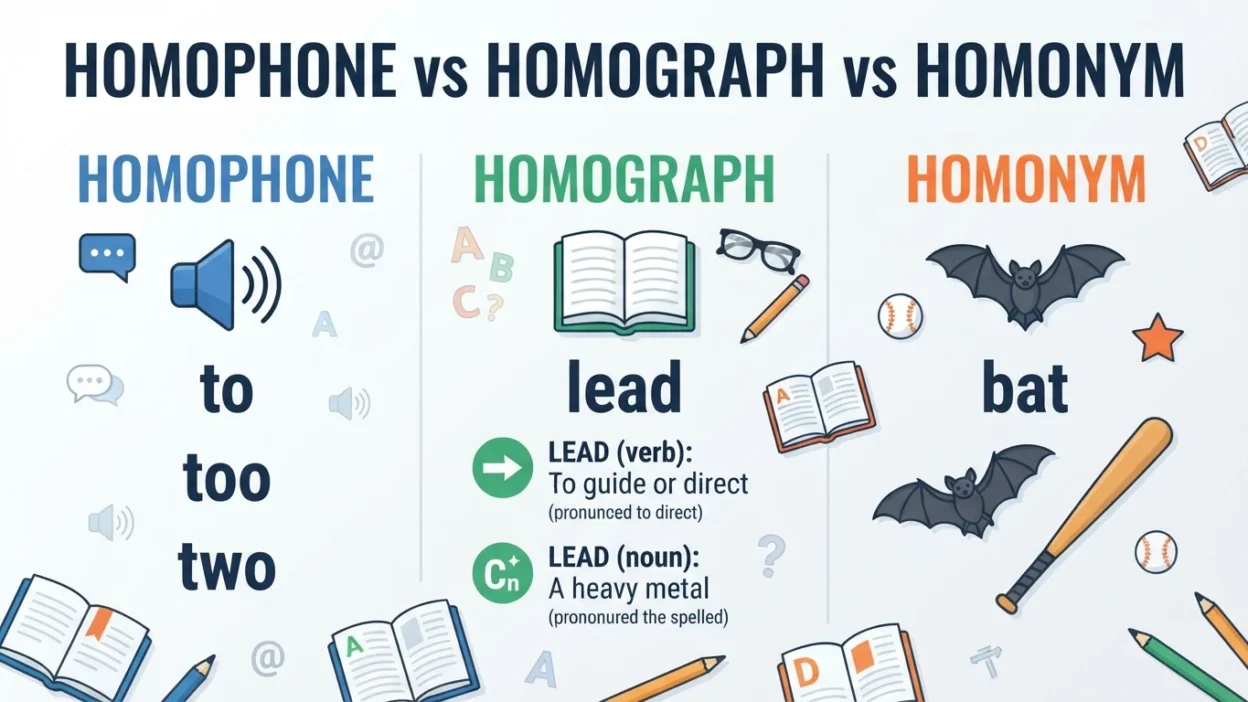
If you’ve ever wondered about homophone vs homograph vs homonym, you’re not alone. These three grammar terms often confuse English learners because they all describe words that are related by sound, spelling, or meaning. Although they seem similar, each one has a unique definition and purpose in the English language.
Understanding the difference between homophones, homographs, and homonyms can improve your grammar, writing, reading, and communication skills. In this guide, you’ll learn what each term means, see easy examples, discover common mistakes to avoid, and find simple memory tricks that make these concepts easy to remember.
Quick Answer
Here’s the easiest way to remember the difference:
- Homophones sound the same but have different meanings and often different spellings.
- Homographs are spelled the same but have different meanings and sometimes different pronunciations.
- Homonyms are words that have the same spelling or pronunciation but different meanings. Some grammar books use homonym as an umbrella term that includes both homophones and homographs.
Examples:
- Homophone: to, two, too
- Homograph: lead (to guide) and lead (the metal)
- Homonym: bat (an animal) and bat (used in baseball)
What Is a Homophone?
A homophone is a word that sounds exactly like another word but has a different meaning and often a different spelling.
The word comes from the Greek words:
- Homo = same
- Phone = sound
So, homophone literally means same sound.
Examples of Homophones
| Word 1 | Word 2 | Meaning |
| to | too | Direction vs also/excessively |
| sea | see | Ocean vs vision |
| right | write | Correct vs record words |
| flour | flower | Baking ingredient vs plant |
| knight | night | Soldier vs evening |
Even though these words sound alike, their meanings are completely different.
What Is a Homograph?
A homograph is a word that has the same spelling as another word but a different meaning. Sometimes the pronunciation changes too.
The word comes from:
- Homo = same
- Graph = writing
Meaning: same writing.
Examples of Homographs
| Word | Meaning 1 | Meaning 2 |
| lead | to guide | a metal |
| tear | drop from the eye | to rip |
| wind | moving air | to twist |
| row | line | argument |
| bow | front of a ship | bend at the waist |
Notice that some homographs are pronounced differently depending on their meaning.
What Is a Homonym?
A homonym refers to words that share the same spelling, the same pronunciation, or both, while having different meanings.
Because language experts define the term slightly differently, you’ll sometimes see homonym used as a broad category that includes both homophones and homographs.
Examples of Homonyms
| Word | Meaning 1 | Meaning 2 |
| bat | flying mammal | baseball bat |
| bark | tree covering | dog’s sound |
| match | contest | item used to light fire |
| ring | jewelry | telephone signal |
| crane | bird | construction machine |
These words have unrelated meanings despite sharing the same form.
Homophone vs Homograph vs Homonym: Comparison Table
| Feature | Homophone | Homograph | Homonym |
| Same Pronunciation | ✅ Yes | Sometimes | Yes or Sometimes |
| Same Spelling | Usually No | ✅ Yes | Sometimes |
| Different Meaning | ✅ Yes | ✅ Yes | ✅ Yes |
| Example | two / too | lead / lead | bat / bat |
This table makes it easier to identify which category a word belongs to.
How to Tell the Difference
A simple way to remember each term is to focus on the ending of the word.
- Phone relates to sound.
- Graph relates to writing.
- Nym relates to name.
Ask yourself these questions:
- Do they sound the same? → Homophone
- Are they spelled the same? → Homograph
- Do they share the same name or form with different meanings? → Homonym
This quick method works in most situations.
Real-Life Examples
Here are some examples you may see every day.
Homophones
- I need two apples.
- I am going to school.
- I like pizza too.
Homographs
- Please lead the group.
- The pipe contains lead.
- The wind is strong today.
- Please wind the clock.
Homonyms
- The bat flew across the sky.
- He picked up the bat before the game.
Context tells readers which meaning is intended.
Common Mistakes
Many learners mix these three grammar terms because they all begin with homo, meaning “same.”
Here are the most common errors.
Mistake 1: Calling every similar word a homophone
Not every confusing word pair is a homophone.
Example:
- lead (guide)
- lead (metal)
These are homographs, not homophones, because the pronunciation changes.
Mistake 2: Assuming homographs always sound the same
Many homographs have different pronunciations.
Example:
- tear (rip)
- tear (from your eye)
Mistake 3: Thinking homonym has only one definition
Different dictionaries explain homonym differently.
Some define it broadly to include homophones and homographs.
Others define it more narrowly.
Understanding both definitions helps avoid confusion.
Memory Tricks
Here are easy ways to remember the difference.
Homophone = Phone = Sound
Think of a telephone.
If two words sound alike, they are homophones.
Homograph = Graph = Writing
Think of handwriting.
If two words share the same spelling, they are homographs.
Homonym = Name
Think of words sharing the same name or form while having different meanings.
These memory tricks are especially helpful for students and English learners.
American vs British English
There is no major difference between American English and British English when defining homophones, homographs, and homonyms.
However, pronunciation differences between the two dialects can affect whether certain word pairs are considered homophones.
For example, a pair of words may sound identical in one accent but slightly different in another. Even so, the grammatical definitions of these terms remain the same in both American and British English.
Why Understanding These Terms Matters
Knowing these concepts helps you:
- Improve your grammar
- Write more accurately
- Avoid spelling mistakes
- Understand English vocabulary
- Read with greater confidence
- Communicate more clearly
- Learn new words faster
- Perform better in school and exams
These language concepts are useful for students, writers, teachers, editors, and anyone learning English.
Related Grammar Terms
You may also encounter these related terms while studying this topic:
- confusing words
- English vocabulary
- grammar rules
- parts of speech
- pronunciation
- spelling
- word meaning
- lexical ambiguity
- polysemy
- multiple meanings
- English language
- language learning
- word usage
- grammar examples
- dictionary definitions
- context clues
- semantics
- linguistics
- English writing
- word pairs
Learning these related concepts strengthens your overall understanding of English grammar.
FAQs
What is the difference between a homophone and a homograph?
A homophone sounds the same as another word, while a homograph is spelled the same as another word.
Is every homograph also a homonym?
Many grammar sources consider homographs to be a type of homonym, but definitions vary.
Can a word be both a homophone and a homograph?
Yes. Some words share both spelling and pronunciation while having different meanings, making them homonyms under many definitions.
Why do dictionaries define homonym differently?
Language evolves over time, and different dictionaries follow different linguistic traditions.
What is the easiest way to remember these terms?
Remember:
- Phone = sound
- Graph = writing
- Nym = name
Are homophones common in English?
Yes. English contains hundreds of homophones because many words share the same pronunciation.
Do British and American English use different definitions?
No. The definitions are essentially the same, although pronunciation differences may affect whether specific words qualify as homophones.
Summary
Understanding homophone vs homograph vs homonym is much easier once you know what each term focuses on. Homophones share the same pronunciation, homographs share the same spelling, and homonyms generally refer to words with the same spelling, pronunciation, or both but different meanings. Recognizing these differences helps you read, write, and speak English with greater confidence.
Rather than memorizing long definitions, focus on the key idea behind each term: sound, spelling, or shared form. With regular practice and attention to context, you’ll quickly identify these word relationships in everyday conversations, books, and writing.
Actionable Takeaway: The next time you encounter confusing English words, ask yourself whether they sound the same, are spelled the same, or simply share different meanings. This simple habit will help you correctly identify homophones, homographs, and homonyms every time.