If you’re wondering about interested in or on, this simple guide explains the correct usage and helps you avoid common grammar mistakes with confidence. If you’re confused about whether to say interested in or interested on, you are not alone. Many English learners and even native speakers pause when choosing the correct preposition after interested. From my experience helping people improve their writing, this small detail is one of the most common grammar questions because using the wrong one can instantly make a sentence sound unnatural and grammatically incorrect.
The good news is that the rule is simple. In standard English, interested in is the correct expression, while interested on is generally considered grammatically incorrect. Once you understand this pattern, choosing the right phrase becomes easier, and your writing will sound more natural and confident.
Quick Answer
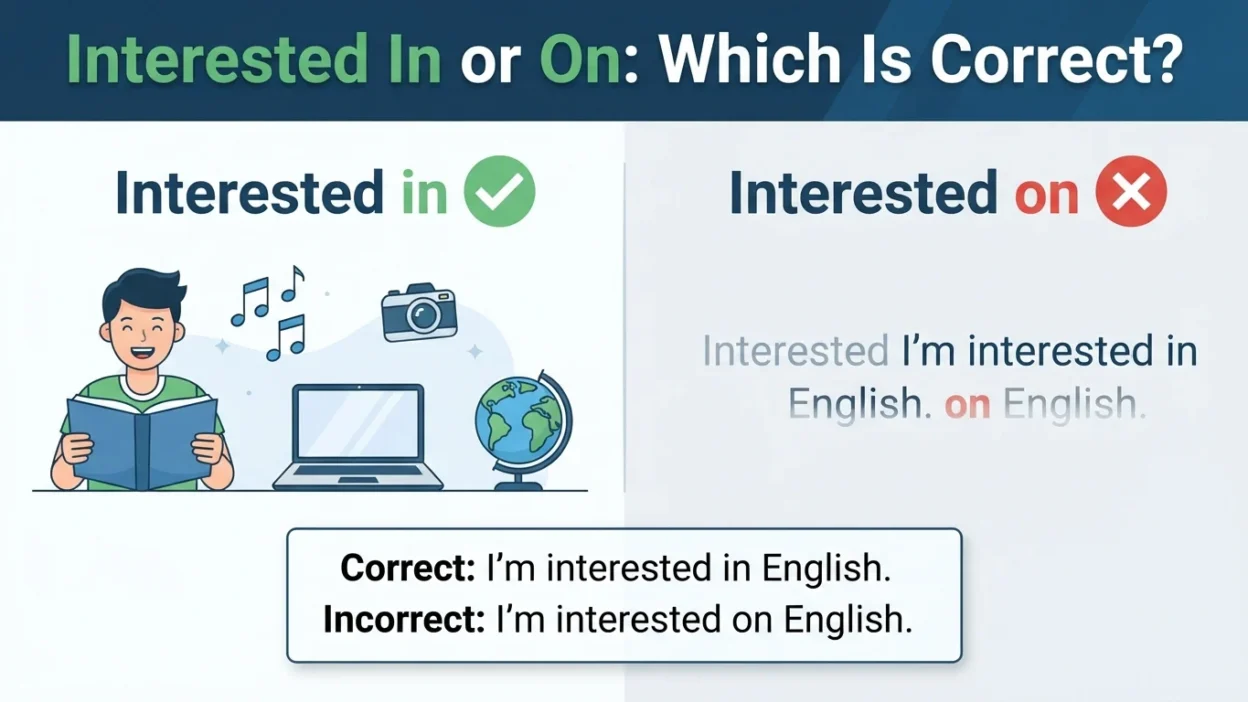
The correct phrase is interested in.
✅ Correct: I’m interested in photography.
❌ Incorrect: I’m interested on photography.
In modern English, interested in is the standard expression used to talk about curiosity, hobbies, subjects, people, or activities. The phrase interested on is generally considered grammatically incorrect except in a few uncommon contexts where “on” belongs to another part of the sentence rather than directly following interested.
Interested In or On: What’s the Difference?
The confusion between interested in or on comes from learning English prepositions. Since prepositions often change from one language to another, many learners accidentally choose the wrong one.
The adjective interested naturally pairs with the preposition in because it expresses curiosity, attraction, attention, or enthusiasm toward something.
For example:
- I’m interested in science.
- She’s interested in learning Spanish.
- They’re interested in joining the club.
Using interested on directly after interested sounds unnatural in standard English.
What Does “Interested In” Mean?
The phrase interested in means having curiosity, concern, enthusiasm, or a desire to know more about someone or something.
It can describe:
- Personal hobbies
- Academic subjects
- Careers
- Sports
- Business opportunities
- Relationships
- Books and movies
- New experiences
Examples
- I’m interested in history.
- She’s interested in photography.
- We’re interested in buying a new house.
- They’re interested in traveling abroad.
- He became interested in artificial intelligence.
In every example above, in correctly connects interested with the object.
Is “Interested On” Ever Correct?
Most of the time, no.
Native English speakers almost never say interested on.
However, you may occasionally see on later in a sentence where it belongs to another phrase.
Example:
- I’m interested in your opinion on climate change.
Notice that on does not follow interested. Instead, it modifies opinion.
Another example:
- She is interested in the discussion on education.
Again, on belongs with discussion, not interested.
Why Do People Make This Mistake?
Several reasons explain the confusion.
Different Native Languages
Many languages use different prepositions after words similar to interested, leading learners to translate directly.
Similar English Expressions
English contains expressions like:
- Focus on
- Depend on
- Work on
- Decide on
Because these use on, learners sometimes assume interested on follows the same rule.
Memorizing Vocabulary Without Context
Learning isolated words instead of complete phrases often causes mistakes.
It’s much easier to remember:
Interested in something
rather than memorizing only the word interested.
Comparison Table: Interested In vs Interested On
| Feature | Interested In | Interested On |
| Standard English | ✅ Yes | ❌ Usually No |
| Everyday conversation | ✅ Correct | ❌ Incorrect |
| Academic writing | ✅ Correct | ❌ Incorrect |
| Business English | ✅ Correct | ❌ Incorrect |
| Native speaker usage | Very common | Extremely rare |
| Grammar books | Recommended | Not recommended |
Examples of Correct Usage
Talking About Hobbies
- I’m interested in painting.
- She’s interested in gardening.
- They’re interested in cooking.
Talking About School
- He is interested in chemistry.
- My daughter is interested in mathematics.
- Students are interested in robotics.
Talking About Careers
- I’m interested in marketing.
- She’s interested in medicine.
- He’s interested in engineering.
Talking About People
- She became interested in her new colleague.
- They’re interested in meeting the author.
Common Mistakes to Avoid
Here are mistakes many learners make.
Incorrect
❌ I’m interested on music.
Correct
✅ I’m interested in music.
❌ She is interested on this project.
✅ She is interested in this project.
❌ We are interested on learning English.
✅ We are interested in learning English.
❌ He’s interested on football.
✅ He’s interested in football.
Whenever interested directly connects to a noun, pronoun, or gerund, always use in.
Easy Memory Trick
A simple trick is this:
Think of interest goes inside something.
You are in a subject.
You are in an activity.
You are in an idea.
That’s why English uses interested in.
You can also remember this common phrase:
Be interested in something.
You’ll hear it everywhere—from classrooms to business meetings.
American vs British English
There is no difference between American and British English regarding this expression.
Both varieties use:
- Interested in ✅
- Interested on ❌
Whether you’re writing in the United States, the United Kingdom, Canada, Australia, or New Zealand, the grammar rule remains exactly the same.
Similar Grammar Patterns
Many English adjectives naturally pair with certain prepositions.
Examples include:
- Good at
- Afraid of
- Proud of
- Responsible for
- Excited about
- Curious about
- Interested in
Learning these adjective-preposition combinations together helps improve fluency and accuracy.
Tips to Remember the Correct Usage
Follow these simple tips:
- Always say interested in.
- Read complete English sentences regularly.
- Listen to native speakers.
- Learn adjective-preposition combinations as phrases.
- Practice writing short sentences every day.
- Use grammar tools to check your writing.
- Notice how books and newspapers use the expression.
Related Words
Using related terms helps reinforce your understanding.
Some useful related phrases include:
- English grammar
- grammar rules
- adjective and preposition
- correct preposition
- English usage
- common grammar mistakes
- writing tips
- language learning
- fluent English
- prepositional phrases
- grammar guide
- English vocabulary
- speaking English
- professional writing
- academic English
- grammar checker
- sentence examples
- natural English
- improve writing
- English learners
FAQs
Is interested in or on correct?
Interested in is correct. Interested on is generally incorrect in standard English.
Why do people say interested on?
Usually because of translation from another language or confusion with other English expressions like focus on or work on.
Can interested on ever be correct?
Only when on belongs to another noun or phrase, such as:
I’m interested in your opinion on politics.
Is interested in formal English?
Yes. It is correct in formal, informal, academic, and professional writing.
Do native English speakers use interested on?
Almost never. Native speakers consistently use interested in.
Does British English use interested on?
No. Both British and American English prefer interested in.
What preposition follows interested?
The standard preposition is in.
How can I remember the rule?
Remember the phrase as a complete expression:
Interested in something?
Learning it this way makes mistakes much less likely.
Summary
The choice between interested in or on is actually quite simple once you understand the rule. In standard English, interested in is the correct expression whenever you’re talking about curiosity, hobbies, people, careers, studies, or activities. It is accepted in everyday conversations, business communication, academic writing, and professional documents across all major English-speaking countries.
Although you may occasionally see the word on later in a sentence, it does not replace the preposition after interested. By practicing complete adjective-preposition combinations instead of individual words, you’ll develop more natural English and avoid one of the most common grammar mistakes made by learners.