Choosing between anyone else, someone else, and everyone else can be confusing because all three expressions refer to people other than a particular person or group. However, they do not mean exactly the same thing. Each phrase has a different purpose, especially when you are asking questions, talking about an additional person, or referring to an entire group.
Understanding the difference will help you communicate more clearly in everyday conversations, emails, professional writing, and academic English. Although these expressions may look similar, using the wrong one can change the meaning of your sentence. Let’s explore their meanings, grammatical uses, and practical examples so you can choose the correct expression confidently.
Quick Answer: Anyone Else vs Someone Else vs Everyone Else
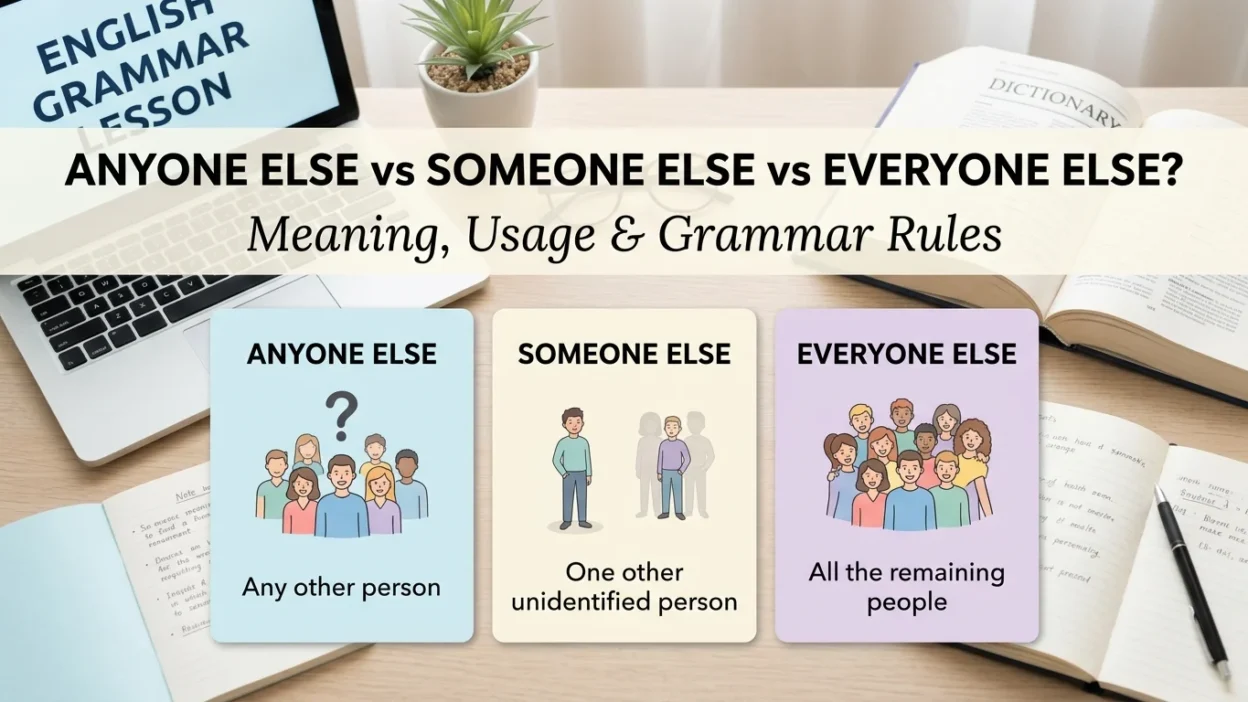
The main difference is how each expression refers to people:
- Anyone else means any other person. It is commonly used in questions and negative sentences.
- Someone else means another person, but that person’s identity is unknown or unspecified.
- Everyone else means all the other people in a particular group, except the person or people already mentioned.
Examples:
- Does anyone else want to join us?
- I think someone else took my notebook.
- Everyone else has already finished the assignment.
In simple terms, use anyone else for any possible person, someone else for an additional or unidentified person, and everyone else for all remaining people.
What Does Anyone Else Mean?
Anyone else refers to any other person besides the person or people already mentioned. It is often used when asking whether another person is available, interested, willing, or involved.
The word anyone is an indefinite pronoun. It does not identify a particular individual. Instead, it leaves the possibility open to any person.
This expression is especially common in questions and negative statements.
Examples of Anyone Else in Sentences
- Does anyone else know the answer to this question?
- Is anyone else coming to the birthday party?
- I don’t think anyone else can solve this problem.
- Would anyone else like a cup of coffee?
- Has anyone else noticed the change in his behavior?
- Did anyone else receive the invitation?
- I haven’t spoken to anyone else about this issue.
In each example, the speaker is referring to any person other than someone already known or mentioned.
When Should You Use Anyone Else?
Use anyone else when:
- Asking whether another person is interested or available.
- Checking if another person has experienced something.
- Asking whether any additional person knows or understands something.
- Making negative statements about other possible people.
For example, if you are organizing a meeting and want to know whether another person plans to attend, you can ask, “Is anyone else joining us?”
What Does Someone Else Mean?
Someone else means another person whose identity is unknown, unspecified, or not important to the conversation.
It refers to one additional person rather than every possible person. You use it when you know or believe that another individual is involved but do not identify that person.
For example, if you cannot find your phone, you might say, “Someone else must have taken it.” You are suggesting that another person took the phone, but you are not saying who.
Examples of Someone Else in Sentences
- Someone else left their umbrella in the office.
- I need someone else to help me with this project.
- Could you ask someone else to complete the task?
- She wants someone else to handle the presentation.
- Someone else has already booked this room.
- I thought you were talking to someone else.
- If you cannot attend, we can invite someone else.
These examples show that someone else identifies an additional person without revealing their name or identity.
When Should You Use Someone Else?
Use someone else when:
- Referring to another unidentified person.
- Asking for help from an additional individual.
- Suggesting that a different person should do something.
- Explaining that an unknown person is responsible for an action.
For example, if your colleague is unavailable to review a document, you might say, “I’ll ask someone else to check it.”
What Does Everyone Else Mean?
Everyone else refers to all the other people in a particular group, excluding the person or people already mentioned.
The word everyone includes every person within the relevant group. Adding else changes the reference to all remaining people.
For example, if a teacher says, “Everyone else has submitted the assignment,” the sentence means that all students except the person or people being discussed have submitted their work.
Examples of Everyone Else in Sentences
- Everyone else has already arrived at the office.
- I finished my work before everyone else.
- Everyone else agreed with the manager’s decision.
- She was working while everyone else was relaxing.
- Everyone else in the class understood the lesson.
- He stayed behind while everyone else went home.
- Everyone else received their certificates yesterday.
In these sentences, the speaker is referring to the entire remaining group, not just one additional person.
When Should You Use Everyone Else?
Use everyone else when:
- Referring to all remaining members of a group.
- Comparing one person with the rest of a group.
- Describing what the majority or entire remaining group is doing.
- Explaining that all other people have completed an action.
For example, “Everyone else is ready for the trip” means that all the other people are ready.
Anyone Else vs Someone Else vs Everyone Else: Key Differences
Although these expressions contain the word else, their meanings and uses are different. The following table makes the distinction easier to understand.
| Expression | Meaning | Common use | Example |
| Anyone else | Any other person | Questions and negative statements | Does anyone else agree? |
| Someone else | Another unspecified person | Referring to an additional individual | Someone else called you. |
| Everyone else | All other people | Referring to the remaining group | Everyone else is waiting. |
Easy Way to Remember the Difference
Think about the first word in each expression:
- Anyone = any person, without choosing a particular individual.
- Someone = one unspecified person.
- Everyone = all people in a particular group.
The word else simply adds the meaning of “other” or “additional.”
Common Grammar Mistakes to Avoid
Even fluent English speakers sometimes confuse these expressions, especially when speaking quickly. Here are some common mistakes and their corrections.
1. Using Someone Else When Asking About Any Possible Person
Incorrect: Someone else wants to ask a question?
Correct: Does anyone else want to ask a question?
Why? The question asks whether any additional person wants to participate. Therefore, anyone else is more natural.
2. Using Anyone Else When Referring to One Unidentified Person
Incorrect: Anyone else called you yesterday.
Correct: Someone else called you yesterday.
Why? The sentence describes an unidentified person who made a call. It does not ask whether any person called.
3. Confusing Everyone Else With Someone Else
Incorrect: Someone else in the team has completed the task. (when you mean the entire remaining team)
Correct: Everyone else in the team has completed the task.
Why? Someone else refers to one additional person, whereas everyone else refers to all the other team members.
4. Using the Wrong Verb Agreement
These expressions are grammatically singular and generally take singular verbs.
- Anyone else is welcome to join.
- Someone else has my book.
- Everyone else was ready.
Avoid using plural verbs simply because the expressions refer to people.
Incorrect: Everyone else are waiting.
Correct: Everyone else is waiting.
Do These Expressions Have Different Meanings in American and British English?
There is no major difference between American English and British English when it comes to the meanings or grammatical rules of anyone else, someone else, and everyone else.
All three expressions are standard in both varieties of English. Their meanings, spelling, and basic sentence structures remain the same.
For example:
- American English: Does anyone else want to come?
- British English: Does anyone else want to come?
Both are correct and natural.
The main differences you may notice are related to pronunciation, accent, and surrounding vocabulary rather than the expressions themselves. You can confidently use all three in American and British English, including formal writing, emails, and everyday conversations.
Anyone Else vs Someone Else vs Everyone Else in Everyday Conversations
Understanding grammar rules is helpful, but seeing how these expressions work in real-life situations makes them easier to remember.
Here are a few practical examples:
At work:
- Anyone else have an update for the meeting?
- Someone else needs to review this report.
- Everyone else has completed the training.
At school:
- Does anyone else understand this chapter?
- Someone else borrowed my calculator.
- Everyone else passed the examination.
Among friends:
- Is anyone else coming to dinner?
- I want someone else to choose the movie.
- Everyone else is already at the restaurant.
In everyday situations:
- Does anyone else feel tired today?
- Someone else is standing at the door.
- Everyone else has gone home.
These examples demonstrate how the three expressions fit naturally into different conversations.
FAQs
1. What is the difference between anyone else and someone else?
Anyone else means any other person and is commonly used in questions or negative statements. Someone else means another unspecified person. For example, “Does anyone else agree?” asks about any additional person, while “Someone else agrees” refers to an unidentified individual.
2. Is everyone else grammatically correct?
Yes, everyone else is grammatically correct. It refers to all other people in a particular group, excluding the person or people already mentioned. For example, “Everyone else has left the building.”
3. Can I use anyone else in a positive sentence?
Yes. Anyone else can appear in positive sentences, although it is especially common in questions and negative statements. For example, “Anyone else interested in joining can contact me.”
4. Is someone else singular or plural?
Someone else is grammatically singular because it refers to one unspecified person. Therefore, it normally takes a singular verb, as in “Someone else is responsible for this decision.”
5. Does everyone else take a singular or plural verb?
Everyone else takes a singular verb in standard English grammar. For example, “Everyone else is ready” is correct, while “Everyone else are ready” is generally incorrect.
6. Can anyone else, someone else, and everyone else be used interchangeably?
No. These expressions have different meanings and cannot always replace one another. Anyone else refers to any additional person, someone else refers to one unspecified person, and everyone else refers to all remaining people in a group.
7. Which expression is best for formal writing?
All three expressions are acceptable in formal and informal writing. Your choice should depend on the intended meaning rather than the level of formality. Use the expression that accurately describes the person or group you are discussing.
Summary: Which Expression Should You Choose?
The difference between anyone else vs someone else vs everyone else becomes simple once you understand what each expression communicates. Anyone else refers to any other person, someone else identifies one additional but unspecified person, and everyone else includes all the remaining people in a group. Although they share the word else, they serve different purposes in English sentences.
To use them correctly, consider whether you are asking about any possible person, referring to one unidentified individual, or talking about an entire remaining group. Remember these three simple meanings, and you will find it much easier to choose the right phrase in conversations, emails, school assignments, and professional writing.
Actionable takeaway: Before using one of these expressions, ask yourself: Am I referring to any person, one other person, or all other people? Your answer will help you select the correct expression.