Have you ever wondered whether to write “eventhough” or “even though”? These expressions look almost identical, which is why many English learners get confused about their correct spelling. Although they may sound like one word when spoken, only one form is accepted in standard English.
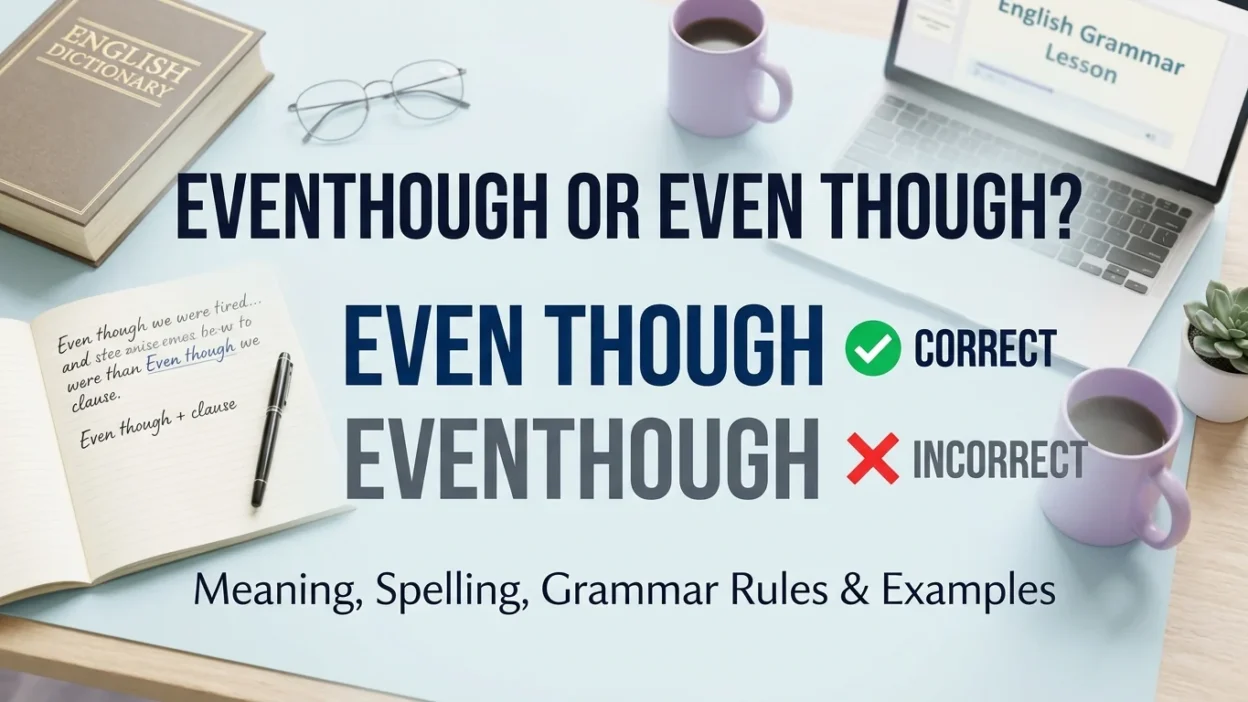
The correct spelling is “even though,” written as two separate words. “Eventhough” is a common spelling mistake and should be avoided in formal and informal writing. Understanding this simple spelling rule will help you write more confidently, improve your grammar, and communicate naturally in emails, essays, and everyday conversations.
Quick Answer: Eventhough or Even Though?
Even though is the correct spelling. It is a subordinating conjunction used to express contrast or an unexpected situation. It means “despite the fact that” or “although.”
“Eventhough” is incorrect because these two words should never be combined into one when expressing this meaning.
Examples:
- Correct: Even though it was raining, we went outside.
- Incorrect: Eventhough it was raining, we went outside.
- Correct: She completed her assignment even though she was tired.
Easy way to remember: Always write “even though” as two separate words.
What Does Even Though Mean?
“Even though” is a subordinating conjunction that introduces a contrasting idea. It connects two related statements when the second situation is unexpected considering the first.
In simple English, you use “even though” when something happens despite a condition that might normally prevent it from happening.
For example:
“Even though she was tired, she continued working.”
This sentence means that she was tired, but she did not stop working. Her tiredness might make someone expect her to rest, yet she continued with her work.
You can use “even though” in everyday conversations, academic writing, professional emails, and storytelling.
Examples of Even Though in Sentences:
- Even though he was nervous, he delivered an excellent presentation.
- I went to work even though I was feeling unwell.
- Even though the exam was difficult, she passed it.
- They enjoyed the trip even though the weather was unpleasant.
- Even though I explained everything, he did not understand.
- She smiled even though she was disappointed.
- Even though the restaurant was crowded, we found a table.
In each example, “even though” connects two contrasting ideas and highlights an unexpected result.
Why Is Eventhough Incorrect?
“Eventhough” is incorrect because standard English does not combine “even” and “though” into one word when expressing contrast.
The confusion usually happens because people pronounce the expression smoothly, making it sound like a single word. However, pronunciation does not change its correct written form.
Consider these examples:
- Incorrect: Eventhough I was busy, I helped him.
- Correct: Even though I was busy, I helped him.
- Incorrect: She attended the meeting eventhough she was sick.
- Correct: She attended the meeting even though she was sick.
Remember that “even” and “though” are separate words. Whenever you use this expression, keep the correct two-word spelling.
How to Use Even Though in a Sentence
You can use “even though” in different positions within a sentence. Its placement depends on how you want to organize your ideas.
Even Though at the Beginning of a Sentence
This is a common sentence structure. Place “even though” before the contrasting situation, followed by a comma and the main clause.
Examples:
- Even though it was late, we continued our discussion.
- Even though she had little experience, she got the job.
- Even though he apologized, I was still upset.
- Even though the task was challenging, everyone completed it.
Even Though in the Middle of a Sentence
You can also place “even though” after the main clause. When the clauses are closely connected, a comma is generally unnecessary.
Examples:
- We continued our journey even though it was raining.
- She completed the assignment even though she was exhausted.
- I enjoyed the movie even though its ending was predictable.
- He remained calm even though everyone else was worried.
Even Though in Everyday Conversations
“Even though” is equally natural in informal communication. You do not need complicated sentence structures to use it correctly.
Examples:
- I like this phone even though it is expensive.
- Even though I’m tired, I want to go out.
- She came to see me even though she was busy.
- He helped me even though we had an argument.
The key is to use this expression whenever you want to show a contrast between two related ideas.
Even Though vs Although vs Though: What Is the Difference?
“Even though,” “although,” and “though” have similar meanings because they all introduce contrasting ideas. However, they differ slightly in emphasis, tone, and sentence structure.
| Expression | Meaning | Example |
| Even though | Despite the fact that; stronger contrast | Even though it was cold, we went swimming. |
| Although | Despite the fact that; neutral contrast | Although it was cold, we went swimming. |
| Though | Although; often conversational | Though it was cold, we went swimming. |
Even Though
“Even though” generally emphasizes a stronger or more surprising contrast between two situations.
Example: Even though he had no experience, he performed exceptionally well.
Although
“Although” introduces a contrasting idea in a neutral way. It is common in both formal and informal writing.
Example: Although she was tired, she finished her assignment.
Though
“Though” has almost the same meaning as “although.” It is often used in everyday conversations and can also appear at the end of a sentence.
Example: The movie was interesting. It was a little long, though.
All three expressions are correct, but “even though” is the appropriate choice when you want to emphasize an unexpected result.
Even Though vs Even If: Are They the Same?
No. Although these expressions look similar, they communicate different ideas.
Even though refers to an actual or accepted situation. It introduces a contrast based on something that is true or presented as true.
Example: Even though it was raining, we went for a walk.
This means it really was raining, but you still went outside.
Even if introduces a possible or hypothetical situation. It describes something that may or may not happen.
Example: Even if it rains, we will go for a walk.
This means rain is a possibility, but your decision will remain the same.
| Even Though | Even If |
| Refers to an actual or accepted situation | Refers to a possible situation |
| Expresses contrast | Expresses a condition |
| Even though I was tired, I worked. | Even if I get tired, I will continue working. |
This distinction is particularly useful in professional writing and everyday English because it helps you communicate whether something is real or hypothetical.
Common Mistakes When Using Even Though
Understanding the correct spelling is important, but there are a few other mistakes worth avoiding.
Writing Eventhough as One Word
Incorrect: Eventhough she was busy, she helped me.
Correct: Even though she was busy, she helped me.
Explanation: Always separate “even” and “though.” The combined spelling is not standard English.
Confusing Even Though With Even If
Incorrect: Even though I win the lottery, I will continue working. (If winning is only a possibility.)
Correct: Even if I win the lottery, I will continue working.
Explanation: Use “even if” for hypothetical situations and “even though” for actual or accepted situations.
Using Although and But Together
Incorrect: Although he was tired, but he continued working.
Correct: Although he was tired, he continued working.
Also correct: He was tired, but he continued working.
Explanation: In this sentence structure, “although” and “but” should not be used together to introduce the same contrast.
Forgetting the Comma
Incorrect: Even though it was raining we went outside.
Correct: Even though it was raining, we went outside.
Explanation: When a sentence begins with an introductory clause containing “even though,” place a comma before the main clause.
However, when the expression appears in the middle of a sentence, a comma is generally unnecessary.
American English vs British English: Is There Any Difference?
There is no spelling difference between American English and British English when using “even though.”
Both varieties use the same two-word expression, and its meaning and grammatical function remain unchanged.
Examples in American English:
- Even though it was cold, we went outside.
- I enjoyed the event even though it was crowded.
Examples in British English:
- Even though it was cold, we went outside.
- I enjoyed the event even though it was crowded.
You can confidently use “even though” in American, British, Canadian, and Australian English.
Writing tip: Do not change the spelling to “eventhough” when switching between English varieties. It remains two separate words everywhere.
FAQs
Is eventhough one word or two words?
The correct form is “even though,” written as two separate words. “Eventhough” is a spelling mistake and is not accepted in standard English.
Is even though grammatically correct?
Yes. “Even though” is a grammatically correct subordinating conjunction used to introduce a contrasting idea or unexpected situation.
Example: Even though he was tired, he finished his work.
Can I use even though at the beginning of a sentence?
Yes. You can begin a sentence with “even though.” When the introductory dependent clause comes first, use a comma before the main clause.
Example: Even though it was expensive, I purchased the laptop.
What is another word for even though?
Some common alternatives include:
- Although
- Though
- Despite the fact that
- While
- Whereas (in suitable contrasting contexts)
The best alternative depends on the sentence and the intended meaning.
What is the difference between even though and although?
Both expressions introduce contrast. However, “even though” generally emphasizes a stronger or more surprising contrast, while “although” is more neutral.
Example:
- Even though she was sick, she attended the meeting.
- Although she was sick, she attended the meeting.
Is even though formal or informal?
“Even though” is appropriate in both formal and informal English. You can use it in academic essays, business emails, professional reports, and casual conversations.
Is even though the same in American and British English?
Yes. Both American and British English use “even though” with the same spelling, meaning, and grammatical rules.
Can even though be used in the middle of a sentence?
Yes. It can appear in the middle or at the beginning of a sentence.
Example: I continued studying even though I was exhausted.
In this structure, a comma is generally not required before the expression.
Summary: Eventhough or Even Though?
The correct spelling is “even though,” not “eventhough.” Always write these words separately when expressing contrast or an unexpected situation. The phrase means “despite the fact that” and is commonly used in everyday conversations, professional emails, academic writing, and other forms of communication.
Although “even though,” “although,” and “though” have similar meanings, they can differ in emphasis and sentence structure. Remember that “even though” emphasizes a contrast, while “even if” introduces a hypothetical possibility. Learning these small differences will help you avoid spelling and grammar mistakes and make your English writing more natural.
Actionable takeaway: Whenever you need to express that something happened despite an unexpected situation, use “even though” as two separate words. Never write “eventhough” in standard English.