Have you ever wondered whether something should be described as invaluable or valuable? Although these two words look similar and both express the importance or worth of something, they have slightly different meanings. Understanding the difference can help you communicate more accurately, especially in professional writing, academic discussions, and everyday conversations.
The confusion often comes from the prefix in-, which usually makes a word negative. However, invaluable does not mean worthless or lacking value. In fact, it means extremely valuable or so important that its worth cannot easily be measured. On the other hand, valuable describes something that has considerable financial, practical, or personal worth. Let’s explore their meanings, differences, and correct usage with simple explanations and examples.
Quick Answer: Invaluable vs Valuable
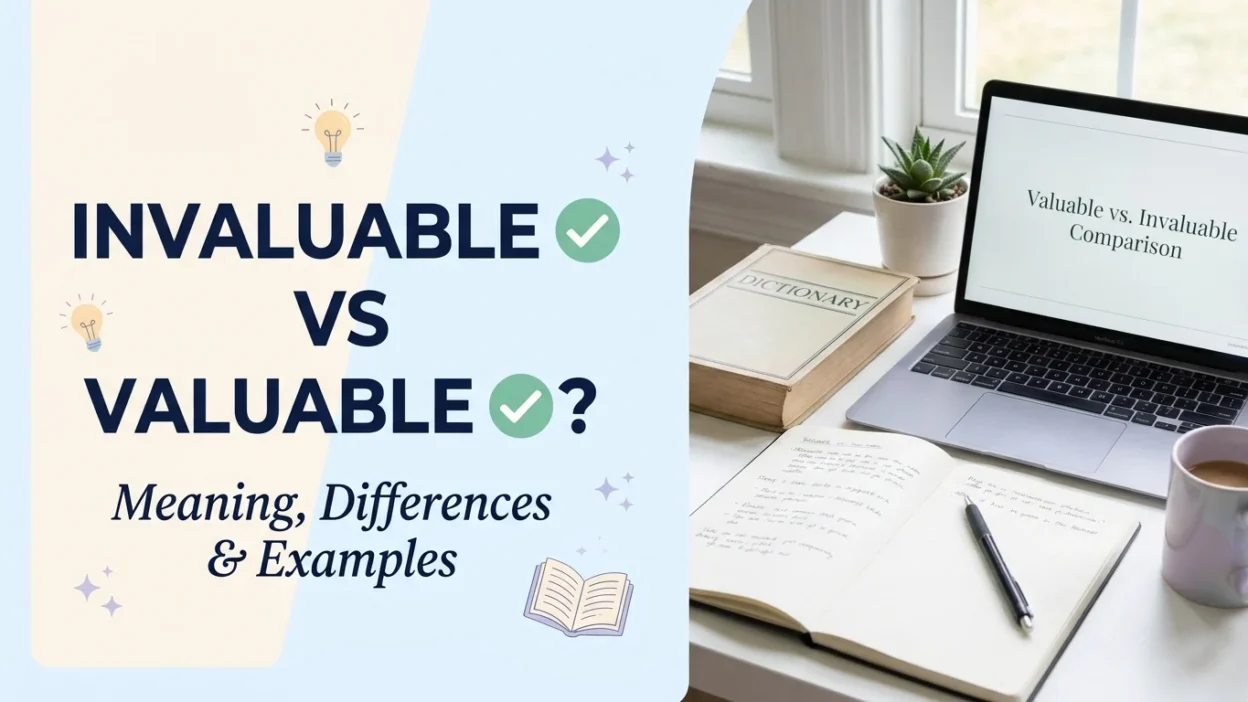
Valuable means something is worth a lot, either financially, practically, or emotionally. Invaluable means something is extremely useful, important, or precious, often to the point that its value is difficult or impossible to measure.
- Valuable: Something has considerable worth or importance.
- Invaluable: Something is exceptionally important, useful, or indispensable.
Examples:
- Her antique necklace is valuable because it is worth thousands of dollars.
- Her grandmother’s advice was invaluable during a difficult time.
Easy way to remember: Valuable means worth a lot, while invaluable means worth more than you can easily measure.
What Does Valuable Mean?
The word valuable is an adjective that describes something having significant financial, practical, emotional, or personal worth. It can refer to physical objects, knowledge, advice, experiences, relationships, or opportunities.
Something valuable does not necessarily have to be expensive. For example, a piece of advice from an experienced teacher can be valuable because it helps you make better decisions.
In everyday English, valuable is commonly used when discussing money, possessions, useful information, and meaningful experiences.
Examples of Valuable in Sentences
- This painting is extremely valuable because it was created by a famous artist.
- She shared some valuable information about improving our writing skills.
- Time is one of the most valuable resources we have.
- His experience in digital marketing makes him a valuable employee.
- The company received valuable feedback from its customers.
- My grandfather gave me a valuable collection of historical books.
- Learning a second language can be a valuable skill in today’s job market.
In each example, valuable describes something that has considerable worth, usefulness, or importance.
What Does Invaluable Mean?
Invaluable is an adjective that means extremely valuable, exceptionally useful, or so important that its worth cannot easily be calculated.
It describes something that provides tremendous help, support, knowledge, or emotional significance. Unlike valuable, which can suggest measurable worth, invaluable often emphasizes extraordinary importance.
For example, a mentor’s guidance may be invaluable because it helps someone overcome challenges and achieve professional success.
One important detail to remember is that invaluable is not the opposite of valuable. Despite beginning with the prefix in-, it has a positive meaning.
Examples of Invaluable in Sentences
- Her experience was invaluable in helping us complete the project successfully.
- My parents’ support has been invaluable throughout my career.
- The research provided invaluable information about climate change.
- His advice proved invaluable when I started my own business.
- The teacher’s guidance was invaluable to struggling students.
- This historical document is an invaluable resource for researchers.
- Their assistance was invaluable during the emergency.
In these examples, invaluable emphasizes exceptional usefulness, importance, or significance.
Invaluable vs Valuable: Key Differences
Although both words describe something important or worthwhile, they are not always interchangeable. The main difference is the degree and nature of the value being expressed.
| Feature | Valuable | Invaluable |
| Meaning | Having considerable worth | Extremely valuable or indispensable |
| Importance | Significant | Exceptional or extraordinary |
| Financial value | Can be measurable | Often difficult to measure |
| Emotional value | Yes | Yes, especially profound significance |
| Practical usefulness | Useful or beneficial | Exceptionally useful |
| Common usage | Money, objects, skills, information | Advice, support, experience, knowledge |
| Overall sense | Worth a lot | Beyond ordinary measurement |
Compare these examples:
- Her feedback was valuable to the team.
- Her feedback was invaluable to the team.
The first sentence suggests that her feedback was useful and important. The second emphasizes that her feedback was exceptionally important and perhaps essential to the team’s success.
Both sentences are grammatically correct, but the second communicates a stronger sense of importance.
When Should You Use Valuable?
Use valuable when you want to describe something that has considerable worth, usefulness, or importance without necessarily suggesting that it is irreplaceable.
Here are some common situations where valuable is the better choice.
1. When Discussing Financial Worth
Use valuable when referring to expensive objects, investments, property, jewelry, or collectibles.
Examples:
- The museum contains several valuable paintings.
- She inherited a valuable diamond ring.
- Gold remains a valuable investment for many people.
2. When Describing Useful Information
Valuable is appropriate when information helps someone understand a subject or make better decisions.
Examples:
- The article contains valuable tips for improving productivity.
- We received valuable information from the customer survey.
3. When Talking About Professional Skills
Use valuable when describing someone’s abilities, experience, or contribution to an organization.
Examples:
- Communication is a valuable skill in the workplace.
- She is a valuable member of our marketing team.
When Should You Use Invaluable?
Use invaluable when you want to emphasize that something is exceptionally important, helpful, or difficult to replace.
It is particularly effective when describing meaningful experiences, guidance, emotional support, and specialized knowledge.
1. When Describing Exceptional Help
Examples:
- Your assistance was invaluable during the preparation of the event.
- Her contribution was invaluable to the success of the organization.
2. When Talking About Advice and Guidance
Examples:
- My father’s advice has been invaluable throughout my life.
- The consultant provided invaluable guidance during the business transition.
3. When Describing Experience and Knowledge
Examples:
- Years of practical experience can be invaluable in solving complex problems.
- The scientist’s research provided invaluable insights into the disease.
4. When Expressing Emotional Importance
Examples:
- My family’s encouragement has been invaluable to me.
- The memories of our childhood are invaluable.
Common Mistakes When Using Invaluable and Valuable
Even fluent English speakers sometimes confuse these words because of their similar appearance. Understanding the following mistakes can help you avoid awkward or incorrect sentences.
Mistake 1: Thinking Invaluable Means Worthless
Incorrect understanding: Invaluable means something has no value.
Correct understanding: Invaluable means extremely valuable or beyond ordinary measurement.
Example:
- Correct: Her support was invaluable during my recovery.
- Incorrect interpretation: Her support was worthless.
Remember that invaluable has a positive meaning.
Mistake 2: Assuming Both Words Have Exactly the Same Meaning
Although the words are related, invaluable expresses a stronger degree of importance.
Compare:
- The training was valuable for my career.
- The training was invaluable for my career.
The second sentence suggests that the training was exceptionally beneficial.
Mistake 3: Using Invaluable Only for Expensive Objects
Invaluable is not limited to expensive possessions. It is frequently used for nonfinancial things.
Examples:
- Her friendship is invaluable.
- His professional experience is invaluable.
- Their advice was invaluable.
Mistake 4: Adding Unnecessary Intensifiers
Because invaluable already communicates an exceptionally high level of worth, expressions such as very invaluable can sound awkward or redundant.
Better alternatives include:
- Truly invaluable
- Absolutely invaluable
- Exceptionally valuable
- Extremely valuable
For example:
- Awkward: Her advice was very invaluable.
- Better: Her advice was invaluable.
- Also correct: Her advice was extremely valuable.
Valuable vs Invaluable: Synonyms and Related Words
Knowing synonyms can help you express different levels of importance and usefulness without repeating the same adjectives.
| Word | Meaning | Example |
| Precious | Extremely important or cherished | Her friendship is precious. |
| Worthwhile | Worth the time or effort | The experience was worthwhile. |
| Beneficial | Producing a positive result | Exercise is beneficial for health. |
| Useful | Helping someone achieve something | This guide contains useful information. |
| Priceless | So valuable that its worth cannot be measured | The photograph is priceless to me. |
| Indispensable | Absolutely necessary | She is an indispensable team member. |
| Significant | Important or meaningful | His contribution was significant. |
| Essential | Extremely necessary | Communication is essential for teamwork. |
A helpful distinction: Priceless and invaluable are often similar, but priceless can emphasize emotional or monetary worth, while invaluable frequently emphasizes exceptional usefulness and importance.
American English vs British English: Is There Any Difference?
There is no significant difference between American English and British English when it comes to the meanings or spellings of valuable and invaluable.
Both varieties use these words in the same way.
| Usage | American English | British English |
| Valuable | Valuable | Valuable |
| Invaluable | Invaluable | Invaluable |
| Meaning | Considerable worth | Considerable worth |
| Meaning of invaluable | Extremely important or useful | Extremely important or useful |
Examples in both varieties:
- Your feedback is valuable to our organization.
- Your experience has been invaluable to our team.
Both expressions are grammatically correct in the United States and the United Kingdom.
Therefore, you do not need to change either word when writing for an American or British audience.
FAQs
1. Is invaluable better than valuable?
Neither word is inherently better. Valuable describes something that has considerable worth, while invaluable emphasizes exceptional importance or usefulness. Choose the word that best communicates your intended meaning.
2. Does invaluable mean more valuable?
Yes, in many contexts. Invaluable generally expresses a greater degree of importance or usefulness than valuable. However, it often suggests immeasurable worth rather than simply a higher financial price.
3. Is invaluable a positive or negative word?
Invaluable is a positive word. It means extremely valuable, exceptionally useful, or indispensable. The prefix in- does not make its meaning negative in this particular word.
4. Can I use invaluable for a person?
Yes. You can describe someone as invaluable when they provide exceptional support, knowledge, or contributions.
Example: She has been an invaluable member of our organization.
5. What is the opposite of invaluable?
There is no single perfect opposite in every context. Words such as useless, insignificant, unimportant, and dispensable can express contrasting meanings, depending on the sentence.
6. Is priceless the same as invaluable?
They are similar but not identical. Priceless generally means that something is so precious that its worth cannot be measured, while invaluable often describes something exceptionally useful or important.
Example:
- This family photograph is priceless to me.
- Her professional advice was invaluable.
7. Can valuable and invaluable be used in the same sentence?
Yes. Both words can appear together when describing different levels or types of worth.
Example: The valuable equipment and invaluable expertise helped the team complete the project.
8. Is invaluable more formal than valuable?
Both words are appropriate in formal and informal English. However, invaluable is especially common in professional, academic, and business writing when emphasizing exceptional importance or usefulness.
Summary: Invaluable vs Valuable
Understanding the difference between invaluable and valuable makes your English more precise and expressive. Valuable describes something that has considerable financial, practical, or emotional worth. Invaluable, however, describes something exceptionally important, useful, or precious, often beyond the ability to measure its true worth. Both words have positive meanings, but invaluable generally communicates a stronger sense of significance.
The easiest way to remember the distinction is that valuable means worth a lot, while invaluable means so valuable that its worth is difficult to measure. Use valuable for expensive possessions, useful skills, and meaningful information. Choose invaluable when describing exceptional advice, irreplaceable support, professional experience, or something truly essential. When you understand this distinction, you can select the right word confidently in everyday conversations and professional writing.
Actionable takeaway: Before using either word, ask yourself whether you are describing something with considerable worth or something exceptionally important and difficult to replace. That simple question will help you choose correctly.