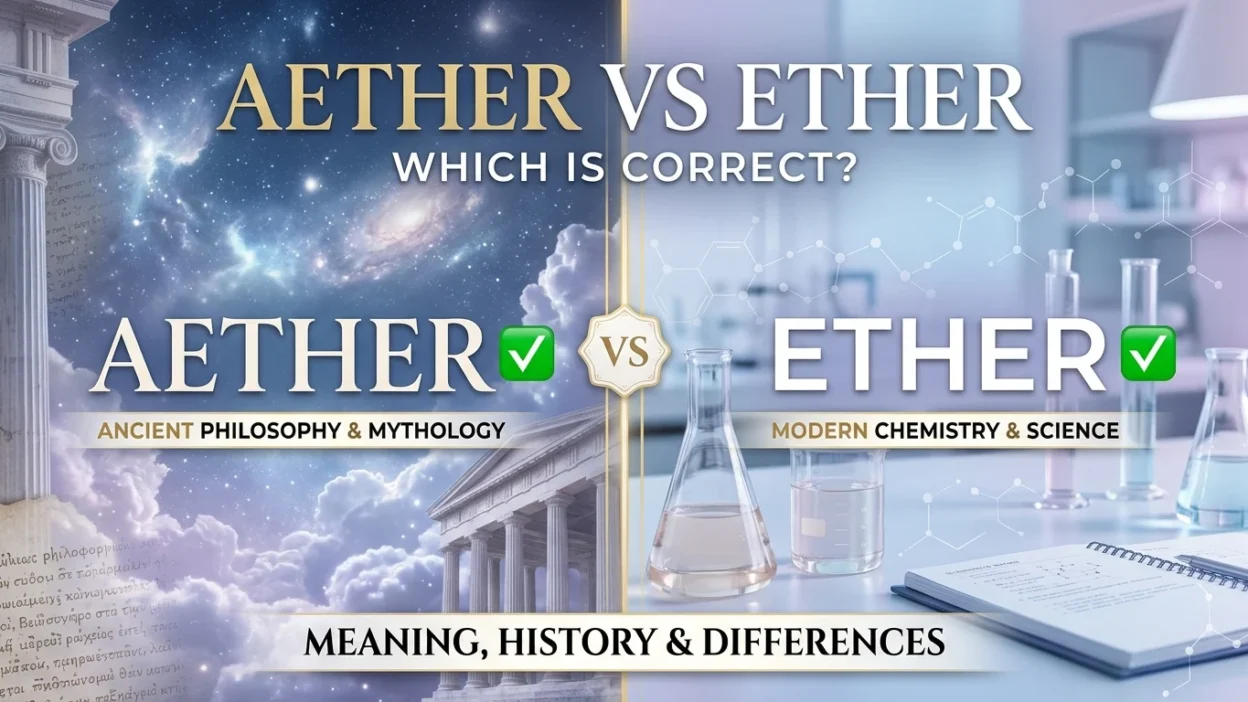
Have you ever wondered whether the correct spelling is aether or ether? Both words look similar, sound almost identical, and have interesting connections to science, philosophy, and ancient beliefs. However, their meanings and historical uses are not always the same. If you have encountered these terms in literature, chemistry, mythology, or scientific discussions, understanding their differences can help you use them correctly.
The confusion between aether and ether is understandable because both words have a shared linguistic history. While ether is the modern standard spelling used in chemistry and everyday English, aether is an older, classical spelling associated with ancient Greek philosophy, mythology, and historical scientific theories. Let’s explore their meanings, origins, examples, and differences so you can confidently choose the right word.
Quick Answer: Aether or Ether?
Ether is the modern and more widely accepted spelling. It commonly refers to a class of organic chemical compounds, a volatile substance, or a historical concept of an invisible medium.
Aether is an older or alternative spelling, traditionally associated with ancient Greek philosophy, mythology, and the historical idea of a fifth element or heavenly substance.
Here is the simplest distinction:
- Ether: The standard modern spelling, especially in chemistry.
- Aether: The classical spelling, often used in mythology, philosophy, fantasy, and historical discussions.
- Best choice for modern scientific writing: Ether.
- Best choice for classical or mythological contexts: Aether.
Example: Diethyl ether is a chemical compound, while aether in ancient Greek philosophy referred to the pure substance believed to fill the heavens.
Although the two spellings are closely related, the context determines which one is more appropriate.
What Does Aether Mean?
Aether is a noun derived from the ancient Greek word aithēr, which referred to the bright, pure upper air or the substance believed to exist in the heavens.
In ancient Greek philosophy, aether was sometimes described as the fifth element, alongside earth, water, air, and fire. Aristotle developed the concept of aether as a heavenly substance associated with celestial bodies.
Unlike ordinary air, which was believed to exist in the earthly atmosphere, aether was considered a pure and unchanging substance that filled the region beyond the terrestrial world.
The word also appears in mythology, literature, and fantasy writing, where it often represents a heavenly atmosphere, invisible energy, or mysterious cosmic substance.
Examples of Aether in Sentences:
- Ancient philosophers believed that aether filled the space beyond the earthly atmosphere.
- The poet described the stars as shining through the endless aether.
- In Greek mythology, aether was associated with the bright upper air of heaven.
- The fantasy novel describes aether as a mysterious source of magical energy.
- Ancient thinkers considered aether the fifth element of the universe.
- The spacecraft appeared to travel through the vast cosmic aether.
- The author used aether as a symbol of purity and celestial beauty.
In modern writing, aether is particularly useful when discussing ancient cosmology, classical mythology, historical philosophy, and fictional worlds.
What Does Ether Mean?
Ether is a noun with several meanings, depending on the subject and context. It is the standard modern spelling used in chemistry and scientific terminology.
In chemistry, an ether is a class of organic compounds containing an oxygen atom connected to two carbon-containing groups. These compounds have the general structure R–O–R′.
One familiar example is diethyl ether, a highly volatile and flammable chemical that was historically used as a general anaesthetic.
Ether also has a historical scientific meaning. Before modern physics established the nature of electromagnetic waves and light propagation, some scientists proposed the existence of a hypothetical substance called the luminiferous ether. They believed it provided a medium through which light waves could travel.
Although this scientific theory was eventually abandoned, the historical term remains important in discussions of physics.
Examples of Ether in Sentences:
- Diethyl ether is a highly volatile organic compound.
- The laboratory stored the ether in a properly sealed container.
- Scientists once believed that light traveled through a medium called ether.
- Ether compounds are important in organic chemistry.
- The historical theory of luminiferous ether influenced early scientific research.
- The chemist explained how an ether molecule contains an oxygen atom between two carbon groups.
- Ether was once widely used in medical anaesthesia.
As these examples demonstrate, ether is particularly relevant to chemistry, medicine, and the history of science.
Aether vs Ether: Key Differences
Although aether and ether share the same historical roots, their modern uses have developed in different directions. The most important distinction is that aether is commonly associated with classical ideas and mythology, whereas ether is the preferred spelling in modern scientific terminology.
Here is a side-by-side comparison:
| Feature | Aether | Ether |
| Meaning | Classical heavenly substance or upper air | Chemical compounds or historical scientific medium |
| Origin | Ancient Greek aithēr | Derived from the same Greek root |
| Part of speech | Noun | Noun |
| Common usage | Mythology, philosophy, literature | Chemistry, medicine, physics |
| Spelling | Classical or alternative | Modern standard |
| Scientific usage | Historical and theoretical contexts | Modern chemical terminology |
| Literary usage | Common in fantasy and classical writing | Less common for celestial imagery |
| Pronunciation | Usually EE-thər | Usually EE-thər |
The easiest way to remember the difference:
- Aether = Ancient philosophy, heavenly substance, and mythology.
- Ether = Chemistry, organic compounds, and historical physics.
However, these distinctions are not absolute. Aether and ether have sometimes been used interchangeably, particularly in older scientific and philosophical texts.
Aether vs Ether: Origins and History
The words aether and ether share a common origin in ancient Greek. The Greek term aithēr referred to the bright, pure air associated with the heavens.
Over time, the word entered Latin and eventually developed into different English spellings.
The History of Aether
In ancient Greek thought, aether represented a special substance associated with the celestial realm. It was considered different from the ordinary elements found on Earth.
Aristotle incorporated aether into his philosophical system as the fifth element, sometimes called quintessence. He believed that celestial bodies were composed of this substance and that it was naturally associated with eternal, circular motion.
The concept remained influential in medieval philosophy and early scientific thinking.
The History of Ether
Ether became the more common spelling in modern English, particularly in scientific terminology.
During the nineteenth century, scientists proposed the luminiferous ether as a hypothetical medium through which light waves traveled. This idea became an important part of historical physics.
However, experiments and developments in modern physics, particularly Einstein’s theory of special relativity, eliminated the need for the classical luminiferous ether as a medium for light propagation.
In chemistry, ether developed a separate and enduring meaning as the name for a family of organic compounds.
Are Aether and Ether Pronounced the Same?
Yes, aether and ether are generally pronounced the same way in modern English.
Both commonly have the pronunciation:
- Aether: /ˈiːθər/
- Ether: /ˈiːθər/
The first syllable sounds like “ee,” while the second syllable sounds like “ther.”
For example, both words rhyme with neither “weather” nor “feather” in their standard pronunciation, although accents can influence the final vowel sound.
The difference is primarily spelling and context rather than pronunciation.
Common Mistakes When Using Aether and Ether
Even experienced writers can confuse these words because they have similar spellings and overlapping historical meanings. Here are some common mistakes to avoid.
1. Assuming aether is always incorrect
Incorrect assumption: Aether is simply a misspelling of ether.
Correct understanding: Aether is a legitimate English spelling with historical, philosophical, mythological, and literary uses.
2. Using aether in modern chemical terminology
Less suitable: The laboratory used aether as a solvent.
Better: The laboratory used ether as a solvent.
When referring to chemical compounds, ether is the standard spelling.
3. Treating the ancient aether and luminiferous ether as exactly the same concept
Although both refer to hypothetical substances associated with the heavens or space, their historical meanings are not identical.
Ancient Greek aether was a philosophical and cosmological element, whereas luminiferous ether was a proposed physical medium for light waves.
4. Assuming ether always refers to a chemical
Ether can also refer to the historical hypothetical medium in physics. Therefore, the surrounding context matters.
5. Confusing spelling with pronunciation
Both words are generally pronounced alike. Hearing either pronunciation does not necessarily tell you which spelling the speaker intends.
Aether vs Ether in American and British English
Unlike many English spelling differences, the distinction between aether and ether is not primarily an American-versus-British issue.
Both American and British English generally use ether as the standard spelling in modern chemistry and scientific writing.
Similarly, aether is recognized in both varieties when discussing ancient philosophy, mythology, historical terminology, or literary subjects.
There is, however, a separate spelling difference worth knowing:
- American English: anesthesia
- British English: anaesthesia
The word ether itself does not normally change spelling between these varieties.
For example:
- American English: Ether was historically used as an anesthetic.
- British English: Ether was historically used as an anaesthetic.
Therefore, when writing for either audience, choose the spelling according to the intended meaning rather than the regional variety of English.
FAQs
1. Is aether or ether the correct spelling?
Both are correct English spellings, but they have different common applications. Ether is the standard modern spelling in chemistry, while aether is traditionally associated with ancient philosophy, mythology, and classical literature.
2. Is aether just an old spelling of ether?
Aether is an older classical spelling derived from ancient Greek. Although the two forms have overlapping historical meanings, aether is particularly associated with ancient cosmology and the heavenly substance described by Greek philosophers.
3. What is the difference between aether and ether in chemistry?
In modern chemistry, ether is the correct standard term for a class of organic compounds containing an oxygen atom bonded to two carbon-containing groups. Aether is not the standard spelling for this chemical classification.
4. Is aether the fifth element?
In Aristotelian philosophy, aether was considered the fifth element, also known as quintessence. It was believed to compose celestial bodies and exist beyond the earthly realm.
5. Is ether still used in modern science?
Yes. Ether remains an important chemical term. Various ether compounds are used in chemical research, industrial processes, and other applications. However, the historical luminiferous ether theory is no longer accepted as a necessary explanation for how light travels.
6. Do aether and ether sound the same?
Yes. Both words are generally pronounced /ˈiːθər/ in English. Their main differences involve spelling, historical background, and context.
7. Should I use aether or ether in fantasy writing?
Aether is often a better stylistic choice in fantasy writing when referring to magical energy, celestial forces, or mystical substances. However, ether can also work if that spelling suits the fictional world’s terminology.