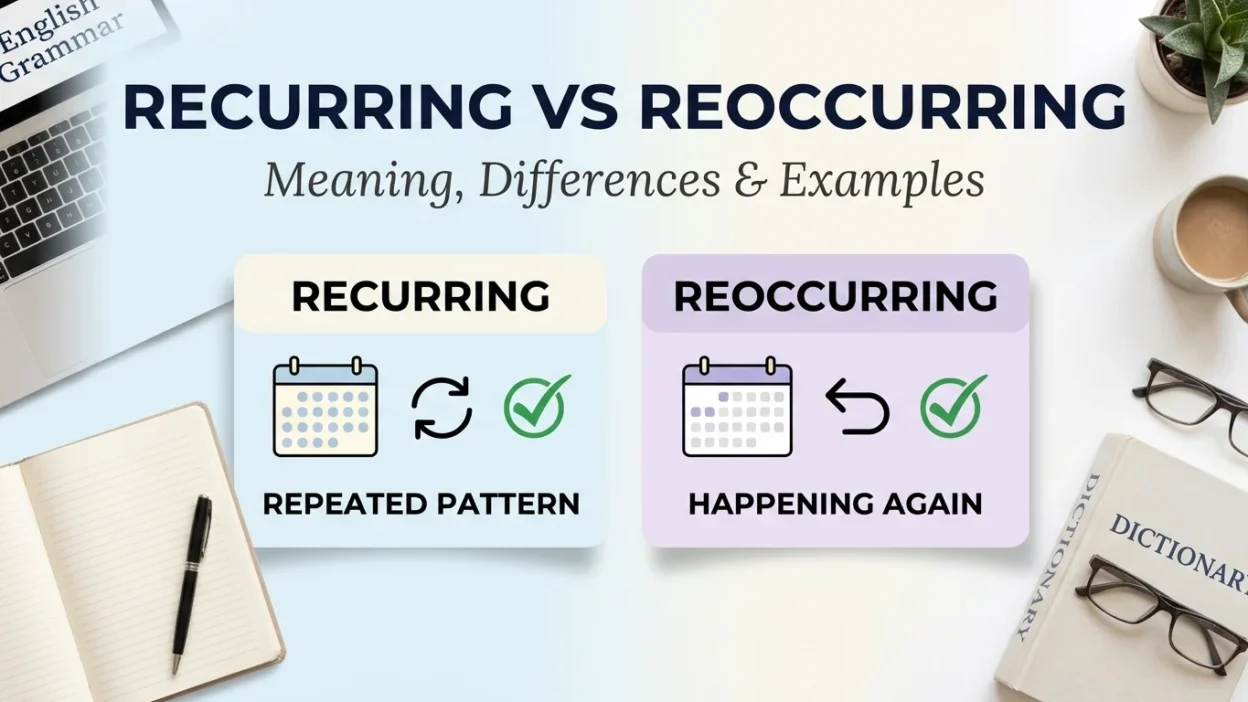
Have you ever wondered whether to use recurring or reoccurring when describing something that happens again and again? These two words look almost identical, and both are grammatically correct. However, they have slightly different meanings and are not always interchangeable. Choosing the right word can make your writing clearer, especially in professional emails, academic assignments, business documents, and everyday conversations.
The confusion usually comes from their shared connection to the word occur, which means to happen or take place. While both recurring and reoccurring describe events that happen again, recurring generally emphasizes a regular, repeated, or continuing pattern. Reoccurring simply emphasizes that something happens again, possibly after an interruption or without following a predictable schedule. Let’s explore their meanings, differences, examples, and common mistakes so you can use both words confidently.
Quick Answer: Recurring vs Reoccurring
Recurring and reoccurring are both correct English words, but they emphasize slightly different types of repetition.
- Recurring: Something that happens repeatedly, regularly, or according to an established pattern.
- Reoccurring: Something that happens again, particularly after it has happened before. It does not necessarily suggest a regular pattern.
Examples:
- I have a recurring meeting every Monday morning.
- The same technical problem keeps reoccurring.
Easy way to remember: Recurring often suggests a repeated pattern, while reoccurring simply means happening again.
In most situations, recurring is the more common and widely preferred choice, particularly when describing regular events, payments, appointments, or problems.
What Does Recurring Mean?
Recurring is an adjective and the present participle of the verb recur. It describes something that happens repeatedly, often at regular intervals or as part of an ongoing pattern.
A recurring event may happen daily, weekly, monthly, annually, or whenever certain conditions arise.
The word is commonly used in business, finance, healthcare, education, and everyday communication.
For example, a recurring payment is a payment that is automatically charged at regular intervals, such as every month. Similarly, a recurring problem is an issue that repeatedly returns.
Examples of Recurring in Sentences
- We have a recurring team meeting every Monday.
- She experiences recurring headaches during stressful periods.
- The company introduced a recurring monthly subscription.
- This recurring issue needs to be addressed immediately.
- He has a recurring appointment with his dentist.
- Recurring expenses can make it difficult to manage a monthly budget.
- The same theme is recurring throughout the novel.
- Our website receives recurring traffic from returning visitors.
In these examples, recurring emphasizes repetition, continuation, or a recognizable pattern.
Common Uses of Recurring
Here are some situations where recurring is particularly appropriate:
- Recurring payments: Payments made repeatedly, usually at scheduled intervals.
- Recurring expenses: Regular financial obligations, such as rent and subscriptions.
- Recurring meetings: Meetings that take place according to a fixed schedule.
- Recurring problems: Issues that repeatedly arise.
- Recurring dreams: Dreams that happen repeatedly.
- Recurring symptoms: Symptoms that return over time.
- Recurring themes: Ideas or subjects that appear repeatedly in a story or discussion.
What Does Reoccurring Mean?
Reoccurring is also an adjective and the present participle of a verb, reoccur. It means happening again or taking place another time.
Unlike recurring, reoccurring does not necessarily suggest a regular schedule, continuous pattern, or predictable frequency.
Something may happen once, disappear for a while, and then reoccur unexpectedly.
For example, if your computer crashes today and the same issue happens again three weeks later, you can describe it as a reoccurring problem.
The word emphasizes that an event has happened before and is happening again.
Examples of Reoccurring in Sentences
- The same error is reoccurring after every software update.
- A strange noise kept reoccurring throughout the night.
- The problem is reoccurring despite our efforts to fix it.
- We noticed a reoccurring issue during the inspection.
- The unexpected delays are reoccurring on several projects.
- His old memories were reoccurring whenever he visited his hometown.
- The system failure is reoccurring without any obvious explanation.
- Similar complaints have been reoccurring since the new policy was introduced.
These examples demonstrate how reoccurring describes something happening again, without necessarily indicating a fixed pattern.
Common Uses of Reoccurring
Reoccurring is often appropriate when describing:
- Reoccurring errors: Mistakes or technical problems that happen again.
- Reoccurring incidents: Events that take place more than once.
- Reoccurring symptoms: Symptoms that return after disappearing.
- Reoccurring delays: Unexpected interruptions that happen again.
- Reoccurring concerns: Issues that repeatedly attract attention.
- Reoccurring situations: Circumstances that arise again.
Although recurring can also be used in many of these situations, reoccurring can emphasize the return of a previously experienced event.
Recurring vs Reoccurring: Key Differences
The main difference between recurring and reoccurring is the emphasis each word places on repetition.
Recurring generally describes a repeated event or an ongoing pattern. Reoccurring emphasizes that something happens again, whether or not it follows a regular schedule.
Here is a comparison table to make the distinction easier.
| Feature | Recurring | Reoccurring |
| Meaning | Happening repeatedly | Happening again |
| Main emphasis | Repetition or pattern | Return of an event |
| Regular schedule | Often, but not always | Not necessarily |
| Frequency | Often repeated | May happen occasionally |
| Common usage | Payments, meetings, expenses | Errors, incidents, unexpected problems |
| Grammar | Correct | Correct |
| Popularity | More common | Less common |
Compare these examples:
- I have a recurring appointment every Friday.
- The same appointment issue keeps reoccurring.
In the first sentence, recurring describes an appointment that follows a regular schedule.
In the second, reoccurring emphasizes that an issue has happened before and is happening again.
However, remember that these distinctions are tendencies rather than strict grammatical rules. Both words can describe repeated problems, events, and experiences.
When Should You Use Recurring?
Use recurring when describing something that happens repeatedly or follows a recognizable pattern.
It is particularly useful in professional, financial, and everyday writing.
1. For Regular Payments and Expenses
Recurring is the standard choice when discussing scheduled financial transactions.
Examples:
- I canceled my recurring subscription.
- Rent is one of my largest recurring expenses.
- The customer agreed to a recurring monthly payment.
2. For Scheduled Events and Meetings
Use recurring when an activity happens at established intervals.
Examples:
- Our recurring meeting takes place every Tuesday.
- She has a recurring appointment with her supervisor.
- The company organizes recurring training sessions.
3. For Repeated Problems
Recurring is also appropriate for issues that keep appearing.
Examples:
- We need to identify the cause of this recurring problem.
- The recurring errors are affecting website performance.
- The team is working to eliminate recurring delays.
When Should You Use Reoccurring?
Use reoccurring when you want to emphasize that something has happened before and is happening again.
It is especially useful when the repetition is occasional, unexpected, or not tied to a regular schedule.
1. For Unexpected Problems
Examples:
- The same technical issue is reoccurring.
- We noticed a reoccurring problem after the latest update.
2. For Repeated Incidents
Examples:
- Similar incidents have been reoccurring in the neighborhood.
- The unusual behavior started reoccurring last week.
3. For Events That Return After an Interruption
Examples:
- The noise disappeared for several days before reoccurring.
- Her symptoms stopped temporarily but began reoccurring later.
The key is to emphasize the return of something that happened previously.
Common Mistakes When Using Recurring and Reoccurring
Even experienced English writers sometimes confuse these words. Here are a few mistakes worth avoiding.
Mistake 1: Thinking Reoccurring Is Incorrect
Incorrect assumption: Reoccurring is not a real English word.
Correct understanding: Reoccurring is a legitimate English word derived from the verb reoccur.
Example:
- Correct: The problem is reoccurring.
- Also correct: The problem is recurring.
Both sentences are grammatically acceptable.
Mistake 2: Using Reoccurring for Every Regular Event
Although reoccurring is not grammatically wrong, recurring is generally more natural when describing scheduled activities.
Less preferred:
– We have a reoccurring meeting every Monday.
Better:
– We have a recurring meeting every Monday.
Mistake 3: Assuming Recurring Always Means Regular
Recurring often suggests a regular pattern, but it does not always require a fixed schedule.
For example:
– The recurring problem keeps appearing whenever the system is overloaded.
The problem repeats under certain conditions rather than at a specific time.
Mistake 4: Confusing Recurring With Reoccurring in Financial Writing
In banking and business, recurring is the established term for payments made automatically at regular intervals.
Better examples:
- Recurring monthly payment
- Recurring subscription fee
- Recurring billing arrangement
Using recurring in these expressions makes your writing sound more natural and professional.
Is There a Difference in American and British English?
There is no significant difference between American English and British English regarding the meanings or spellings of recurring and reoccurring.
Both varieties recognize and use both words.
| Usage | American English | British English |
| Recurring | Correct | Correct |
| Reoccurring | Correct | Correct |
| Recurring payment | Common | Common |
| Recurring problem | Common | Common |
| Reoccurring incident | Correct | Correct |
The preference for recurring in expressions involving regular payments, scheduled events, and repeated patterns is shared by both varieties.
You do not need to change the spelling when writing for American or British audiences.
Recurring vs Reoccurring: Synonyms and Related Words
Understanding related vocabulary can help you express repetition more naturally and avoid unnecessary word repetition.
| Word | Meaning | Example |
| Repeated | Happening more than once | Repeated errors affected the results. |
| Repetitive | Involving the same action repeatedly | The job involves repetitive tasks. |
| Frequent | Happening often | We receive frequent customer complaints. |
| Periodic | Happening at regular intervals | The equipment needs periodic maintenance. |
| Continuous | Happening without interruption | Continuous monitoring is necessary. |
| Occasional | Happening sometimes | We experience occasional delays. |
| Recurrent | Happening repeatedly | Recurrent problems require attention. |
| Reappearing | Appearing again | The error is reappearing. |
Helpful distinction: Recurrent is particularly close in meaning to recurring. Both describe something that happens repeatedly. Recurrent is often used in formal, medical, and technical contexts.
FAQs
1. Is recurring or reoccurring correct?
Both recurring and reoccurring are correct English words. Recurring generally describes repeated events or patterns, while reoccurring emphasizes that something happens again.
2. Is recurring more common than reoccurring?
Yes. Recurring is generally more common, particularly in business, finance, and everyday writing. Expressions such as recurring payments, recurring expenses, and recurring meetings are widely established.
3. Does reoccurring mean the same as recurring?
They have similar meanings, but their emphasis differs. Recurring often suggests an ongoing or repeated pattern, whereas reoccurring simply emphasizes that something happens again.
4. Is it a recurring problem or a reoccurring problem?
Both expressions are grammatically correct. However, recurring problem is generally more common and natural when describing an issue that keeps happening.
5. What is the difference between recurring and recurrent?
Both words describe something that happens repeatedly. Recurring is common in everyday English, while recurrent is often used in more formal, medical, and technical contexts.
Example:
- She experiences recurring headaches.
- The patient has a history of recurrent infections.
6. Is a recurring payment or reoccurring payment correct?
Recurring payment is the standard and preferred expression. It describes a payment that takes place automatically at regular intervals, such as weekly or monthly.
7. Can reoccurring describe something unexpected?
Yes. Reoccurring can describe an event or problem that happens again unexpectedly, without following a predictable schedule.
Example: The unusual noise kept reoccurring throughout the evening.
8. What is the opposite of recurring?
The opposite depends on the context. Words such as one-time, single, isolated, and nonrecurring can describe something that happens only once rather than repeatedly.
Summary: Recurring vs Reoccurring
Understanding recurring vs reoccurring is easier when you focus on the difference between a repeated pattern and the return of an event. Recurring generally describes something that happens repeatedly, often at regular intervals or as part of an ongoing pattern. Reoccurring means happening again, particularly when an event returns after it has happened before. Both words are grammatically correct, but recurring is more widely used in everyday English, professional communication, and financial terminology.
When writing about scheduled payments, regular appointments, monthly expenses, or ongoing issues, recurring is usually the better choice. Use reoccurring when you want to emphasize that an event or problem has happened before and is happening again. Although their meanings overlap, understanding this small distinction will help you communicate more naturally and accurately.
Actionable takeaway: Remember this simple rule: Recurring means happening repeatedly; reoccurring means happening again. When in doubt, choose recurring because it is the more widely accepted and natural option in most everyday and professional contexts.